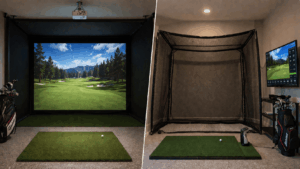
A small indoor golf venue with 2-3 bays launches for $55,000-$230,000 all-in depending on location, equipment tier, and buildout scope. A mid-sized facility with 4-6 bays, a bar, and a lounge area runs $350,000-$700,000+. Single bays generate $4,000-$22,000/month in revenue. Most operations reach breakeven within 12-18 months. The global golf simulator market hit $2.1 billion in 2025 and is projected to reach $4.8 billion by 2030 – the demand is real and growing.
I’ve consulted on both home builds and commercial installations, and the gap between the two is wider than most aspiring business owners realize. A commercial bay sees 12+ hours of daily use, takes hits from golfers at every skill level, and has to produce revenue every hour it’s open. That changes every equipment, design, and operational decision. This guide covers the real costs, the revenue math, the equipment choices, and the mistakes that sink first-time operators – not the theoretical version, the practical one.
The honest starting numbers: Equipment: $15,000-$60,000 per bay depending on launch monitor tier. Buildout: $30,000-$250,000 depending on space condition. Annual lease: $24,000-$120,000+ depending on market and square footage. Revenue: $40-$90/hour per bay at most venues. Breakeven: 12-18 months for well-run operations. Margin: 17-25% EBITDA for entertainment models, 35-60% for membership-only or unmanned venues.
Step 1: Define your business model (this drives every other decision)
There are four fundamentally different indoor golf business models, and each one has different equipment needs, revenue structures, and capital requirements. Picking the wrong model for your market is the most expensive mistake you can make.
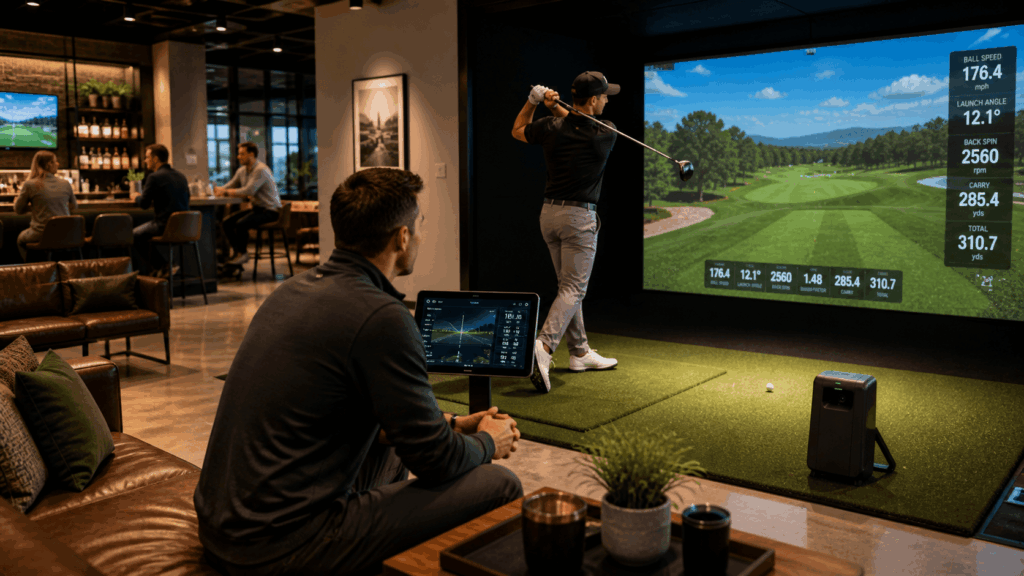
The entertainment lounge combines golf with food, drinks, and social atmosphere. Think X-Golf or Five Iron Golf. Bays rent at $60-$90+/hour, F&B drives 30-40% of total revenue, and the business model depends on high bay turnover and group bookings. Equipment needs to be durable and entertaining, not necessarily tour-grade accurate. Capital requirement: $200,000-$700,000+ for a proper buildout with kitchen/bar.
The coaching and fitting studio centers on lessons, club fitting, and player development. Equipment accuracy matters more than entertainment features – you need a launch monitor that coaches and fitters trust. Revenue comes from lesson packages ($60-$150/hour), fitting fees, and supplemental bay rentals. Capital requirement: $80,000-$250,000 for 2-3 bays with premium launch monitors and a fitting cart.
The membership club operates like a private indoor golf club with monthly dues, priority booking, and member-exclusive events. Revenue is predictable and recurring, which banks love. The model works best in cold-climate markets where members can’t golf outdoors for 4-6 months. Capital requirement: $150,000-$400,000 with a strong presale membership campaign before opening.
The unmanned/24-7 facility uses technology to eliminate staffing costs. Members access bays with key cards, book via app, and the facility runs with minimal oversight. EBITDA margins can hit 35-60% because labor – the biggest variable cost – is nearly eliminated. Capital requirement: $100,000-$300,000 with investment in access control, booking software, and security systems.
Step 2: Budget the real numbers (not the optimistic ones)
Equipment costs per bay
This is the line item most aspiring operators understand. It’s also the one where the range is widest. A single commercial simulator bay costs $15,000-$60,000 in equipment depending on the launch monitor tier and finish level.
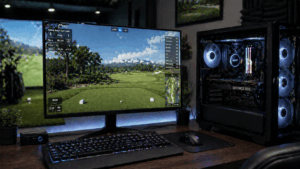
Budget commercial bay ($15,000-$25,000): Uneekor EYE XO2 ($10,000-$12,000) or SkyTrak+ ($1,995-$2,495) with commercial licensing, SIG10 or Carl’s Place commercial enclosure ($3,000-$5,000), commercial-grade projector ($1,500-$3,000), gaming PC ($1,500-$2,000), commercial mat ($500-$1,500), GSPro or E6 Connect commercial license ($250-$600/year). This tier works for coaching studios and budget entertainment venues.
Mid-tier commercial bay ($25,000-$40,000): Foresight GCQuad ($14,000-$18,000) or Trackman iO ($13,995) with commercial software, premium enclosure, 4K laser projector, and finished bay surround. This is what most successful entertainment lounges and mixed-use facilities use.
Premium commercial bay ($40,000-$65,000): Full Swing KIT ($30,000-$60,000), Golfzon with moving swing platform ($35,000-$65,000), or Trackman 4 with full commercial software. These are the turnkey commercial systems used by franchise operations and high-end venues. The moving platform on Golfzon units simulates uphill, downhill, and bunker lies – a genuine differentiator for entertainment venues.
Space and buildout costs
Plan 200-300 square feet per bay, plus additional space for lounge seating, reception, restrooms, and F&B if applicable. A 3-bay venue needs minimum 1,200-1,500 square feet. A 6-bay venue with a bar and lounge needs 3,000-5,000 square feet.
Buildout costs depend entirely on the starting condition of the space. A finished retail space with 10-foot ceilings and existing HVAC might need only $30,000-$60,000 in modifications (electrical, framing, flooring, acoustic treatment). A raw warehouse or shell space needing plumbing, HVAC, ceiling work, and full interior finish can run $100,000-$250,000 before any equipment goes in. Ceiling height of 9 feet minimum is non-negotiable – anything lower rules out full driver swings for most customers.
Lease costs vary dramatically by market. Budget $15-$30 per square foot annually in suburban markets and $30-$60+ in urban or high-traffic locations. A 3,000 sq ft space at $20/sq ft costs $60,000/year in rent before any revenue.
Soft costs (the ones that surprise first-timers)
Business licenses and permits: $2,000-$10,000 depending on your municipality and whether you’re serving alcohol. A liquor license alone can run $3,000-$15,000 in some states. Insurance: $3,000-$8,000/year for commercial general liability, property insurance, and equipment coverage. Booking and POS software: $200-$500/month for systems like Rex Reservations or SimBox that handle bay scheduling, memberships, and payment processing. Marketing launch: $5,000-$20,000 for pre-opening marketing, website, signage, and soft launch events.
The cost that blindsides first-time operators most consistently isn’t equipment. It’s the buildout. I’ve watched three different business owners budget $50,000 for “minor renovations” and spend $150,000 when the contractor opened the walls and found inadequate electrical, HVAC that couldn’t handle the heat from four projectors and PCs running simultaneously, and a ceiling that needed 6 inches of structural modification for adequate swing clearance. Get a full contractor bid with the walls open before signing a lease.
Step 3: Choose equipment for durability, not specs
A home simulator sees 5-15 hours of use per week from one or two people. A commercial bay sees 40-80 hours per week from dozens of golfers at every skill level. That changes the equipment calculation entirely. The launch monitor that works brilliantly in a home build may fail in a commercial environment within a year.
Launch monitors for commercial use: The Foresight GCQuad and Trackman 4/iO are the industry standards for commercial bays because they’re built for continuous operation and abuse. The Uneekor EYE XO2 is increasingly popular in mid-tier venues for its overhead mounting (nothing on the floor to kick or trip over), zero hardware subscription, and strong GSPro/E6 compatibility. Avoid consumer-grade units like the Garmin R10 or SkyTrak+ in commercial settings – they’re not built for the volume.
Enclosures and screens: Use commercial-grade enclosures rated for continuous use. Carl’s Place Commercial and SIG offer commercial products specifically designed for high-traffic environments. Budget for screen replacement every 12-18 months in a busy venue versus 2-5 years in a home build. Commercial mats need to absorb 200+ swings per day without degradation – the Fiberbuilt Flight Series and TrueStrike are the commercial standards.
Projectors: Laser projectors are strongly preferred over lamp projectors in commercial settings. A lamp projector in a bay running 12 hours/day burns through its bulb in 6-12 months at $150-$400 per replacement. Laser projectors rated for 20,000+ hours eliminate bulb replacement entirely and maintain brightness consistency over years. The BenQ LK936ST at 5,100 lumens is the commercial community favorite.
Step 4: Build your revenue model (be conservative)
Revenue in an indoor golf business comes from four primary streams, and the healthiest businesses don’t depend on any single one.
Hourly bay rentals are the foundation. Most venues charge $40-$90/hour depending on market, time of day, and day of week. Dynamic pricing is essential – prime evening and weekend slots should price 40-60% higher than Tuesday morning slots. A 3-bay venue booking 60% utilization at an average of $55/hour across 12 available hours per day generates roughly $36,000-$40,000/month in bay revenue.
Food and beverage can drive 25-40% of total revenue in entertainment-model venues. Alcohol margins are high (70-80%), food margins are lower (30-40%), and the combo keeps customers in the bay longer. A group that orders two rounds of drinks and appetizers while playing adds $60-$100 to a $55 bay hour. F&B requires a kitchen build, liquor licensing, and food service staff – real operational complexity.
Memberships smooth cash flow and create predictable recurring revenue. Monthly dues of $99-$299 depending on the tier and market, with benefits like priority booking, discounted rates, guest passes, and league access. Strong presale membership campaigns before opening can generate $20,000-$50,000 in pre-revenue commitment.
Leagues, events, and lessons fill off-peak hours and build community. Weeknight leagues at $20-$30/player fill Tuesday-Thursday bays that would otherwise sit empty. Corporate events book at premium rates ($500-$2,000+ per event). Lessons from PGA professionals generate $75-$150/hour with the venue taking 30-50% of the fee.
Step 5: Choose your location (this makes or breaks you)
Dense suburbs and entertainment districts with high visibility outperform rural or hard-to-find locations by a wide margin. Your target customer needs to drive past your venue regularly. A location that requires GPS navigation to find will struggle regardless of how good the equipment is.
Look for spaces with minimum 9-foot ceilings (10+ preferred), adequate parking, visible signage from a main road, and proximity to restaurants, bars, or other entertainment. Being near complementary businesses creates foot traffic. Being in an industrial park with no visibility creates a marketing cost that never ends.
Cold-climate markets (Great Lakes states, Northeast, Pacific Northwest, Canada) have the strongest built-in demand because golfers lose 4-6 months of outdoor play annually. These markets generate the highest winter utilization rates and the most predictable seasonal revenue patterns. Warm-climate markets (Southwest, Southeast, Florida) can work but face year-round competition from outdoor golf, which compresses pricing and utilization.
Step 6: Don’t skip marketing (the bays don’t fill themselves)
The most common mistake first-time operators make after opening: assuming the equipment will sell itself. It won’t. You need aggressive pre-launch marketing, a grand opening event strategy, and ongoing customer acquisition.
Pre-opening (3-6 months before launch): Build a website and social media presence. Run targeted Facebook and Instagram ads in your local market. Offer early-bird membership pricing to generate presale revenue and validate demand. Partner with local golf courses, country clubs, and PGA professionals for referrals.
Ongoing: Experienced operators report that Facebook is the most effective paid channel for local indoor golf businesses. Google Ads targeting “golf simulator near me” and “indoor golf [city]” capture intent-based searches. League announcements, tournament results, and customer content create organic engagement. Email marketing to your customer database drives repeat bookings.
Budget $1,000-$3,000/month for ongoing marketing in the first year. Venues that cut marketing to save money during the ramp-up phase take twice as long to reach breakeven. Marketing spend should be proportional to available bay hours – filling 60% of your capacity is the breakeven target for most venues.
Frequently asked questions
How much does it cost to start a golf simulator business?
A small venue with 2-3 bays launches for $55,000-$230,000. A mid-sized facility with 4-6 bays and F&B runs $350,000-$700,000+. Equipment is $15,000-$60,000 per bay. Buildout varies from $30,000 for a finished space to $250,000 for a raw shell. Lease, licensing, insurance, and marketing add $30,000-$80,000+ in soft costs.
How much revenue does a golf simulator business generate?
Single bays generate $4,000-$22,000/month depending on utilization and pricing. Mid-sized venues with 4-6 bays typically gross $300,000-$850,000/year with leagues, events, and F&B contributing alongside bay rentals. EBITDA margins range from 17-25% for entertainment models to 35-60% for membership-only or unmanned venues.
Do I need to be a golfer to run this business?
No. Hospitality, sales, and marketing expertise matter more than golf skills. The most successful operators I’ve seen are hospitality professionals, not golfers. Hire PGA professionals for instruction and club fitting. Keep your focus on the business operations, customer experience, and revenue optimization.
How long does it take to break even?
Most well-run operations reach breakeven within 12-18 months. Factors that accelerate breakeven: strong presale memberships, prime location with visibility, multiple revenue streams (bay + F&B + events), and aggressive opening marketing. Factors that delay it: over-investment in premium equipment without matching revenue model, poor location, and under-marketing.
Should I franchise or build independently?
Franchises (X-Golf, Five Iron Golf, Golf VX) provide proven systems, brand recognition, and operational playbooks. Costs start at $500,000+ including franchise fees. Independent builds offer complete control over equipment, pricing, and branding at lower initial cost but require you to build every system from scratch. First-time operators in competitive markets often benefit from franchise support. Experienced operators in underserved markets can save $100,000+ going independent.
What’s the best launch monitor for a commercial golf simulator?
For entertainment venues: Full Swing KIT or Golfzon for entertainment features and durability. For coaching studios: Foresight GCQuad or Trackman 4 for tour-grade accuracy. For budget-conscious multi-bay builds: Uneekor EYE XO2 for overhead mounting, zero hardware subscription, and strong software compatibility. Avoid consumer-grade units in commercial settings.
In summary: the business plan matters more than the equipment
The operators who succeed in the indoor golf business are not the ones with the most expensive launch monitors. They’re the ones who matched their business model to their market, budgeted conservatively, chose a visible location, and marketed aggressively from day one. A 3-bay facility with Uneekor EYE XO2 units in a high-traffic suburban location with strong league programming will outperform a 6-bay Trackman facility in an industrial park with no marketing budget.
Run the numbers before you sign a lease. Model three utilization scenarios: pessimistic (40% utilization), realistic (55-60%), and optimistic (75%). If the pessimistic scenario doesn’t cover your fixed costs within 18 months, the business plan needs work – not more optimistic projections.
One angle most business guides skip: visit 5-10 existing indoor golf venues as a customer before you commit any capital. Play a round, order food, observe the flow, talk to staff, note what works and what frustrates you. The operators who do this homework before building produce venues that feel right from day one. The operators who skip it learn every lesson the expensive way.
The most successful indoor golf business I’ve consulted for started with the owner spending three months as a regular customer at six different competitors in three states. He played at every price point, at every time slot, and took notes on everything from check-in flow to bay temperature to how fast the bartender poured. When he opened his own venue, every operational detail was borrowed from the best version he’d experienced somewhere else. His first-year retention rate was 78%. The industry average is under 50%. Research doesn’t cost money. It saves it.