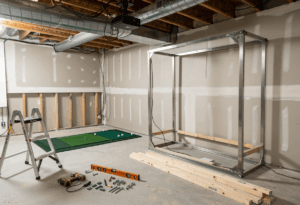
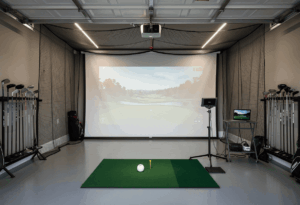
The practical minimum for a home golf simulator is 10 feet wide, 16 feet deep, and 9 feet high – and that’s tight. The comfortable real-world standard most builders aim for is 14 feet wide, 18 feet deep, and 10 feet high. Anything less and you start compromising on either club selection, launch monitor choice, or swing freedom.
I’ve measured hundreds of rooms for clients, and ceiling height kills more simulator dreams than any other dimension. It’s also the one nobody can fix retroactively. Width and depth have workarounds. A low ceiling does not. This guide walks through every dimension that matters, with specific numbers by launch monitor type, so you can decide before you buy whether your space is a clear yes, a clear no, or a yes-with-tradeoffs.
The quick answer: Minimum 10W x 16D x 9H feet. Comfortable 14W x 18D x 10H feet. Ideal 16W x 20D x 11H feet. Camera-based launch monitors need 15-16 ft depth. Radar-based units need 18-20 ft depth. Ceiling is the most common dealbreaker – measure it before anything else.
Ceiling height: the dimension that makes or breaks the build
The functional minimum ceiling for a full driver swing is 9 feet, and that assumes an average-height golfer with a neutral swing plane. For most adult golfers, 10 feet is the real-world standard. Taller players or anyone with an upright swing plane will want 10.5 to 11 feet to avoid the psychological hesitation that wrecks swing tempo.
The math behind 9 feet is simple. A standard 45-inch driver swung by a 5’10 » golfer at full extension reaches roughly 8 feet 4 inches at the top of the backswing. Add 6-9 inches of safety clearance and you’re at 8’10 » to 9’1″. Below 9 feet, you’re either choking down, restricting yourself to irons and wedges, or buying a 44-inch driver. None of these are great long-term solutions for a serious golfer.
Don’t measure floor to drywall and call it done. The hitting mat adds 1-2 inches of effective lift. Soffits, beams, ductwork, recessed lighting, and ceiling fans all create low spots that may sit directly above your swing arc. The right way to measure: stand in the intended hitting position, take a slow full backswing with your driver, mark the highest point with painter’s tape, and add 9 inches of clearance to that mark. That’s your real required ceiling height.
Trackman iO specifies a 9 ft 4 in minimum room height for their ceiling-mounted unit, with optimal mounting between 9-10 feet. Uneekor recommends the same range for their overhead launch monitors. If your room is under 9 feet anywhere along the swing path, overhead systems are off the table.
Room width: side clearance and handedness
Width determines whether you can stand comfortably, swing without flinching toward a wall, and accommodate both right and left-handed players from a centered hitting position. 10 feet is the absolute minimum, and it forces an offset hitting position – you stand to one side rather than centering on the screen.
The breakdown by tier: 10-11 feet works only for offset hitting with one dominant hand and is uncomfortable for casual use. 12-13 feet is comfortable for a single-handed player hitting from center. 14-15 feet is the practical standard for most home builds and accommodates both right and left-handed players from the same stance position. 16+ feet is ideal for mixed-handed households or commercial bays.
Trackman 4 specifies roughly 15 feet (4.6 meters) of width minimum for their floor-mounted radar unit. Most enclosure kits like the SIG10 and Carl’s Place DIY systems are built around a 10-12 foot internal width with the screen centered. If your room is exactly 10 feet wall-to-wall, you’ll need to subtract 6 inches per side for the enclosure frame, leaving you 9 feet of usable width – workable but tight.
Room depth: where launch monitor type forces your hand
Depth is the dimension that directly determines which launch monitors you can use. Get this wrong and you’ll buy a $2,499 Bushnell Launch Pro for a 14-foot room and discover it doesn’t work properly.
The standard depth math: 12-16 inches behind the screen for flex absorption, plus 10-12 feet from screen to tee, plus 4-7 feet of stance and backswing space behind the ball. Add it up and the comfortable minimum is roughly 16 feet. Anything tighter starts forcing compromises.
Camera-based launch monitors like the Bushnell Launch Pro, Foresight GC3, SkyTrak+, and Uneekor EYE XO2 work in 15-16 feet of total depth. They capture data from the impact zone itself, so they don’t need ball flight distance to function. Radar-based units like the Garmin R10, FlightScope Mevo+, and Trackman 4 need 18-20 feet minimum because the radar requires 7-9 feet of clear ball flight to track properly.
Trackman iO is the exception that breaks the rule. Because it’s ceiling-mounted and combines radar with imaging, it has no minimum distance requirement in front of or behind the ball. This makes it the only Trackman product viable in rooms under 18 feet deep, and it’s why Trackman positions the iO specifically for indoor home use.
The depth shortcut: Under 16 feet deep, you’re limited to camera-based or ceiling-mounted units. Under 15 feet, your only realistic options are SkyTrak+, Foresight GC3, or Trackman iO. Don’t buy a radar unit for a room under 18 feet – it will not work properly.
Recommended dimensions by build tier
Here are the room sizes I recommend at three tiers, based on what actually works in client builds versus what works on paper.
Minimum viable build: 10W x 16D x 9H feet. This works with a Bushnell Launch Pro, SkyTrak+, or Trackman iO. Offset hitting position, single-handed use only, no radar units allowed. Tight but functional – you can play full rounds and use a driver, just don’t expect comfort.
Comfortable standard build: 14W x 18D x 10H feet. This is the sweet spot for most home builds. Centered hitting position, both right and left-handed players, full driver swings without hesitation, and compatibility with virtually any launch monitor including radar units. This is the dimension target I push every client toward if their space allows.
Ideal premium build: 16W x 20D x 11H feet. This is what commercial bays and high-end residential installs aim for. Full Trackman 4 compatibility, room for spectator seating, multi-bay potential, and zero compromises on any equipment choice. If you’re building from scratch in a finished basement or new construction, target this range.
Garage vs. basement vs. dedicated room
Each space type has its own constraints, and the right launch monitor depends as much on the room as on your budget.
Garages are the most common build location because of floor plan flexibility. The ideal two-car garage is 14 ft wide x 20 ft deep with 10-foot ceilings. The two garage-specific hazards: door tracks and temperature. Steel garage door tracks run parallel to the swing plane and a full driver backswing can clip them violently. Stand in your hitting spot and take a slow practice swing before you commit. For year-round use in cold climates, you need a mini-split or insulated garage – launch monitor accuracy degrades meaningfully below 50°F.
Basements typically win on depth and temperature stability but lose on ceiling height. Unfinished basements often have 7-8 feet of headroom, and finishing the ceiling eats another 4-6 inches. Soffits, beams, and ductwork are the constant enemies – they create low strips above the swing path that aren’t obvious until you’re mid-backswing. Rotate the hitting zone if needed to dodge the lowest point.
Dedicated rooms and bonus spaces are the easiest to work with because you can plan the layout from scratch. New construction with 10-foot ceilings, no soffits, and a dedicated electrical circuit produces the cleanest builds. If you’re choosing between a 9-foot basement and a 10-foot bonus room over the garage, the bonus room wins on every metric except temperature stability.
The single most expensive measurement mistake I see: clients measure floor to drywall, get 9’2″, and assume a 9-foot driver swing works. They forget the 1.5 inches of mat lift, the 4-inch ductwork running across the ceiling, and the recessed light fixture directly above the hitting zone. Real clearance ends up at 8’4″. The driver gets shelved permanently. Measure with painter’s tape, not assumptions.
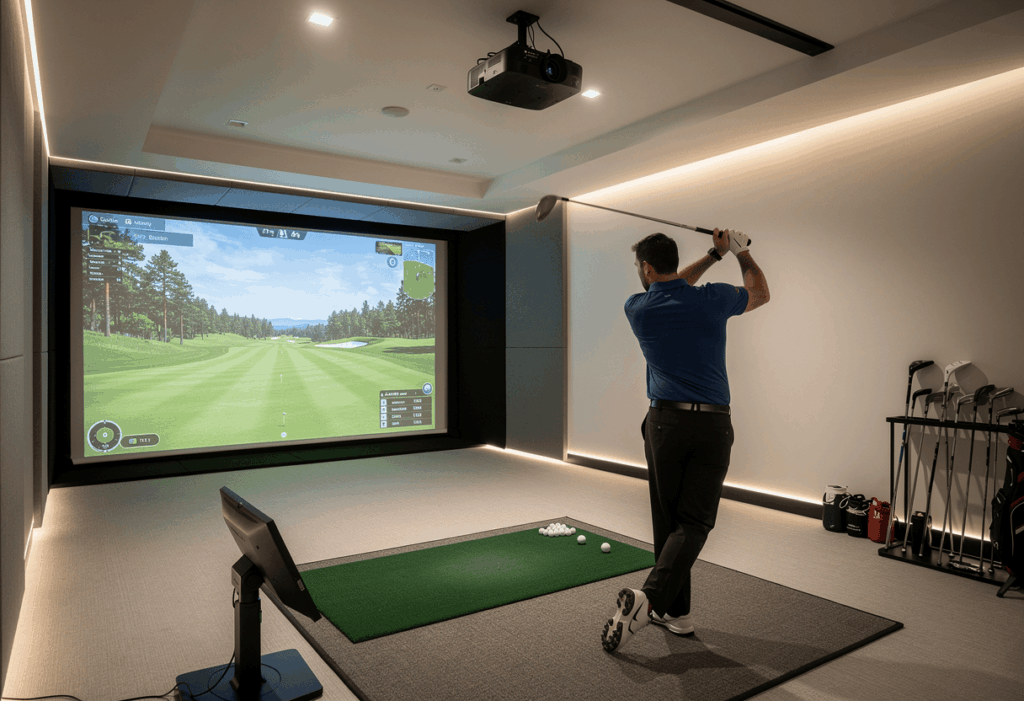
The tape test: how to measure properly before you buy anything
Before you spend a dollar on equipment, run this 15-minute check. It’s the same protocol I use on client site visits.
Stand in the exact intended hitting position with your driver. Take a slow, full backswing and have someone mark the highest point of the clubhead on the ceiling with painter’s tape. Repeat for the follow-through. The highest tape mark plus 9 inches of clearance is your real ceiling requirement. If the room comes up short, you’re looking at a wedge-and-iron-only sim, a 44-inch driver workaround, or a different room.
For width, measure the smallest distance between side walls (rooms aren’t always perfectly square). Subtract 6 inches per side for enclosure frame and buffer. The remaining number is your usable width. Under 9 feet usable, you need offset hitting. Under 8 feet, the room won’t work.
For depth, measure floor-to-floor wall distance and subtract 16 inches for screen buffer. Your usable depth determines launch monitor compatibility: under 15 feet means camera-based or ceiling-mounted only, 15-18 feet opens up most camera systems, and 18+ feet allows any launch monitor including radar units.
Frequently asked questions
Can I build a golf simulator with an 8-foot ceiling?
Technically yes, practically no – not for a full driver swing. An 8-foot ceiling restricts you to irons and wedges for almost all adult golfers. If you absolutely have to work with 8 feet, options include using a 44-inch driver, choking down significantly, or excavating a 3-4 inch depression under the hitting mat to gain effective clearance. None of these are great long-term solutions.
What is the minimum room size for a Trackman?
Trackman iO works in rooms as small as 10W x 14D x 9’4″H because of its ceiling-mounted design and zero minimum distance requirement. Trackman 4 needs at least 15 feet of width and 16-18 feet of depth to function as a radar unit. If your room is under 18 feet deep, the iO is the only Trackman product that will work properly.
How much room do I need for a full driver swing?
For an average adult golfer, you need a minimum of 9 feet of ceiling height, 10 feet of width, and enough depth to safely position yourself 10+ feet from the impact screen. Below those minimums, you’ll either be modifying your swing unconsciously or restricting yourself to shorter clubs.
Can two car garages fit a golf simulator?
Yes – a standard two-car garage at 20-22 feet wide and 20 feet deep is one of the better simulator spaces if the ceiling is at least 9 feet. Watch out for garage door tracks running along the ceiling parallel to the swing plane, and plan for temperature control in cold climates.
Do left-handed golfers need more space?
No – lefties need the same total dimensions as right-handed players. The issue is whether you can hit from a centered position to accommodate both handedness. That requires 14+ feet of width. In narrower rooms, you’re stuck with offset hitting from one side, which means moving the launch monitor and recalibrating every time you switch players.
In summary: measure twice, buy once
The right golf simulator room size isn’t the one you can technically squeeze a sim into. It’s the one that lets you swing freely without unconscious modifications, lets you use any club in your bag, and accommodates your launch monitor choice without forcing depth-related workarounds. 14W x 18D x 10H feet is the target. Anything less involves real tradeoffs you should make consciously, not by accident.
One angle most space guides miss: the psychological component of clearance. A room that’s technically adequate but feels tight will change your swing in ways that don’t show up on a tape measure. You’ll shorten the backswing, flatten the plane, ease off the speed – all unconsciously, all measurable in the launch monitor data. I’ve watched clients with marginal rooms lose 5-10 mph of clubhead speed compared to their range numbers. Build for comfort, not minimums.
If your room comes up short on any dimension, the smartest move is to match the launch monitor to the space rather than fight the space. SkyTrak+, Bushnell Launch Pro, and Trackman iO all work in tighter rooms than radar units. Choose accordingly and you’ll end up with a sim you actually use.
Before you spend anything, take 30 minutes to do the painter’s tape test in your intended room. Stand where you’ll hit, swing your driver in slow motion, mark the high points, then walk through the space imagining where the screen, projector, and launch monitor will sit. That free 30 minutes prevents 90% of post-build regret in this hobby.