A functional home golf simulator costs between $2,000 and $70,000+, but that spread hides the only number most buyers actually need: a setup that feels like a real sim, holds up long-term, and produces data you can trust lands at $5,000 to $12,000 all-in. Anything below that involves real compromises. Anything above is diminishing returns until you hit the $20K+ tier.
I’ve built and fitted sim rooms for private clients for eight years, and the single most common mistake is underestimating everything except the launch monitor. Buyers fixate on the headline unit price, then discover the projector, enclosure, mat, PC, and software together cost as much as the monitor itself. This guide fixes that.
The quick answer: Budget tier $1,500-$3,000 (compromised). Mid-tier $5,000-$12,000 (sweet spot for most buyers). Premium $15,000-$30,000 (overhead tracking, 4K laser projection). Ultra-premium $35,000-$70,000+ (Trackman iO, Full Swing, Foresight GCQuad builds).
Where your money actually goes
The launch monitor eats 40-60% of the budget on most builds, and everything else splits the remainder. A buyer spending $2,499 on a Bushnell Launch Pro typically drops another $3,000 to $6,000 on the surrounding hardware before the first ball gets hit. The projector is usually the second-biggest line item, followed by the enclosure and screen.
Here’s the honest component breakdown I use when quoting a mid-tier home golf simulator for a client. Prices reflect current 2026 market pricing, not last year’s list prices.
Launch monitor: $400 to $20,000+
This is the brain of the whole system, and price roughly tracks indoor accuracy. The Garmin Approach R10 at $499 is the functional entry point – radar-based, works outdoors well, struggles with spin data indoors. The Bushnell Launch Pro at $2,499 is the mid-tier default: camera-based, GSPro-compatible, accurate enough that most serious home users stop here.
Above that, the SkyTrak+ sits around $1,995 after its recent price drop, and the Uneekor EYE MINI at roughly $3,825 gives you overhead-adjacent accuracy in a portable footprint. The Foresight GC3 ($7,500+) and Trackman iO ($13,995) anchor the premium tier. Commercial-grade Trackman 4 and GCQuad builds start around $14,000 and climb past $20,000 for the hardware alone.
Projector: $700 to $4,000
Short-throw is not optional for most simulator rooms. A standard-throw projector needs 10 to 15 feet of distance behind the golfer, which almost no one has. The BenQ TH671ST at $700-$900 is the budget workhorse: 1080p, 3,000 lumens, and it handles screens up to 10 feet wide in a controlled-light basement.
Step up to the BenQ TK710STi at roughly $1,500 for true 4K at 3,200 lumens – this is the community consensus pick for 2026 mid-tier builds. The reference option is the BenQ LK936ST at $3,500-$4,000, a laser unit with 5,100 lumens and a dedicated golf mode built for mixed lighting garages.
Enclosure and impact screen: $300 to $5,000+
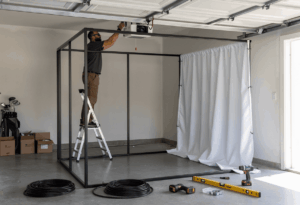
The cheapest path is a basic golf net at $200-$400 with a portable mat – it contains the ball and nothing else. A Carl’s Place DIY enclosure kit runs $800-$1,500 for frame plus screen, and the assembly takes 4 to 6 hours if you’ve never done it before.
Pre-built SIG10 or SIG12 packages from Shop Indoor Golf sit at $3,599-$3,999, which buys you a professional-grade screen, frame, side baffles, and consistency you won’t match with a garage build. Commercial and custom installs climb past $5,000 and often include ceiling tracks for retractable setups.
Hitting mat: $150 to $950
This is the single most underrated component in the entire build, and the one I see clients skimp on most. A $150 foam mat transmits shock straight to your wrists and elbows, and after a few hundred swings you’ll feel it. The community consensus on r/golfsimulator is blunt: cheap mats cause joint damage.
The Country Club Elite at $200-$350 is the mid-tier default – firm, realistic feedback, accepts real tees. The Fiberbuilt 4×7 Studio Mat at $949 is what I recommend for anyone hitting more than 50 balls a week: joint-friendly construction, rated for 300,000+ swings, and it’s the long-term community favorite for a reason.
PC and software: $800 to $2,500+
Most serious simulator software runs on Windows only. For GSPro at 1080p, you need at minimum an i7, 8GB RAM, and an RTX 3060 – a build around $900-$1,100. For comfortable 4K gameplay, bump to an i9, 16GB RAM, and an RTX 3080, which runs closer to $1,900 in early 2026.
Software subscriptions are the most consistently forgotten line item in home golf simulator cost planning. GSPro is $250/year and the community favorite. E6 Connect runs $300-$600/year depending on tier. TGC 2019 is a one-time purchase around $900 with a massive user-created course library. Trackman and Full Swing lock you into their own software, which adds $700-$1,100/year on top of the hardware.
The hidden cost most buyers miss: Software subscriptions, a dedicated PC, and room prep (electrical, ceiling finishing, acoustic panels) typically add $1,500-$3,000 to any build. Budget these upfront or you will be surprised twice.
Golf simulator cost by tier: what each budget actually gets you
The market breaks into four honest tiers. I’m giving you sample builds using real current-market components, not theoretical configurations. These are setups I’d actually recommend to a client at each price point.
Budget tier: $1,500 to $3,000
This tier exists, but it comes with real compromises. You’re looking at a Garmin R10 ($499) or Rapsodo MLM2PRO ($699), a basic net-and-mat combo ($300-$500), a budget 1080p projector ($500-$700), and either a free app or a minimal software subscription. Total: roughly $1,800-$2,800.
Expect your sim scores to run 10-15 strokes better than real golf, limited spin data indoors, and frustration with putting and short game. It works for casual practice and off-season swing maintenance, but it won’t meaningfully improve a single-digit handicap. The R10 also lacks native GSPro support – it only connects through a third-party bridge, which surprises buyers who expected a full sim experience.
Mid-tier: $5,000 to $12,000
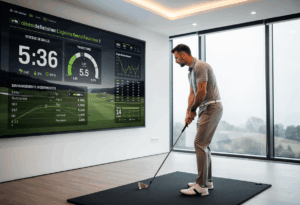
This is where most serious home buyers should land, and where the value curve is steepest. A Bushnell Launch Pro at $2,499 paired with a Carl’s Place enclosure ($1,200), a BenQ TK710STi projector ($1,500), a Fiberbuilt Studio mat ($949), a GSPro subscription ($250/year), and a capable gaming PC ($1,200) lands at roughly $7,600 all-in.
At this price, you get a setup that holds its own against $20,000 commercial installs from a decade ago. Spin data is reliable, GSPro runs smoothly at 4K, the mat saves your joints, and the whole thing lasts 5+ years without major replacements. This is the golf simulator cost range I recommend to 8 out of 10 clients.
Premium tier: $15,000 to $30,000
Premium builds typically center on overhead or camera-based tracking with no compromises. A Uneekor EYE XO at $8,000 or Foresight GC3 at $7,500, a SIG12 enclosure at $3,999, a BenQ LK936ST laser projector at $3,800, a premium mat at $949, and a high-end PC at $1,900, plus professional installation ($1,500-$3,000) puts you at $25,000-$28,000.
What you’re buying here is ambient-light performance, left/right-hand flexibility without re-calibration, and club data at a level that actually helps a low-handicap player improve. If you host other golfers or run a coaching side hustle, this is the real starting point.
Ultra-premium tier: $35,000 to $70,000+
This is where the Trackman iO, Full Swing KIT Studio, and Foresight GCQuad builds live. The Trackman iO starts at $13,995 for the unit alone, and a complete iO home setup with enclosure, 4K projection, custom room construction, and installation runs $30,000-$45,000. Add a moving platform or commercial-grade finishes and you’re past $50,000 quickly.
Most buyers in this tier are running commercial venues, building dedicated sim rooms as entertainment spaces, or they’re tour-adjacent players who need LIDAR-scanned course accuracy. For a normal home user, the jump from mid-tier to this tier is diminishing returns – I’ve watched plenty of $30,000 builds go unused while a $7,000 setup next door gets swung a thousand times a week.
The clients who use their simulator the most aren’t the ones who spent the most. The $8,000 builds in finished basements see 10x the swings of the $40,000 builds in « someday I’ll finish that garage » spaces. Room readiness matters more than component tier.
The ongoing costs nobody tells you about
Initial purchase is maybe 70% of your 5-year simulator cost – this is the most repeated piece of advice on r/golfsimulator, and after fitting dozens of clients I can confirm it’s accurate. The cost you’re calculating on day one is not the cost you’ll actually pay over five years of ownership.
Software subscriptions are the main driver. GSPro at $250/year is the cheapest serious option. E6 Connect runs $300-$600/year. Trackman and Full Swing software sit at $700-$1,100/year and are locked to their own hardware. Over five years, that’s $1,250 to $5,500 in subscriptions alone.
Then there’s replacement components. Impact screens last 2-5 years depending on how hard you hit them – budget $300-$800 for a replacement. Mats wear out in the strike zone after 50,000-100,000 swings – another $200-$900. Projector lamps (on non-laser units) need replacing every 2,000-4,000 hours at $150-$400 a pop.
Electricity is the small one, but it exists. A projector, PC, and launch monitor running 10-15 hours a week adds roughly $15-$30/month to your power bill. Over five years, that’s another $900-$1,800 most buyers never account for.
DIY vs. pre-built packages: which saves money
A full DIY build – Carl’s Place enclosure kit, sourced projector, standalone launch monitor, your own PC – typically saves $1,000 to $3,000 compared to a pre-built package at the same component tier. The trade-off is 8-15 hours of assembly, research time, and the risk of choosing incompatible components.
Pre-built packages from Shop Indoor Golf, Rain or Shine Golf, and Carl’s Place bundle everything into turnkey configurations. You pay more for the convenience, but compatibility is guaranteed and customer support is a single phone call instead of three manufacturers pointing at each other. For first-time buyers, the packaged route is usually worth the premium.
Professional installation adds another $1,500 to $3,000 on top of either path. Skip it if you’re mechanically inclined and your room is already finished. Pay for it if you’re running complex cable routing, ceiling mounts, or integrated AV systems. Industry data suggests professionally installed systems see meaningfully fewer technical issues long-term, though I’ve had plenty of DIY clients run problem-free for years.
Is a golf simulator worth the cost?
The math is straightforward for anyone who plays 30+ rounds a year in a climate with a real off-season. A mid-tier $8,000 simulator costs less than five years of range bucket fees plus 20 weekend rounds annually at a mid-priced public course. Add the winter months where your alternative is no golf at all, and the payback period shortens fast.
The math is brutal for occasional golfers. If you play 8-10 rounds a year and hit the range twice a month, renting simulator bay time at $40-$80/hour is dramatically cheaper than ownership. You need volume of use to justify the sunk cost, and honest self-assessment here saves thousands.
The non-financial value is real too – year-round practice, weather independence, zero travel time, and the ability to actually see launch data on every swing. For a low-handicap player chasing improvement, that data feedback loop is worth more than any number of outdoor range sessions. For a casual player who just wants to hit balls, it’s overkill.
What I’d buy at each budget (right now)
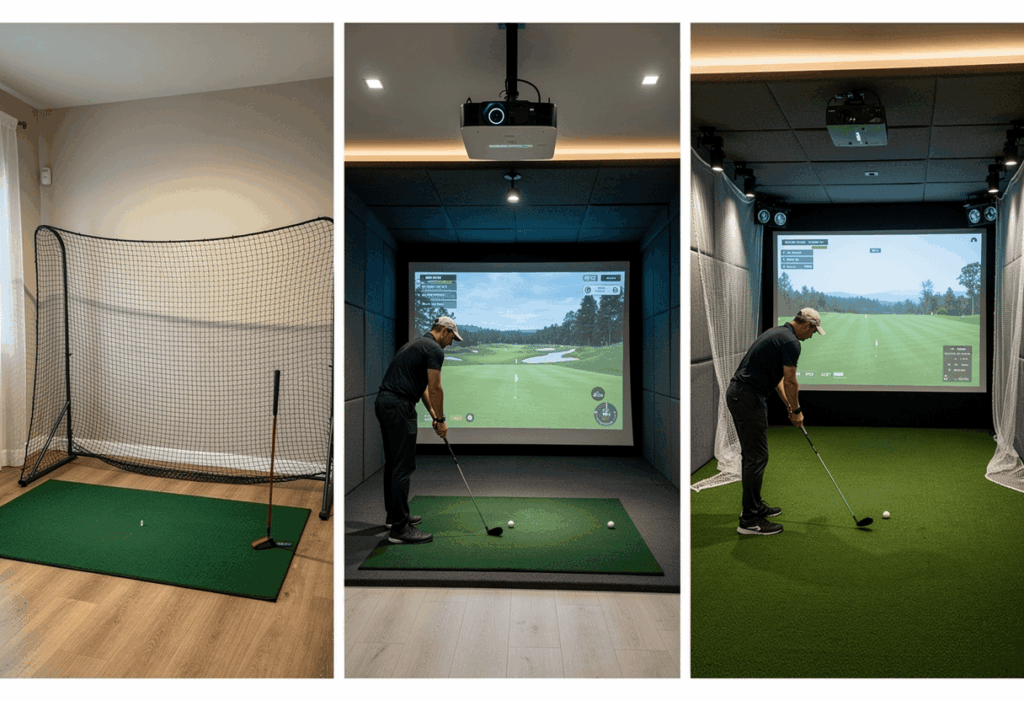
If I had $3,000 to spend, I’d put it toward a Bushnell Launch Pro ($2,499) and a $400 net-and-mat setup, skip the projector entirely, and use the monitor’s own app on a tablet. You lose the visual sim experience but you get tour-grade data, which is what actually improves your game.
If I had $8,000, I’d build the mid-tier config above: Launch Pro, Carl’s Place enclosure, TK710STi, Fiberbuilt mat, gaming PC, GSPro subscription. This is the best dollar-for-dollar golf simulator setup in 2026, and I’d bet my fitting reputation on it.
If I had $20,000, I’d look hard at a Uneekor EYE XO overhead setup with a SIG12 enclosure and a BenQ LK936ST laser projector. The overhead tracking eliminates left/right calibration headaches and the laser projector handles ambient light that would wash out cheaper units. This is the « build it once and forget it » tier.
Common mistakes that inflate your golf simulator cost
1. Buying the launch monitor first, then discovering the room won’t work
Measure your ceiling height, room depth, and width before you touch a product page. A Trackman 4 needs 16 feet of depth. Camera-based systems like the Launch Pro work in 12-15 feet. Low ceilings under 9 feet rule out most driver swings entirely. Buying hardware that doesn’t fit your space is the single most expensive mistake I see.
2. Underspending on the mat and overspending on the projector
Buyers pour money into 4K laser projection, then skimp on a $150 mat that wrecks their elbows. The mat is the component your body touches on every single swing, and a bad one ends your simulator career inside six months. Spend $500-$950 here before you spend $3,500 on projection.
3. Forgetting subscription costs in the budget
That $7,000 package doesn’t include the $250-$1,100/year software subscription, and over five years that’s a meaningful chunk of additional spend. Calculate total cost of ownership, not just day-one purchase price. The community rule of thumb is that initial purchase represents about 70% of your 5-year cost.
4. Choosing a launch monitor that doesn’t support your preferred software
Trackman hardware doesn’t run GSPro – that’s a dealbreaker for a lot of community members who want access to the 4,000+ GSPro course library and the Sim Golf Tour tournaments. Verify software compatibility before you buy the hardware, not after. The Rapsodo MLM2PRO works with none of the major simulator platforms, which surprises buyers who expected a full sim experience.
Frequently asked questions
What is the cheapest functional golf simulator?
Roughly $1,500-$2,000 all-in. A Garmin R10 ($499), a basic net and mat ($400), a budget projector ($700), and either an iPad or existing laptop gets you a working setup. Accuracy is limited indoors and the sim experience is basic, but it functions as a practice tool.
How much does a home golf simulator cost for most buyers?
Most serious home buyers land in the $5,000 to $12,000 range. This tier includes a quality camera-based launch monitor, a proper enclosure and impact screen, a short-throw projector, a joint-friendly mat, a gaming PC, and a software subscription – everything needed for a long-term enjoyable simulator.
How much does a Trackman simulator cost?
The Trackman iO unit alone starts at $13,995. A complete Trackman home setup with enclosure, projector, mat, PC, software, and installation runs $30,000-$45,000 depending on finish level. Trackman software adds another $700-$1,100/year on top of the hardware.
How much does golf simulator software cost?
GSPro is $250/year and the community favorite for 2026. E6 Connect runs $300-$600/year depending on tier. TGC 2019 is a one-time purchase around $900 with a huge user-created course library. Trackman and Full Swing lock you into their own software at $700-$1,100/year.
Is it cheaper to build a DIY golf simulator?
Yes, typically $1,000-$3,000 cheaper than an equivalent pre-built package, but it costs 8-15 hours of assembly time and carries compatibility risk if you choose components poorly. For a first build, I usually recommend a pre-built package for the support alone.
What is the best golf simulator for the money?
The Bushnell Launch Pro paired with a Carl’s Place enclosure and GSPro software is the community consensus value pick in 2026 – roughly $7,000-$8,000 for a setup that competes with $20,000 commercial installs on accuracy and software flexibility.
In summary: the number that actually matters
Forget the $1,500 to $70,000 headline range – it’s too wide to be useful. The number to anchor your planning on is $8,000 for a mid-tier build that lasts 5+ years, then adjust up or down based on two honest questions: how finished is your room, and how many swings per week will you actually take.
One angle I haven’t seen in other cost guides but that’s consistent across every client I’ve fitted: resale value holds up remarkably well on camera-based launch monitors. A 3-year-old Bushnell Launch Pro or SkyTrak+ still sells for 60-70% of new on the used market, which means the real depreciation cost of a mid-tier build is closer to $2,500-$3,500 over five years – not the full $8,000. Factor that into your worth-it calculation, because most buyers don’t.
The buyers who regret their purchase almost always fall into one of two camps: they overbought a premium system for a room that wasn’t ready, or they underbought a budget setup and spent another $4,000 a year later upgrading the pieces that didn’t work. Pick your tier honestly on day one and you skip both traps.