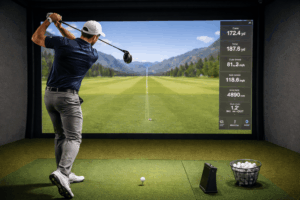
A quality golf simulator delivers carry distance accuracy within 1-2% of outdoor reality. A 150-yard 7-iron outdoors reads 148-152 yards on a properly calibrated indoor sim. Ball speed, launch angle, and spin rate on premium camera-based and radar units track within 1 mph, 1 degree, and 100-200 RPM respectively of what you’d see from a Trackman on the range. That level of precision is why PGA Tour players, club fitters, and coaches trust this technology for real decisions.
But “accurate” has a boundary. Simulators nail the data at impact and do a genuinely impressive job modeling ball flight – then quietly fall apart on green reading, short game feel, lie variation, and the mental pressure of a real round. I’ve tested every major launch monitor against my Trackman 4 baseline, and the numbers confirm what the community says: the data is trustworthy, but the experience isn’t identical to outdoor golf. Knowing exactly where the gap is makes you a better indoor practitioner.
The short answer: Premium simulators (Trackman, Foresight, Uneekor) achieve 95-99% accuracy on ball speed, carry distance, and spin rate. Mid-tier units (SkyTrak+, Bushnell Launch Pro) hit 90-95%. Budget units (Garmin R10, Rapsodo MLM2PRO) are 85-90% on carry but struggle with indoor spin data. Sim scores run 5-10 strokes better than real golf due to perfect lies, no lost balls, and flat putting.
What simulators measure accurately (and how they do it)
Modern launch monitors capture data at the moment of impact using one of two core technologies: high-speed cameras (photometric) or Doppler radar. Camera systems photograph the ball at impact and use the images to calculate speed, spin, and launch angle from the first few inches of flight. Radar systems track the ball’s Doppler signature as it travels, measuring speed and trajectory from the radar wave’s return signal.
The metrics that both technologies nail consistently: ball speed within 1-2 mph, launch angle within 1 degree, carry distance within 1-3 yards on a well-struck shot. These numbers hold across Trackman, Foresight GCQuad, Uneekor EYE XO2, and even mid-tier units like the SkyTrak+ and Bushnell Launch Pro. When I run my 50-shot testing protocol (driver, 7-iron, wedge) against my Trackman 4 baseline, the premium camera-based units routinely match within margins that PGA Tour fitters consider negligible.
Spin rate is where accuracy tiers separate most clearly. Premium units measuring spin directly from high-speed imagery (Foresight, Uneekor, Trackman) produce spin data within 100-200 RPM of outdoor truth. Mid-tier units that measure spin indirectly or from fewer data points produce wider variance – the SkyTrak+ is consistent but occasionally 200-400 RPM off on specific shot types. Budget radar units like the Garmin R10 calculate spin rather than measuring it, which means indoor spin data can be unreliable enough to mislead your club fitting.
Camera vs. radar: accuracy differences indoors
This distinction matters enormously for indoor accuracy. Camera-based launch monitors are universally more accurate indoors than radar units, and the community consensus on r/golfsimulator is unambiguous on this point.
Camera systems (Foresight GC3, Bushnell Launch Pro, SkyTrak+, Uneekor) capture data at the moment of impact. They don’t need ball flight to function – they see the ball leave the face and calculate everything from that instant. Indoor accuracy is essentially identical to outdoor accuracy because the measurement happens before the ball travels any meaningful distance.
Radar systems (Garmin R10, FlightScope Mevo+, Trackman 4) need ball flight distance to track the Doppler signal. Outdoors, where the ball flies 200 yards, they’re remarkably precise. Indoors, where the ball hits a screen 10 feet away, the radar has to extrapolate the full flight from a fraction of a second of data. The extrapolation is good – but it’s not measurement. It’s prediction. And predictions introduce variance that camera systems don’t have.
Basements add another layer of radar difficulty. Concrete walls reflect radar signals, metal ductwork scatters the wave, and steel beams absorb it. Camera systems don’t care about the room’s materials because they’re photographing the ball, not bouncing radio waves off it. For indoor simulator accuracy, camera-based is the right choice in almost every scenario.
Where simulators fall short (be honest about these)
The accuracy conversation is incomplete without acknowledging the genuine gaps. Simulators are excellent at measuring what happens at impact. They’re mediocre to poor at replicating everything that happens after impact and around the game.
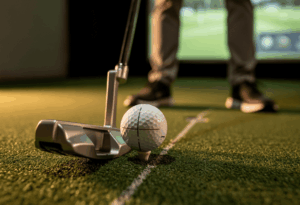
Putting is the biggest weakness. Most launch monitors struggle with shots under 20 yards where the ball doesn’t travel far enough for accurate spin and trajectory measurement. Putting on a flat mat with projected green contours bears almost no resemblance to reading a real green with grain, slope, moisture, and speed variation. Dedicated putting systems like ExPutt improve this, but they’re an add-on, not integrated into the standard sim experience.
Lie variation doesn’t exist. Every sim shot comes from a perfect, flat mat lie. No buried lies in bunkers, no thick rough, no bare tight lies, no downhill stances, no mud on the ball. This single factor explains most of the 5-10 stroke gap between simulator scores and real-world scores. A golfer who shoots 78 on course will often shoot 68-73 on the same course in a simulator, and the lie advantage accounts for the majority of that difference.
Wind modeling is approximate. Simulator software adds wind to the ball flight algorithm, but it applies uniformly across the shot’s trajectory. Real wind is different at ground level than at ball apex height. Real gusts are unpredictable. The software wind is consistent, which means your “15 mph crosswind” round on GSPro isn’t training you for real wind conditions – it’s training you for a math problem.
Mental pressure is absent. The water hazard on screen doesn’t create the same anxiety as the real thing. The $5 nassau doesn’t feel the same when the ball is hitting a screen 10 feet away. Competitive Sim Golf Tour rounds on GSPro generate some pressure, but it’s a fraction of what standing on a real first tee with your handicap on the line produces.
The accuracy gap I see clients misunderstand most: they compare their sim carry distance to their outdoor total distance. The sim shows 155 yards carry on a 7-iron. They go outside and hit it 165 yards total with roll. They say “my sim is 10 yards short.” It’s not. Their carry is identical – the outdoor roll adds the extra distance. Always compare carry to carry, never carry to total.
Why sim scores are 5-10 strokes better than real golf
This is the most frequently debated topic in the simulator community, and the answer is straightforward once you break it down. Simulators don’t inflate your ability – they remove the penalty shots that outdoor golf constantly imposes.
Perfect lies on every shot eliminate the 1-2 strokes per round you lose to bad lies on course. No lost balls removes penalty-and-distance situations that cost 1-3 strokes per round for most amateur golfers. Gimme putts under certain distances (many sim software platforms auto-hole putts inside 3-4 feet) eliminate the 1-2 short misses per round. No weather variability removes the adaptation strokes that wind, rain, and temperature changes cost you.
Add those up and the 5-10 stroke gap is fully explained without any measurement inaccuracy at all. The data is right. The conditions are just easier. A golfer who understands this uses sim scores as a relative benchmark (am I improving session over session?) rather than an absolute benchmark (I’m now a 72-shooter).
Accuracy by launch monitor tier
Premium tier: Trackman 4, Foresight GCQuad, Uneekor EYE XO2
These units deliver tour-grade accuracy within 1% on ball speed and carry, within 100 RPM on spin rate. They measure spin directly rather than calculating it. They provide 30-50+ data parameters including club delivery metrics (path, face angle, attack angle, dynamic loft) that lesser units can’t see. If accuracy is the only criteria, these are the definitive answer – which is why PGA Tour players and professional fitters use them exclusively.
Mid-tier: Bushnell Launch Pro, SkyTrak+, Foresight GC3, Uneekor EYE MINI
90-95% accuracy on the metrics that matter most for home practice and game improvement. Carry distance within 2-3 yards of premium units. Ball speed within 1-2 mph. Spin rate within 200-400 RPM on most shots. These are genuinely useful for training, club gapping, and tracking improvement over time. The data won’t match a Trackman shot-for-shot, but the trends and patterns are reliable.
Budget tier: Garmin R10, Rapsodo MLM2PRO, FlightScope Mevo Gen 2
85-90% accuracy on carry distance, variable on spin. The R10 calculates spin rather than measuring it, which means indoor spin data is inconsistent enough to mislead. The MLM2PRO provides useful ball speed and carry data but doesn’t support any major simulator platform. These units are adequate for casual practice and entertainment but shouldn’t be trusted for club fitting decisions or serious swing work.
How to maximize your simulator’s accuracy
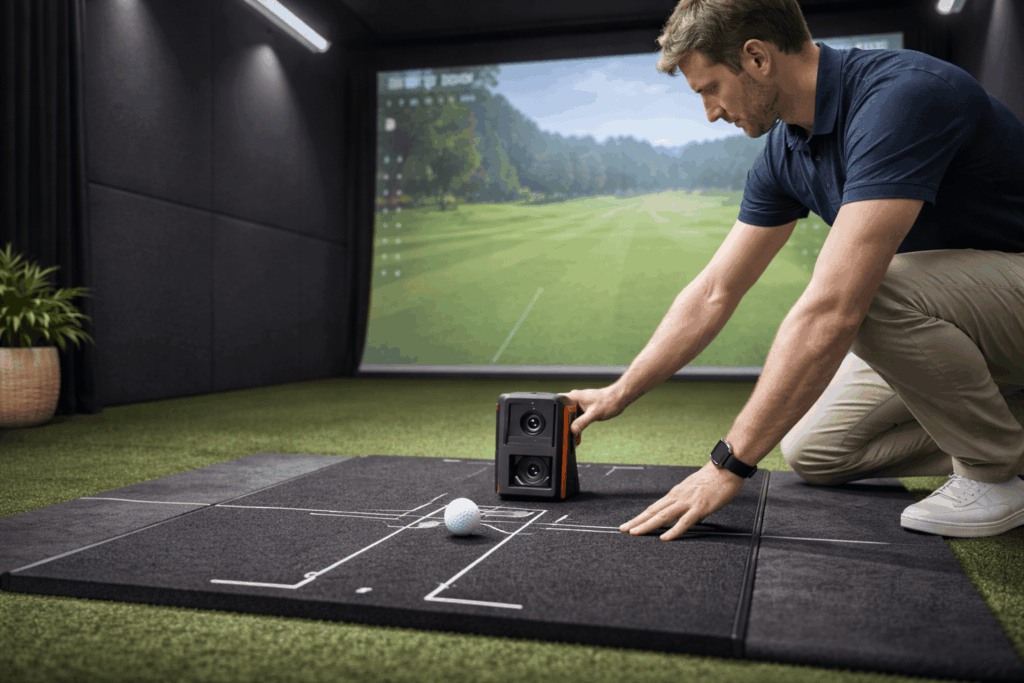
Even the best launch monitor produces garbage data if the setup is wrong. A few calibration habits make the difference between trustworthy numbers and numbers that send you down the wrong improvement path.
Calibrate your launch monitor every session. Camera-based units are sensitive to position. If the unit shifts 1 inch between sessions, your data shifts with it. Mark the exact position on the floor with tape and verify placement before hitting.
Use the same ball type consistently. Different golf balls produce different spin characteristics, and mixing balls between sessions introduces variance that looks like swing changes when it’s just equipment noise. Pick a premium ball (Pro V1 or comparable) and stick with it.
Control the lighting in the hitting zone. Camera-based units need consistent lighting to photograph the ball accurately. Direct sunlight crossing the ball position, flickering fluorescent lights, and shadows from the golfer’s body all degrade data quality. Consistent LED lighting in the hitting zone solves this for $50-$200.
Compare carry to carry, never carry to total. Outdoor total distance includes roll, which varies by firmness, slope, and moisture. Carry distance is consistent between indoor and outdoor environments. A sim that shows 155 yards carry on a 7-iron is accurate even if your outdoor total is 165 – the 10-yard difference is roll, not inaccuracy.
Run a baseline test. Hit 20 shots with your 7-iron on your sim and record average carry, ball speed, and spin rate. Then hit 20 shots outdoors on a Trackman-equipped range (many facilities rent bay time) and compare. If the numbers are within 3-5 yards of carry and 200-300 RPM of spin, your sim is calibrated well. If they’re further apart, troubleshoot placement, lighting, and ball type before assuming the unit is inaccurate.
Frequently asked questions
Are golf simulator distances accurate?
Yes – carry distance on premium and mid-tier simulators is within 1-3 yards of outdoor reality when properly calibrated. Total distance (carry plus roll) is harder to match because roll depends on ground conditions the simulator models algorithmically rather than measuring directly. Always compare carry to carry for the most meaningful accuracy check.
Why do I score better on a simulator than on the course?
The 5-10 stroke gap comes from perfect lies, no lost balls, gimme putts, and no weather variability – not from inaccurate data. The simulator isn’t making you better. It’s removing the penalty situations that outdoor golf imposes. Use sim scores as a relative improvement tracker, not an absolute benchmark.
Is a radar or camera launch monitor more accurate indoors?
Camera-based systems are more accurate indoors because they measure the ball at impact rather than tracking it in flight. Radar systems need ball flight distance to work, and the short indoor flight (10 feet to the screen) forces them to extrapolate rather than measure. For indoor-only builds, camera-based is the clear accuracy winner.
Can I trust simulator data for club fitting?
On premium and mid-tier units (Foresight GC3, Bushnell Launch Pro, SkyTrak+), yes – ball speed, launch angle, and spin rate data is reliable enough for gapping and shaft fitting. On budget units that calculate spin indirectly (Garmin R10), use the data directionally but don’t make purchase decisions based on small spin differences. Professional fitters use Trackman or Foresight GCQuad for good reason.
Do indoor spin rates match outdoor spin rates?
Indoor spin rates tend to be slightly lower than outdoor rates due to the controlled environment and mat surface. The difference is typically small enough (100-300 RPM on mid-irons) to not affect practice value, but it means your indoor numbers may show slightly more distance than you’ll see outdoors, especially on wedge shots where spin is the dominant distance factor.
What is the most accurate golf simulator?
For pure data accuracy, Trackman 4 and Foresight GCQuad are the gold standard, used by 95%+ of PGA Tour players and professional fitters. For home builds at a fraction of the price, the Foresight GC3 and Uneekor EYE XO2 deliver accuracy within 1-2% of those flagships. The Bushnell Launch Pro at $2,499 offers the best accuracy-per-dollar ratio in the market.
In summary: trust the data, manage the experience gap
Golf simulator accuracy on the metrics that matter – ball speed, carry distance, launch angle, spin rate – is genuinely excellent in 2026. A quality camera-based unit in a well-lit, properly calibrated room produces data you can trust for practice, club gapping, and tracking improvement over time. That data is real. It transfers to outdoor golf. It makes you better.
What doesn’t transfer is the experience. The score you shoot on a simulator is not the score you’ll shoot on the course, and the gap is explained by conditions, not by measurement error. The golfers who get the most from their sims understand this distinction intuitively: they trust the numbers, ignore the score, and use the data to build a swing that performs better in both environments.
One angle worth knowing: accuracy improves meaningfully with consistent setup habits. A launch monitor that sits in the exact same spot, with the same lighting, using the same ball, session after session, produces data you can trend over months. A unit that gets moved around, used in variable lighting, with random ball types produces data that looks inconsistent even when the unit itself is accurate. The human variable in setup is often larger than the technology variable in measurement.
The most useful accuracy test I run with clients is dead simple: hit 10 shots with your 7-iron indoors, record average carry. Then hit 10 shots with the same club at a Trackman-equipped range, record average carry. If the two numbers are within 3 yards, your sim is telling you the truth. Every client who runs this test stops worrying about accuracy and starts using the data to actually improve. The anxiety about “are the numbers real?” disappears permanently.