The functional minimum is 9 feet for most adult golfers, and the real-world standard that eliminates the ceiling question entirely is 10 feet. At 10 feet, a golfer up to 6’4″ swinging a standard 46-inch driver has full clearance through the entire swing arc without modifications. Below 9 feet, you’re giving up the driver or changing your swing – and either one defeats the purpose of a home sim.
Ceiling height is the one dimension that kills a golf simulator build with no workaround. Width can be offset. Depth can be solved with camera-based launch monitors. A low ceiling either restricts your club selection or trains bad mechanics without you noticing – the subconscious flattening, the shortened backswing, the half-speed driver you tell yourself is “good enough.” I’ve measured hundreds of rooms, and this is the dimension that separates the builds that get used from the builds that get abandoned.
The quick answer: Under 5’8″ = 9 ft minimum. 5’8″ to 6’0″ = 9.5-10 ft. 6’0″ to 6’4″ = 10-10.5 ft. Over 6’4″ = 11 ft. Always measure to the lowest obstruction in the swing zone (beam, duct, track), not to the drywall. Add 1.5 inches for mat thickness. The painter’s-tape swing test takes 15 minutes and prevents the most expensive mistake in this hobby.
Why the number on the tape measure isn’t the number that matters
The most common mistake in golf simulator builds isn’t choosing the wrong launch monitor. It’s measuring floor to drywall and calling that the ceiling height. Your real swing clearance is measured from the top of your hitting mat to the lowest obstacle directly above your swing arc, and those two numbers are almost never the same.
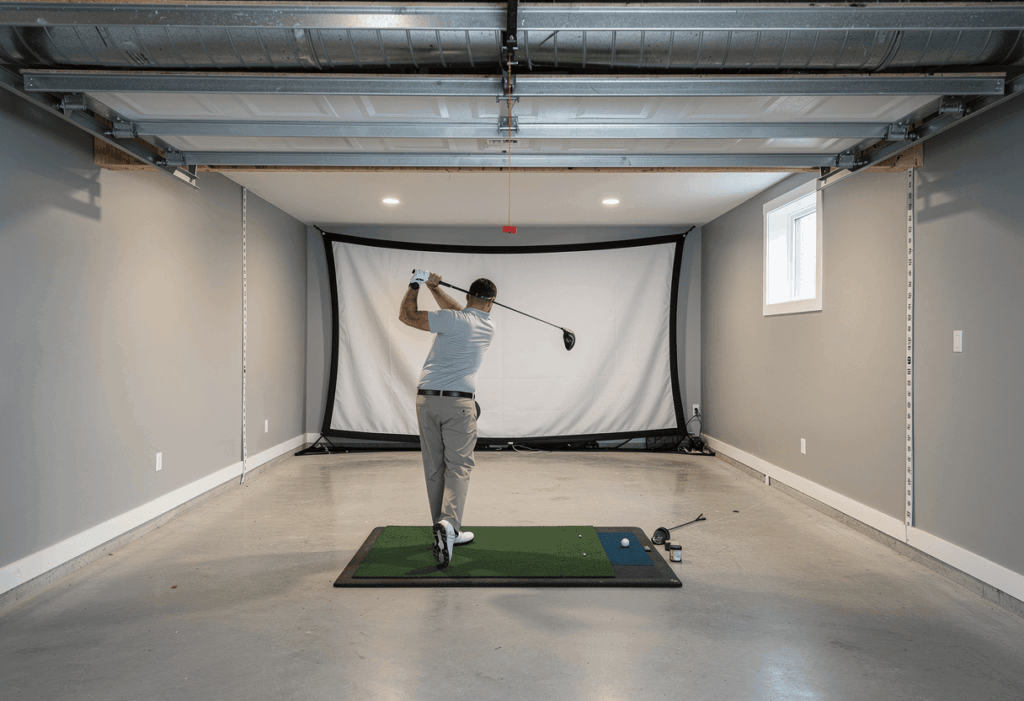
In garages, door tracks typically hang 12-24 inches below the structural ceiling. In basements, soffits, HVAC trunk lines, structural beams, and plumbing runs routinely steal 4-12 inches. Drop ceiling tiles add another 4-6 inches of loss. The hitting mat itself adds 1.5-1.75 inches to the floor height. A room that measures 9’4″ floor-to-drywall often delivers 8’4″ of usable clearance once you account for all of this.
The only measurement that matters is the distance from the top of your hitting mat to the lowest obstruction directly above the spot where your driver reaches the peak of its arc. Everything else is noise.
Ceiling height by golfer height: the real numbers
Your swing arc is determined by your height, arm length, club length, and swing plane. Taller golfers with upright swings reach higher. Shorter golfers with flatter swings require less clearance. Here’s the practical breakdown I use when consulting on builds.
Under 5’6″: 8.5-9 feet works for a full bag including driver. Compact swing arcs give you flexibility most taller golfers don’t have. At 8.5 feet, you can comfortably swing irons and wedges, and most golfers this height manage the driver without anxiety.
5’6″ to 5’10”: 9 feet is the minimum for comfortable driver swings. 9.5 feet gives you breathing room. At 9 feet, the clearance above your swing apex is roughly 6-8 inches with a standard 45-inch driver, which is enough but tight. A steep, upright swing plane at this height range can still clip a 9-foot ceiling.
5’10” to 6’2″: 10 feet is the target. At 9 feet, many golfers in this range start subconsciously flattening their backswing to avoid the ceiling. That unconscious swing modification is the worst outcome – it changes your mechanics without you realizing it, and the changed mechanics follow you outdoors. 10 feet gives you full clearance with no hesitation.
6’2″ to 6’4″: 10-10.5 feet. At this height, a standard driver swing with an upright plane easily reaches 9 feet 4 inches at the apex. Add 9 inches of safety clearance and you’re past 10 feet. For tall golfers with upright swings, 10 feet is the minimum, not the comfort zone.
Over 6’4″: 11 feet. No shortcuts. A 6’6″ golfer with an upright swing needs every inch of it. If the room can’t deliver 11 feet, the tall-golfer trade-offs are a shorter driver shaft (44 inches), a deliberate flatter swing plane, or accepting an iron-and-wedge-only build.
The swing plane variable: A 6-foot golfer with an upright swing can reach 2-3 inches higher than another 6-footer with a flat, rotational move. Your swing style matters almost as much as your height. Do the painter’s-tape test with YOUR swing, not a chart.
The painter’s-tape test: 15 minutes that prevents thousands in regret
This is the same protocol I use on every client site visit. It takes 15 minutes, costs nothing, and eliminates the single most expensive mistake in home simulator builds.
Stand in the exact intended hitting position in your room. Take a slow, full backswing with your driver and have someone mark the highest point of the clubhead on the ceiling with painter’s tape. Now take a slow, full follow-through and mark that apex too. The higher of those two marks is your swing apex.
Measure from that tape mark to the lowest obstruction directly above it. You need at least 6-9 inches of clearance above the apex. Less than 6 inches and you’ll flinch on every full swing. Less than 3 inches and you’ll hit the ceiling regularly. Zero inches and the driver goes in the bag until you find a different room.
Now do the same test with a pitching wedge. Wedges are actually the more likely ceiling-contact risk in marginal rooms because of their steep swing plane and high launch angle. A golfer who cleared the driver backswing isn’t necessarily clear with a gap wedge from a tight lie. Test both clubs before committing.
What happens at each ceiling height tier
8 feet: iron-and-wedge practice only
At 8 feet, most golfers over 5’8″ are physically unable to swing a driver without ceiling contact. The build is restricted to 7-iron through lob wedge for most adults. This isn’t necessarily a bad sim – short game and iron practice represent 75% of scoring improvement for most golfers – but it’s not a “full simulator” and you should go in with that expectation.
Shorter golfers under 5’6″ with flat swings can sometimes swing mid-irons and even fairway woods at 8 feet. But the psychological constraint is real. Knowing the ceiling is there changes your tempo, and changed tempo means changed data.
8.5 feet: limited full bag for short golfers
This is the threshold where golfers under 5’8″ can often manage the full bag, including driver with care. Golfers 5’10” and above are still restricted to irons and wedges. The Uneekor EYE MINI specifies 8.5-9 feet as its minimum ceiling height, which makes it a viable launch monitor for marginal-ceiling rooms. The SkyTrak+ and Bushnell Launch Pro also work at this height.
9 feet: functional minimum for driver
The most commonly cited minimum for home simulator builds, and the number that shows up in most manufacturer specs and forum discussions. At 9 feet, an average-height golfer (5’8″ to 5’11”) can swing driver with roughly 6-8 inches of clearance above the swing apex. It works, but it’s tight enough that some golfers with steep, upright swing planes still hesitate.
Overhead launch monitors like the Trackman iO (9’4″ minimum) and Uneekor EYE XO2 (9-10 foot mounting range) become borderline at 9 feet. The iO technically needs 9’4″, which means a 9-foot room is off limits. The EYE XO2 can mount at 9 feet but has zero installation tolerance for error.
10 feet: the real-world standard
At 10 feet, 95% of golfers swing every club without any modification. Ceiling-mounted launch monitors, overhead projectors, and full enclosure kits all have room to work. This is the number that Carl’s Place, Rain or Shine Golf, and most simulator builders recommend as the baseline for new builds because it removes the ceiling calculation from the equation entirely.
Golfers up to 6’4″ with standard swing planes have full clearance at 10 feet. Only very tall golfers (6’5″+) or those with exceptionally steep swings need more than 10 feet. For most buyers, this is the target to aim for.
11 feet and above: premium and commercial
This is what commercial simulator bays and high-end residential builds target. It accommodates every golfer regardless of height, every club regardless of shaft length, every swing plane regardless of style, and every overhead launch monitor with comfortable installation clearance. If you’re building new construction for a dedicated sim room, 11 feet is the height to spec.
The worst outcome I see isn’t a golfer who clips the ceiling once and adjusts. It’s the golfer who never clips it but swings tight for months, unconsciously shortening the backswing by 3 inches and flattening the plane by 2 degrees. The launch monitor data looks fine indoors. Then they go outdoors and can’t figure out why their driver pattern changed. Low ceilings don’t just limit your build – they quietly retrain your swing.
Low-ceiling workarounds: what actually helps
If your room comes up short, you have options beyond “give up.” Some are free. Some cost money. All involve honest trade-offs.
Use a 44-inch driver instead of the standard 45-46 inch shaft. This reduces your swing arc measurably without changing your swing pattern significantly. In a room with 9 feet of clearance, cutting an inch off the shaft can be the difference between comfortable and anxious. Several club manufacturers offer cut-down options, or any clubfitter can trim and re-grip a standard driver.
Shift the hitting position laterally or forward/backward. In garages with door tracks and basements with beams, the lowest point in the room is rarely directly above the most obvious hitting position. Moving your stance 2-3 feet often puts your swing under the highest portion of the ceiling.
Recess the hitting platform. Excavating 3-4 inches of concrete under the hitting mat and building a recessed platform effectively lowers your position by that amount. In a 9-foot room, that gains you 3-4 inches of overhead clearance. Cost: $2,000-$5,000 depending on structural complexity.
Raise garage door tracks. If the door track is the lowest point (which it often is), a garage door company can reconfigure standard tracks to sit closer to the ceiling. Typical cost: a few hundred dollars. Typical gain: 6-12 inches.
Convert to a side-mount garage door opener. Central openers hanging from the ceiling consume 12-16 inches of headroom in the worst possible location. A side-mount or wall-mount opener eliminates this entirely. Cost: $400-$800 installed.
Accept the club restriction. An iron-and-wedge simulator in a 8-foot room is still an excellent practice tool. Most scoring happens from 150 yards in. A sim that lets you train approach shots, wedge distances, and putting (if your setup supports it) provides real improvement even without a driver.
How ceiling height affects equipment choices
The ceiling doesn’t just affect your swing. It determines which launch monitors, projectors, and enclosures you can physically install.
Overhead launch monitors like the Trackman iO (9’4″ minimum), Uneekor EYE XO2 (9-10 foot mounting range), and Foresight GCHawk all require ceiling clearance for both the unit itself and your swing beneath it. Below 9 feet, ceiling-mounted units are off the table entirely. Floor-based camera units like SkyTrak+, Bushnell Launch Pro, and Uneekor EYE MINI have no ceiling requirements beyond your own swing clearance.
Projector mounting also depends on ceiling height. A ceiling-mounted short-throw projector needs to sit above the swing arc and at least 2 feet behind your hitting position. In a 9-foot room, the projector housing itself can eat 6-8 inches of clearance. Rooms under 9 feet may need ultra-short-throw projectors mounted at screen level (pointing upward from the floor) with a protective cage – a workable but more complex setup.
Enclosure sizing responds directly to ceiling height. The Carl’s Place 8×10.5 ft enclosure fits under an 8.5-foot ceiling. The SIG10 at 8’4″ high requires 9 feet minimum. Full-height SIG12 enclosures need 10+ feet. If your ceiling is marginal, check enclosure dimensions before ordering.
Frequently asked questions
Can I use a golf simulator with an 8-foot ceiling?
Yes, with real limitations. At 8 feet, most golfers are restricted to irons and wedges. Golfers under 5’6″ with flat swings may manage mid-irons and hybrids. The driver is off the table for anyone over 5’8″ with a standard swing. The build works as a short-game and iron practice tool, which still covers 75% of scoring improvement.
Is 9 feet enough for a full driver swing?
For most golfers 5’10” and under, yes. The clearance above the swing apex will be roughly 6-8 inches with a standard 45-inch driver. Taller golfers or those with steep, upright swings may find 9 feet tight and start unconsciously modifying their swing. Do the painter’s-tape test to confirm before committing.
What’s the ideal ceiling height for a golf simulator?
10 feet. At this height, 95% of golfers swing every club without modification. Overhead launch monitors, ceiling projectors, and full-height enclosures all install cleanly. Both Carl’s Place and Rain or Shine Golf specify 10 feet as the recommended baseline for new builds.
Does the hitting mat affect ceiling clearance?
Yes. A standard hitting mat adds 1.5-1.75 inches to your effective floor height, which means 1.5-1.75 inches less clearance above your head. In a marginal-ceiling room, this matters. Account for mat thickness when measuring your usable swing clearance.
Can I add ceiling padding to protect against club strikes?
You can, but padding doesn’t change the physics – it just protects the ceiling and club from damage. Two inches of foam on the ceiling reduces your usable clearance by those same 2 inches. It’s a damage prevention measure, not a clearance solution. A 9-foot room with 2 inches of padding becomes an 8’10” room.
What launch monitors work in rooms under 9 feet?
Floor-mounted camera-based units only. SkyTrak+ ($1,995), Bushnell Launch Pro ($2,499), Foresight GC3 ($7,500), and Uneekor EYE MINI (~$3,825) all sit on the floor next to the ball with no ceiling requirements beyond your own swing. Overhead units are off the table under 9 feet.
In summary: measure the reality, not the blueprint
The golf simulator ceiling height conversation comes down to one honest question: can you swing a driver at full speed without hesitation? Not “can you technically clear the ceiling if you shorten your backswing.” Not “can you avoid it if you flatten your plane.” Can you swing naturally, without any thought about what’s above you?
If the answer is yes at your measured clearance, build. If the answer is “barely,” either modify the room (raise tracks, recess platform, reroute duct) or accept the club restriction honestly. The worst possible outcome is a build that technically clears the ceiling but changes your swing – you’ll spend months grooving indoor mechanics that don’t transfer outdoors, and the launch monitor data will show “improvement” that vanishes the moment you step on a real course.
One angle I rarely see covered: ceiling height requirements shift based on hitting surface elevation. If you’re building a raised hitting platform (common in premium builds for flush-mount turf), even 2-3 inches of platform height reduces your usable clearance by that amount. Conversely, a recessed hitting pit gains you that clearance. Factor any floor modifications into your ceiling calculation before ordering equipment.
The 15-minute painter’s-tape test is the highest-value thing you can do before spending a dollar on simulator equipment. I’ve had clients cancel $14,000 Trackman iO orders because the tape test revealed their “9’6″ garage” was actually 8’10” at the door track. Better to find out with $3 of tape than $14,000 of ceiling-mounted hardware that won’t fit.