At $500 and below, every launch monitor is a Doppler radar unit with a built-in screen. There are no cameras, no spin axis, no club path data, and no simulator course play at this price. What you get instead is carry distance, ball speed, swing speed, smash factor, and sometimes launch angle, displayed directly on the device without needing a phone. For most golfers, that’s exactly enough to make range sessions productive.
I’ve tested every unit on this list against a Trackman 4 reference using a 50-shot protocol across driver, 7-iron, and wedge. At this tier, I score on carry distance accuracy (the metric that matters most for scoring), ease of use (can you hit shots without fumbling with an app?), and total cost (no hidden subscriptions). Every unit here works out of the box with zero ongoing fees.
The honest truth: the gap between a $199 launch monitor and a $399 one is launch angle and apex data. The gap between a $399 unit and a $699 one is measured spin, club path, and swing video. If all you need is carry and speed, there’s no reason to spend more than $400.
Our top picks at a glance
- Best overall: Swing Caddie SC300i, built-in screen, launch angle, apex, voice output, and app-optional at $399
- Best budget: Shot Scope LM1, the most accurate $199 launch monitor on the market
- Simplest to use: PRGR HS-130A, pocket-sized, no app, no Bluetooth, just turn it on and swing
Side-by-side comparison
| # | Launch monitor | Score | Screen | Key metrics | Price |
|---|---|---|---|---|---|
| 1 | Swing Caddie SC300i | 9.0 | Built-in LCD | Carry, speed, launch, apex, spin (app) | $399 |
| 2 | Shot Scope LM1 | 8.7 | Built-in color | Carry, total, ball speed, club speed, smash | $199 |
| 3 | PRGR HS-130A | 8.4 | Built-in LCD | Carry, total, ball speed, club speed, smash | $229 |
| 4 | Swing Caddie SC200 Plus | 8.1 | Built-in LCD | Carry, speed, smash, voice output | $279 |
| 5 | Izzo Launch Mate Tour | 7.8 | Built-in LCD | Carry, speed, launch angle, attack angle | $499 |
| 6 | Garmin Approach G80 | 7.5 | Built-in touchscreen | Carry, speed, smash + GPS rangefinder | $499 |
All units are radar-based with built-in screens. Zero require a phone, subscription, or app to function. Every price is verified under $500.
The 6 best launch monitors under $500 in 2026
1. Swing Caddie SC300i, the most complete launch monitor under $500
The Swing Caddie SC300i at $399 is the best launch monitor under $500 because it gives you launch angle and apex height on top of the standard carry, ball speed, swing speed, and smash factor that every unit in this bracket provides. Those two extra metrics make it the only sub-$500 device where you can actually diagnose ball flight issues rather than just measuring distance.
The SC300i has a built-in LCD screen with voice distance output and a magnetic remote control for switching clubs and display modes from the hitting position. The optional MySwingCaddie app adds calculated spin rate and swing video capture when connected via Bluetooth, but the unit works perfectly without it. A 20-hour rechargeable battery and USB-C charging make it genuinely grab-and-go.
In testing, carry distance tracked within 3-4 yards of the Trackman 4 baseline, and launch angle improvements versus the older SC300 were noticeable. At 6.5 inches wide and just over an inch thick, it sits in your golf bag without taking space from anything else.
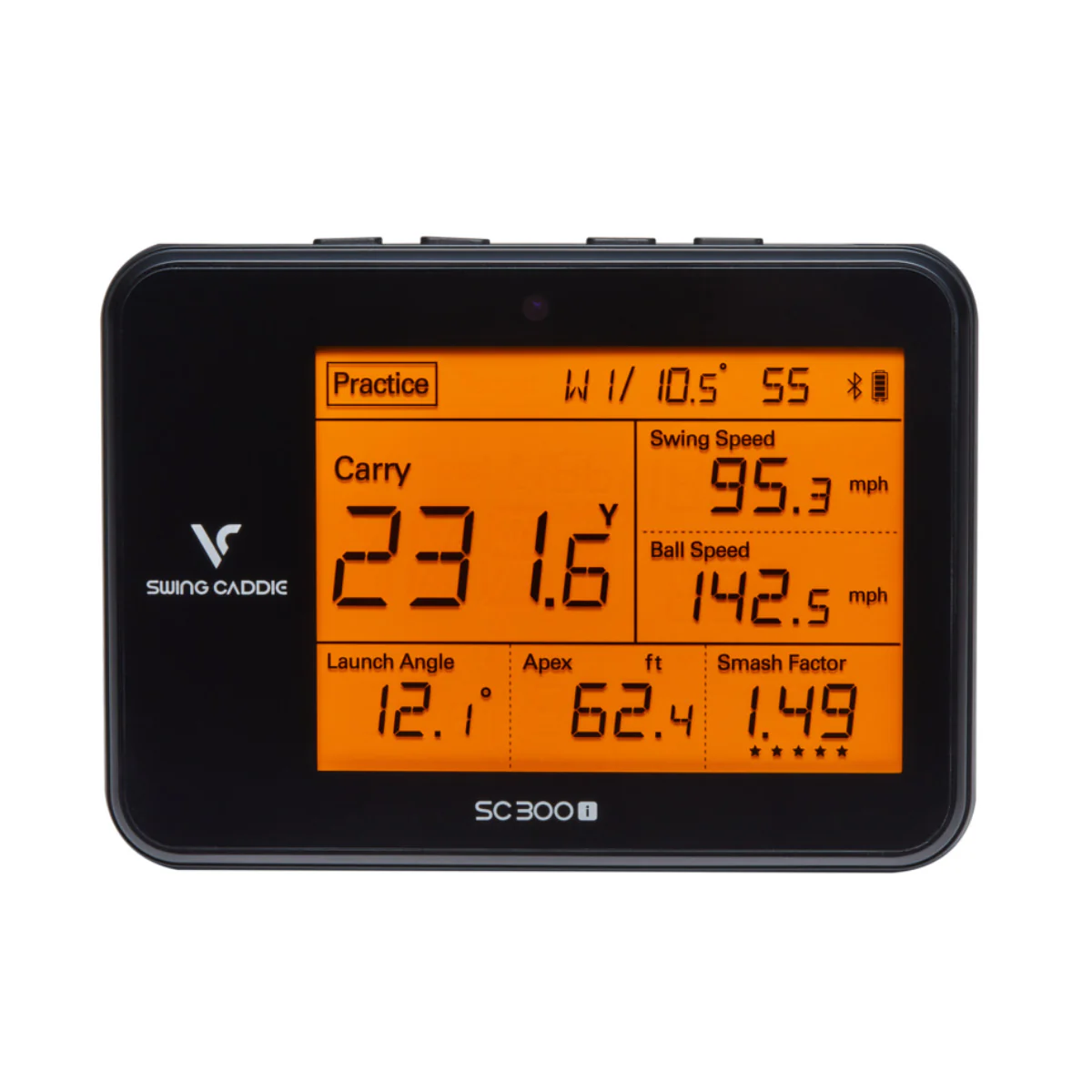
The SC300i is the launch monitor I’d buy if $400 was my absolute ceiling. Launch angle and apex data separate it from the cheaper options, the voice output is genuinely convenient, and the remote control means you never have to walk back to the device between shots. At $399, it hits the sweet spot between data and price.
Built for
- Range sessions focused on dialing in distances and launch
- Players who want data without using a phone
- Anyone who values voice distance feedback
Not ideal for
- Players who need simulator course play (go MLM2PRO or R10)
- Anyone who needs measured spin data
2. Shot Scope LM1, the most accurate $199 launch monitor
The Shot Scope LM1 at $199 is the 2026 newcomer that shocked the budget launch monitor market. Shot Scope has a strong reputation for GPS and performance tracking data, and the LM1 leverages that expertise in a pocket-sized radar unit with a 3.5-inch color display. In testing by independent reviewers, it tracked within 2% of Trackman on ball speed, which is remarkable for a $199 device.
The LM1 measures five metrics: carry distance, total distance, ball speed, club speed, and smash factor. No launch angle, no spin, no apex. But what it measures, it measures well. The color screen is brighter and easier to read than the PRGR’s, and the Shot Scope app syncs session history optionally. At $199, it’s less than a round at a premium course and will make every range session you take afterward more productive.
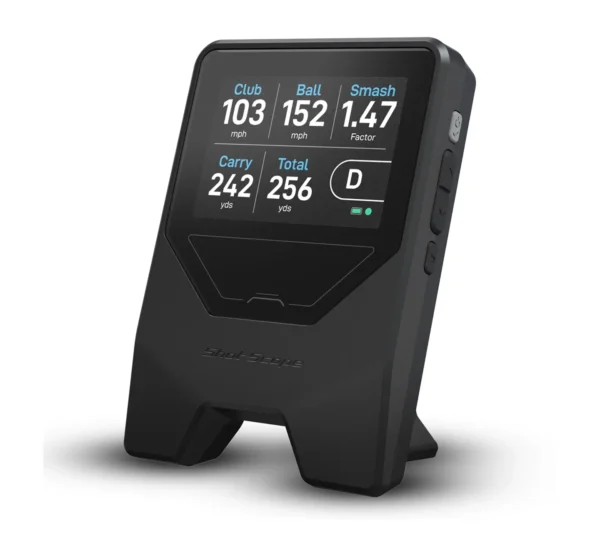
The LM1 is the launch monitor I recommend to every golfer who says “I just want to know my actual distances.” Five metrics, a color screen, no app required, and accuracy that embarrasses devices costing twice as much. At $199, there’s no reason not to own one.
Ideal for
- Golfers who just want real carry and speed numbers
- Speed training with swing-only detection
- First-time launch monitor buyers on a tight budget
Not ideal for
- Players who want launch angle or apex data (go SC300i)
- Anyone who needs simulator compatibility
3. PRGR HS-130A, the pocket-sized veteran with zero tech friction
The PRGR HS-130A at $229 is the launch monitor for the golfer who hates technology. There is no app, no Bluetooth, no WiFi, no subscription. You insert two AAA batteries, turn it on, set it behind the ball, and swing. The built-in LCD shows carry, total distance, ball speed, club speed, and smash factor. That’s it. It stores 500 swings in memory and also measures dry swing speed without a ball, making it the budget standard for speed training with tools like Rypstick and SuperSpeed.
At 4.4 ounces, the PRGR is lighter than most smartphones and fits in your pocket. PRGR is a division of Yokohama Rubber, a Japanese manufacturer that has been making Tour-level equipment since 1983. The radar sensor is proven and reliable. In testing, carry distance tracks within 4-5 yards of the Trackman 4 on full swings.
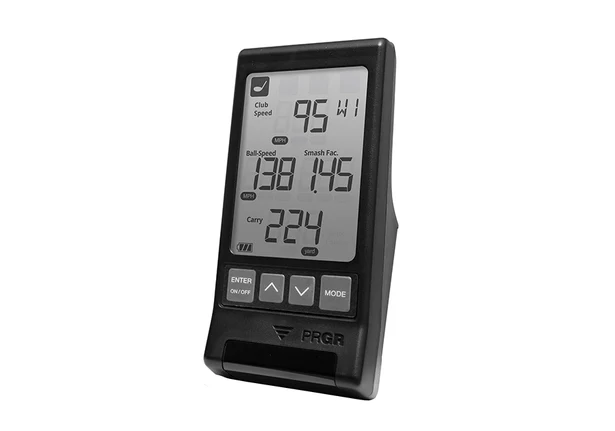
The PRGR is the launch monitor for golfers who want to practice, not troubleshoot. No app, no Bluetooth, no syncing. Turn it on, hit, read the screen. Plus it reads dry swings for speed training, which most budget units can’t do. At $229 with AAA batteries, it’s the simplest and most reliable unit under $500.
Built for
- Golfers allergic to apps and Bluetooth
- Speed training with Rypstick or SuperSpeed
- Anyone who wants the simplest possible experience
Not ideal for
- Players who want launch angle or spin data
- Anyone who wants session history or app tracking
4. Swing Caddie SC200 Plus, voice output with speed training mode
The Swing Caddie SC200 Plus at $279 is the older sibling of the SC300i and remains a strong pick for golfers who want voice distance output, practice modes, and swing speed training without the $399 price of the SC300i. It measures carry, ball speed, swing speed, and smash factor. The SC200 Plus uniquely supports practice swings without a ball for speed training, which the SC300i dropped.
The trade-off versus the SC300i: no launch angle, no apex, and no app-based video or spin. But the included Approach mode and Target mode make range sessions more engaging, and the voice output calling your carry distance after each shot is a feature most golfers love once they’ve used it.
5. Izzo Launch Mate Tour, the only sub-$500 with attack angle data
The Izzo Launch Mate Tour at $499 is the most data-rich unit in this bracket. It measures launch angle and attack angle on top of the standard carry, ball speed, swing speed, and smash factor, making it the only sub-$500 device that gives you vertical swing plane data. For a player working with a coach on swing path, that attack angle number is genuinely useful.
The trade-off: at $499, it’s only $100-$200 below devices like the Garmin R10 and Rapsodo MLM2PRO that offer dramatically more features. If $500 is a hard ceiling, the Launch Mate Tour fills the gap. If you can stretch to $599-$699, the R10 or MLM2PRO is a better investment.
6. Garmin Approach G80, the launch monitor + GPS rangefinder combo
The Garmin Approach G80 at $499 is the only device on this list that doubles as a full-color GPS rangefinder with top-down course maps and yardage to any point. The built-in Doppler radar measures carry, ball speed, swing speed, smash factor, and launch angle. The G80 also includes a basic simulator mode where you can play virtual holes on the touchscreen.
For the golfer who wants one device for range sessions and on-course GPS, the G80 eliminates the need to carry a separate rangefinder. The trade-off: accuracy is a step behind the SC300i and LM1 on full-swing carry, and the device is thicker and heavier than a dedicated launch monitor. If you already own a Garmin watch or rangefinder, the G80 adds redundancy. If you own neither, it fills both roles at $499.
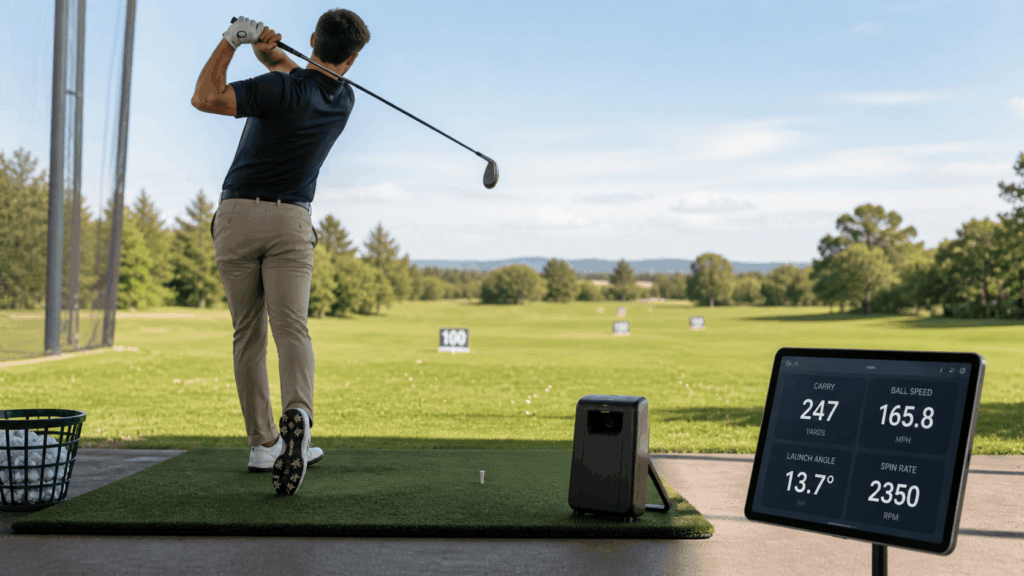
At this price, the biggest accuracy killer isn’t the launch monitor. It’s setup. Every radar unit in this bracket needs to be exactly 3.5-5 feet behind the ball, level with the hitting surface, and aligned to your target line. Move it two inches off-center and your carry numbers jump by 5-10 yards. The first thing I tell every client who buys a budget launch monitor: measure the placement distance once, mark it on the mat or floor, and never eyeball it again.
How we test launch monitors under $500
Every unit runs the same 50-shot protocol against a Trackman 4 reference: 20 driver, 20 7-iron, 10 wedge. At this tier, carry distance accuracy is the primary metric because it’s the number that directly translates to club selection on the course. Ball speed and swing speed are secondary confirmations. Spin and club path don’t exist at this price, so they aren’t scored.
Testing protocol: 50 shots per unit (driver, 7-iron, wedge) vs Trackman 4. Carry within 5 yards = pass. Ball speed within 2% = pass. Setup sensitivity tested at 3ft, 4ft, and 5ft behind ball.
What $500 actually buys you in launch monitor data
Every unit under $500 is a Doppler radar device that reads the ball after impact and uses algorithms to calculate its flight. None of them use cameras, none directly measure spin, and none provide club face or path data. That’s not a criticism, it’s a physics and cost constraint. Cameras and image processing add $200-$500 to the build cost, which is why the first camera-based unit (Square Golf) starts at $699.
What you do get reliably at this price: carry distance (±5 yards), ball speed (±2%), swing speed (±2%), and smash factor. The SC300i adds launch angle and apex. The G80 adds GPS. The SC200 Plus adds speed training. Everything else, including spin, club path, and simulator course play, lives at $599+.
The community consensus on r/golfsimulator is practical: if you just want to build a real yardage book and practice with purpose, a $199-$399 launch monitor is genuinely all you need. The jump to $599-$699 makes sense only when you want simulator rounds, swing video, or measured spin data.
Launch monitor under $500 FAQ
What’s the best launch monitor under $500 overall?
The Swing Caddie SC300i at $399 is the best overall thanks to launch angle and apex data that no other sub-$500 unit provides. For pure budget, the Shot Scope LM1 at $199 delivers remarkable accuracy for the price. For maximum simplicity, the PRGR HS-130A at $229 is the no-app, no-Bluetooth option.
Can I use a sub-$500 launch monitor for simulator course play?
No. None of the units under $500 connect to GSPro, E6, or other simulator software. If simulator course play matters, the Garmin R10 at $599 is the cheapest unit that supports it. The Garmin G80 has a basic built-in simulator mode but it’s not comparable to GSPro.
Do I need spin data?
For most amateur golfers, no. Spin matters for club fitting and advanced shot shaping, but carry distance and ball speed are the numbers that improve your scoring. Every unit on this list provides those accurately. If spin becomes important later, you can upgrade to a camera-based unit like the MLM2PRO or Square Golf.
Which is better, the PRGR or the Shot Scope LM1?
The LM1 ($199) has a brighter color screen and optional app integration. The PRGR ($229) has dry swing measurement for speed training and is smaller. If speed training matters, go PRGR. If screen quality and Shot Scope’s app ecosystem matter, go LM1. Both are accurate within the same tolerance on carry distance.
Should I save up for a $599-$699 launch monitor instead?
It depends on what you want. If you just need carry distances for a real yardage book and productive range sessions, a $199-$399 device is genuinely sufficient. If you want simulator rounds, measured spin, swing video, or club path data, saving for a Garmin R10 ($599), Rapsodo MLM2PRO ($699), or Square Golf ($699) is worth the wait.
The bottom line on launch monitors under $500
The sub-$500 launch monitor market in 2026 is genuinely useful for the first time. The Shot Scope LM1 at $199 proves you don’t need to spend $500+ to get accurate carry distances. The SC300i at $399 adds launch angle and apex that make ball flight diagnosis possible. And the PRGR at $229 is still the simplest practice tool in golf.
If $400 is your ceiling, buy the SC300i and never look back. If $200 is your ceiling, the LM1 is the smartest $199 in golf. Both will make every range session you take afterward more productive than the one before it. You can find the Swing Caddie SC300i directly on Voice Caddie.