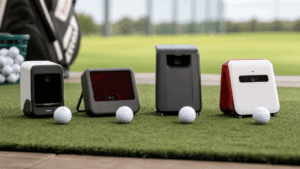
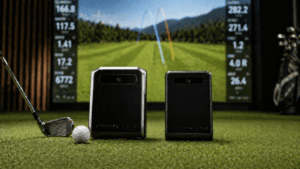
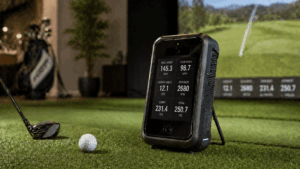
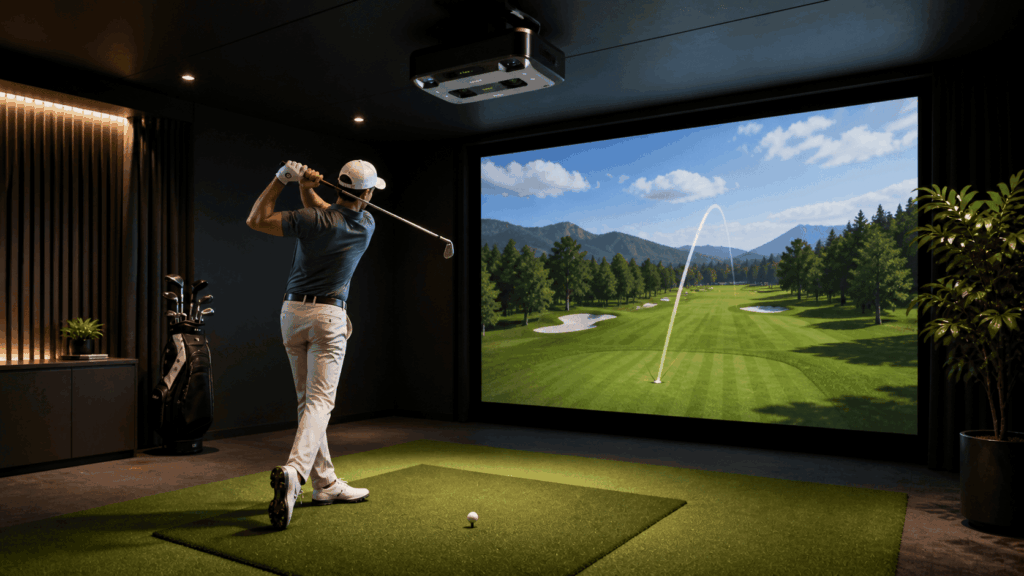
An overhead launch monitor is a ceiling-mounted tracking system that watches your swing from above. Once it’s installed, you never move it, never recalibrate it, and never trip over it. Left-handed player wants to hit? Step up and swing. Right-handed player next? Same thing. No repositioning, no stickers on the floor, no cables running across the hitting zone. This is why overhead systems are the gold standard for permanent home simulators and commercial bays.
I’ve tested every unit on this list against a Trackman 4 reference using a 50-shot protocol across driver, 7-iron, and wedge. For overhead units, I add three criteria that floor-mounted monitors don’t face: installation complexity (ceiling height, mounting hardware, wiring), hitting zone size (how far off-center can you tee it?), and L/R switching speed (is it instant or does it need a button press?).
The overhead market in 2026 has more real competition than ever. Prices range from $5,000 to $14,000+, and the accuracy gap between the cheapest and most expensive units is smaller than you’d expect. The real differentiators are hitting zone size, software ecosystem, sticker requirements, and long-term subscription costs.
Our top picks at a glance
- Best overall: Uneekor EYE XO2, three-camera overhead with the largest hitting zone, trouble mat compatibility, and GCQuad-level accuracy
- Best value: ProTee VX, the community sleeper pick with built-in swing cameras, no stickers, and the lowest price in the category
- Best accuracy: Trackman iO, dual radar + camera from the brand that PGA Tour coaches trust above all others
Side-by-side comparison
| # | Launch monitor | Score | Stickers? | Min ceiling | Price |
|---|---|---|---|---|---|
| 1 | Uneekor EYE XO2 | 9.5 | No | 9.5 ft | ~$11,000 |
| 2 | ProTee VX | 9.2 | No | 9 ft | ~$5,500 |
| 3 | Trackman iO | 9.1 | No | 10 ft | ~$13,000 |
| 4 | Foresight Falcon | 8.9 | No | 9.5 ft | ~$9,500 |
| 5 | Uneekor EYE XR | 8.6 | No | 9 ft | ~$7,000 |
| 6 | TruGolf APOGEE | 8.3 | No | 9 ft | ~$7,000 |
Prices are for the launch monitor unit only. Enclosures, projectors, PCs, and mats are additional. Every unit on this list operates sticker-free in 2026.
The 6 best overhead launch monitors in 2026
1. Uneekor EYE XO2, the most complete overhead system on the market
The Uneekor EYE XO2 at ~$11,000 is the overhead launch monitor that changed the conversation in 2025. Three high-speed cameras in a ceiling-mounted unit deliver accuracy that matches the Foresight GCQuad and Trackman iO across every club in the bag. In testing, carry deviation against the Trackman 4 is under 2 yards on driver and irons, with spin tracking within 150 rpm consistently.
What separates the EYE XO2 from every other overhead system is trouble mat compatibility. When hitting from the included rough and bunker mats, the software calculates adjusted ball flight based on the lie. No other overhead unit does this. The Dimple Optix technology reads the ball surface directly, eliminating marked balls or stickers entirely. The hitting zone is the largest in the Uneekor lineup, accommodating players of all sizes and stances.
Software is flexible: the EYE XO2 connects to GSPro, E6 Connect, and Uneekor’s View software. The subscription model offers three tiers: Pro ($199/year for third-party software access), Champion ($399/year for Refine+ training modes), and Legend ($1,999 one-time for lifetime access). For a permanent home build, the Legend package eliminates recurring costs entirely.
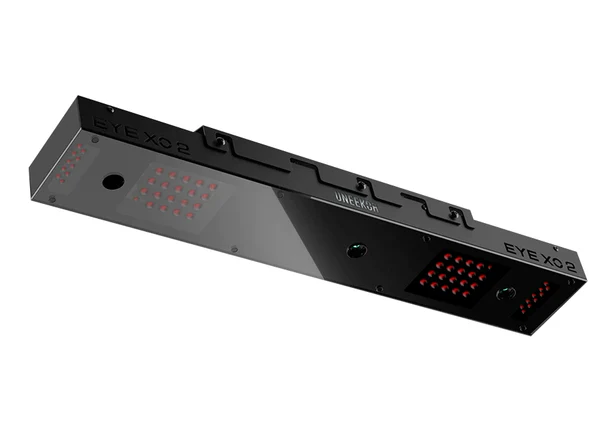
The EYE XO2 is the overhead system I recommend most often. Trouble mat compatibility, the largest hitting zone, GCQuad-level accuracy, and a $1,999 lifetime software option that eliminates recurring costs. If your ceiling is 9.5+ feet, this is the build.
Built for
- Permanent home builds with 9.5+ foot ceilings
- Mixed L/R households with zero repositioning
- Players who want trouble mat lie simulation
Consider alternatives if
- Budget is under $8,000 for the unit alone
- You prefer the Trackman brand and LIDAR course library
2. ProTee VX, the community sleeper pick with built-in swing cameras
The ProTee VX at ~$5,500 is the overhead launch monitor the r/golfsimulator community keeps recommending when nobody’s watching. It uses AI-driven high-speed cameras in a ceiling-mounted unit, includes built-in swing cameras for synchronized video replay at impact, handles L/R switching without recalibration, and requires no stickers, marked balls, or special equipment. At roughly half the price of the EYE XO2, it delivers accuracy that competes with units twice its cost.
The ProTee VX measures both ball and club data, projects shot results in under one second, and connects natively to GSPro, E6 Connect, TGC 2019, and ProTee’s own Play software. The built-in swing cameras are genuinely unique at this price, giving you synchronized video of club delivery at impact alongside every data point. No other overhead unit under $10,000 includes that.
Owner feedback on customer service is consistently the strongest of any brand in the overhead category. The ProTee team is responsive, pushes regular firmware updates, and actively engages with the community. The trade-off: ProTee doesn’t have the dealer network or brand recognition of Uneekor or Trackman, which matters more for commercial installs than home builds.
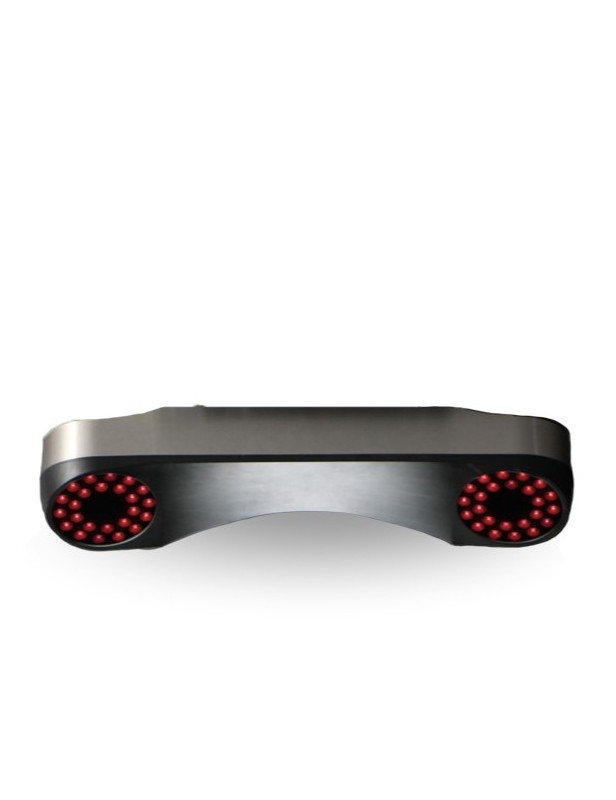
The ProTee VX is the best value in overhead launch monitors. Built-in swing cameras, no stickers, GSPro-ready, and customer service that puts bigger brands to shame, all at roughly half the price of the EYE XO2. If brand name doesn’t matter to you, this is the smartest buy in the category.
Built for
- Home builders who want the most overhead for the money
- GSPro users who want native, zero-bridge compatibility
- Players who value swing video alongside shot data
Not ideal for
- Commercial installs where brand recognition matters
- Players who want trouble mat lie simulation (EYE XO2 only)
3. Trackman iO, the gold standard for overhead radar + camera
The Trackman iO at ~$13,000 is the overhead system that PGA Tour coaches, club fitters, and teaching professionals trust above all others. It combines dual Doppler radar with high-speed cameras in a ceiling-mounted unit, delivering the most data-rich tracking available. Shot data appears on screen in under a second, and the LIDAR-scanned course library is the highest-quality simulation software on the market.
The iO handles L/R switching seamlessly, needs no stickers or marked balls, and Trackman’s brand name on the wall commands premium session pricing in teaching and commercial environments. In accuracy testing, the iO is the reference standard everything else on this list is measured against.
The trade-offs: the $700-$1,100/year software subscription is the highest recurring cost of any overhead system. Trackman does not support GSPro, which locks you into Trackman’s proprietary ecosystem. And at $13,000 for the unit alone, it’s the most expensive option on this list. For home golfers, the EYE XO2 or ProTee VX deliver comparable accuracy at a lower total cost. For teaching pros, the Trackman name justifies the premium.
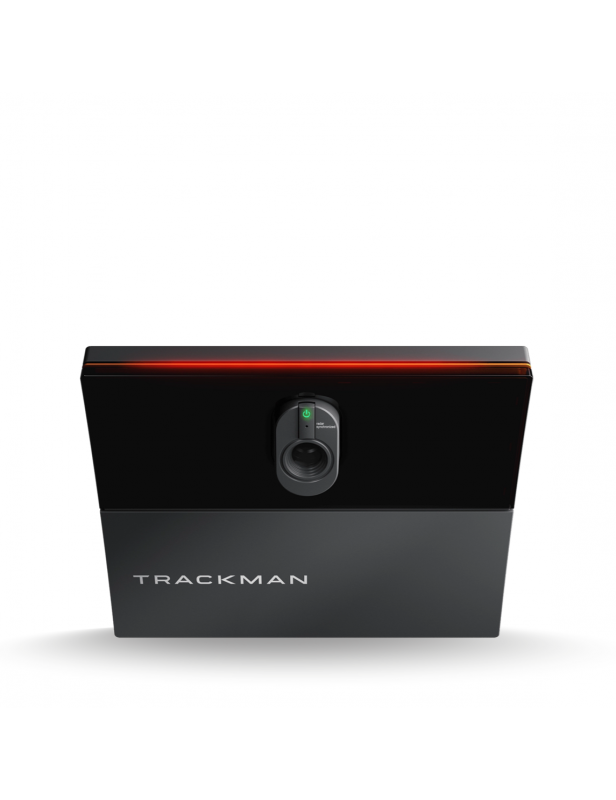
Trackman is still the name that carries the most weight. The iO is the accuracy benchmark for every overhead system. But the $700+/year software, no GSPro, and $13K unit price mean you’re paying for the brand as much as the data. For home golfers, the EYE XO2 or ProTee VX are the smarter financial choices.
Built for
- Teaching pros and club fitting studios
- Golfers who want the Trackman ecosystem and LIDAR courses
- Dedicated rooms with 10+ foot ceilings
Consider alternatives if
- GSPro and the Sim Golf Tour matter to you
- Ongoing $700+/year software costs strain the budget
4. Foresight Falcon, overhead photometric with Foresight accuracy
The Foresight Falcon at ~$9,500 brings Foresight’s tour-trusted photometric engine to the ceiling. It uses the same quadrascopic high-speed camera system as the GCQuad and GC Hawk, mounted overhead with an automatic latching system for L/R switching. The Falcon is more compact than the Uneekor units and processes data faster, with shot-to-screen latency consistently under one second.
For Foresight loyalists who want overhead mounting without switching brands, the Falcon is the only option. It runs FSX Play natively, connects to GSPro and E6, and delivers accuracy that matches the floor-mounted GC3 in an overhead format. The hitting zone is slightly smaller than the EYE XO2, which matters if multiple players with very different stances share the bay.
5. Uneekor EYE XR, the budget-friendly stickerless Uneekor
The Uneekor EYE XR at ~$7,000 is Uneekor’s most affordable overhead unit and the only rear-mounted monitor in this comparison. Its standout feature: AI-powered club tracking and Dimple Optix that deliver 19 data points entirely stickerless. The EYE XR uses a single high-speed camera rather than the EYE XO2’s three, which keeps the price $4,000 lower while still delivering accurate ball and club data.
The EYE XR connects to GSPro, E6, and Uneekor View with the same subscription tiers as the EYE XO2. The hitting zone is smaller than the XO2, and it lacks trouble mat compatibility. For a home builder who wants Uneekor accuracy on a tighter budget, the XR is the sweet spot between the ProTee VX and the EYE XO2.
6. TruGolf APOGEE, the hospitality-ready overhead with voice commands
The TruGolf APOGEE at ~$7,000 is the overhead system designed for venues where non-golfers operate the simulator. The APOGEE has voice command functionality for hands-free adjustments, an auto-calibrating laser indicator for ball alignment, and a compact mounting position closer to the hitting area than competitors. It’s the only overhead unit that reads the fastest ball speeds and tap-in putts with equal reliability.
The APOGEE currently runs exclusively on E6 Connect, which limits its software ecosystem versus the GSPro-compatible options above. For a hotel, country club, or commercial venue where E6’s polished interface and licensed courses matter more than GSPro’s community library, this is a legitimate choice. For home golfers who want GSPro, look elsewhere.
The single most common installation mistake with overhead units is ceiling height. Every system on this list needs at least 9 feet, and 9.5-10 feet is genuinely better for comfort and data quality. Measure your ceiling before you shop. If your basement is 8 feet, you’re looking at extension poles that add cost and complexity, or you’re better off with a floor-mounted GC3 or SkyTrak ST MAX.
How we test overhead launch monitors
Every unit runs the same 50-shot protocol against a Trackman 4 reference: 20 driver, 20 7-iron, 10 wedge. For overhead units specifically, I add installation time (from unboxing to first shot), hitting zone coverage (how far off-center can you tee it before data degrades?), and L/R switching speed (instant auto-detect vs. button press vs. software toggle).
I also test short game accuracy, which is where overhead units have a genuine advantage over floor-mounted radar. Putting, chipping, and pitch shots are captured more reliably from above because the cameras see the full impact zone without the ball needing to travel a minimum distance for radar to track it.
Testing protocol: 50 shots per unit (driver, 7-iron, wedge) vs Trackman 4. Carry within 2 yards = pass. Spin within 200 rpm = pass. L/R switching under 5 seconds = pass. Hitting zone coverage tested at center, 3 inches off-center, and 6 inches off-center.
Why overhead beats floor-mounted for permanent builds
Floor-mounted launch monitors like the Foresight GC3, Bushnell Launch Pro, and SkyTrak ST MAX are excellent devices. But for a permanent home simulator, overhead mounting solves three problems that floor units create. First, L/R switching: floor-mounted photometric units need to be repositioned every time a left-handed player steps up. Overhead units handle it automatically. Second, floor clutter: no cables, no tripods, no units to trip over or accidentally kick. Third, short game tracking: overhead cameras see putting and chipping that floor-mounted radar units consistently miss.
The trade-off: overhead units require permanent installation (ceiling mounting with proper hardware), 9+ foot ceilings, and a dedicated gaming PC connected via ethernet or USB. They’re not portable, they’re not for renters, and they’re not for low-ceiling basements. If your space meets those requirements, overhead is the better long-term choice for a permanent build.
The community consensus on r/golfsimulator is clear: if you have the ceiling height and the budget, go overhead. The convenience of zero floor clutter and instant L/R switching is a quality-of-life improvement that floor-mounted users consistently say they wish they’d had from the start.
Overhead launch monitor FAQ
What’s the best overhead launch monitor overall?
The Uneekor EYE XO2 is the best overall thanks to its three-camera system, largest hitting zone, trouble mat compatibility, and GCQuad-level accuracy. The ProTee VX is the best value at roughly half the price with built-in swing cameras. The Trackman iO is the accuracy benchmark but costs more with higher ongoing fees.
What ceiling height do I need?
Minimum 9 feet for the ProTee VX, EYE XR, and APOGEE. Minimum 9.5 feet for the EYE XO2 and Falcon. Minimum 10 feet for the Trackman iO. If your ceiling is under 9 feet, overhead is not practical and you should consider a floor-mounted unit like the Foresight GC3.
Do I need stickers or marked balls?
No. Every overhead unit on this list operates sticker-free in 2026. The older Uneekor EYE XO (not listed here) required club stickers, but the EYE XO2, EYE XR, ProTee VX, Falcon, and APOGEE all track without any markings on clubs or balls.
ProTee VX or Uneekor EYE XO2?
The EYE XO2 wins on hitting zone size, trouble mat compatibility, and brand ecosystem. The ProTee VX wins on price ($5,500 vs $11,000), built-in swing cameras, and customer service reputation. Both deliver accurate data. For a home builder on a budget, the ProTee VX is the smarter buy. For a no-compromise permanent build, the EYE XO2 is the long-term investment.
Can I install an overhead unit myself?
Yes, with a second person and basic tools. Most installations take 2-4 hours. You’ll need to locate ceiling joists, mount a bracket or plate, run a USB/ethernet cable, and calibrate the unit’s position relative to the hitting zone. Hiring a professional adds $500-$1,000 but guarantees proper alignment. The ProTee VX and EYE XR have the simplest mounting processes.
The bottom line on overhead launch monitors
Overhead launch monitors are the best technology available for permanent home simulators and commercial bays. The Uneekor EYE XO2 is the most complete system on the market with trouble mats, the largest hitting zone, and accuracy that matches tour-level devices. The ProTee VX delivers 90% of that performance at roughly half the cost with built-in swing cameras the EYE XO2 doesn’t include. And the Trackman iO remains the accuracy benchmark for teaching pros who need the Trackman name.
If I were building a permanent sim room today and my ceiling cleared 9.5 feet, I’d choose between the EYE XO2 for no-compromise accuracy and the ProTee VX for the best value per dollar. Both will last a decade. You can find the Uneekor EYE XO2 directly on The Indoor Golf Shop.