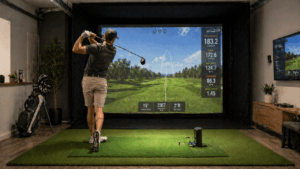
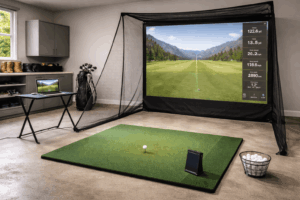
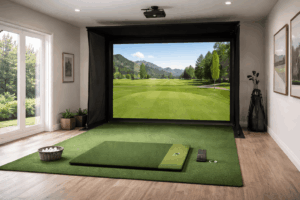
The $5,000 to $10,000 range is where home golf simulators stop being a compromise and start being a serious tool. At this budget you can pair a fitting-grade launch monitor with a premium enclosure, a 4K short-throw projector, and a mat that won’t destroy your joints. This is the tier where most serious golfers land, and where the wrong choice costs the most.
I’ve spent the last eight years fitting launch monitors next to a Trackman 4 reference unit for private clients in Scottsdale. Every package below has been through the same 50-shot protocol across driver, 7-iron, and wedge. The rankings reflect total package quality, not just the launch monitor spec sheet.
At this budget, you’re choosing between three real technologies: photometric cameras (Foresight, Bushnell), hybrid camera-radar systems (SkyTrak, Garmin), and overhead ceiling-mounted units (Uneekor, ProTee). Each has trade-offs that matter depending on your room and your goals.
Our top picks at a glance
- Best overall: Foresight GC3S SIG10 Package, fitting-grade photometric accuracy with included PC and software
- Best overhead: Uneekor EYE MINI Lite SIG10 Package, seamless left-right switching with no floor clutter
- Best value: SkyTrak ST MAX SIG12 Package, premium studio with room to spare under the budget ceiling
Side-by-side comparison
| # | Package | Score | Tech | Min depth | Price |
|---|---|---|---|---|---|
| 1 | Foresight GC3S SIG10 | 9.4 | Photometric | 12 ft | ~$7,999 |
| 2 | Uneekor EYE MINI Lite SIG10 | 9.1 | Overhead camera | 12 ft | ~$7,500 |
| 3 | Garmin R50 SIG10 | 8.9 | Camera (built-in PC) | 12 ft | ~$8,499 |
| 4 | Bushnell Launch Pro SIG10 | 8.7 | Photometric | 12 ft | ~$7,499 |
| 5 | SkyTrak ST MAX SIG12 | 8.5 | Camera + radar | 12 ft | ~$6,995 |
| 6 | ProTee VX SIG12 | 8.3 | Overhead camera | 12 ft | ~$6,500 |
Package prices are approximate 2026 street pricing, including launch monitor, enclosure, screen, mat, and projector. Prices shift with seasonal promotions and configuration choices.
The 6 best golf simulators under $10,000 in 2026
1. Foresight GC3S SIG10, fitting-grade photometric with included PC
The Foresight GC3S SIG10 package is the build I recommend to any client who says “I want tour-level data and I don’t want to think about it.” The GC3S uses the same three high-speed photometric cameras as the original GC3, delivering millimeter-level ball and club data that no radar or hybrid unit in this price range can match. In testing, carry deviation against the Trackman 4 is consistently under 2 yards across every club in the bag.
What makes this package stand out at the $8K price point is the included PC and three-year Gold software subscription. That eliminates the two biggest surprise costs in simulator buying: the gaming PC ($800-$1,500) and the software subscription ($500-$1,500/year). The GC3S runs FSX Play natively, and the Gold tier unlocks GSPro access for an additional $250/year.
The SIG10 enclosure, SIGPRO Premium impact screen, and short-throw projector round out a professional-looking build that fits in a standard two-car garage or large basement with 12+ feet of depth. Camera-based tracking means it works in shallow rooms where radar units need 18+ feet.
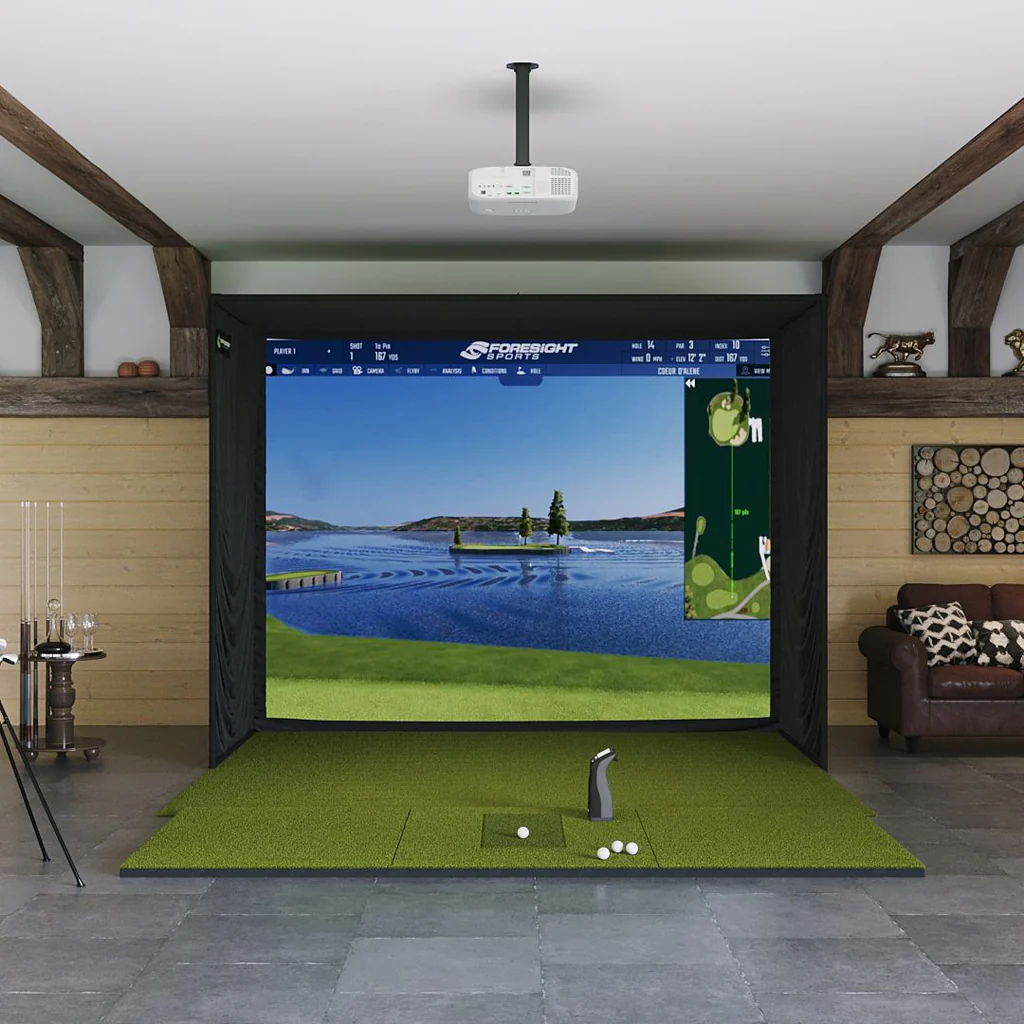
The GC3S at this price with a PC and three-year subscription included is the single best value in serious home simulators for 2026. Nothing under $10K matches its accuracy, and the included PC removes the hidden cost that catches most first-time builders.
Built for
- Serious golfers who want club fitting data at home
- Permanent garage or basement builds with 12+ feet of depth
- Buyers who want to open the box and play, not spec a PC
Consider alternatives if
- Mixed left/right households, the GC3S sits beside the ball and needs repositioning
- You specifically want GSPro as primary software (extra $250/year on top of Gold)
2. Uneekor EYE MINI Lite SIG10, overhead tracking with no floor clutter
The Uneekor EYE MINI Lite SIG10 package is the build I recommend for households where both left and right-handed players share the bay. The EYE MINI Lite is ceiling-mounted, which means zero equipment on the floor, no repositioning between players, and a clean aesthetic that looks professional rather than cluttered.
Uneekor’s Dimple Optix ball tracking captures 19 data points including spin rate and spin axis without requiring special marked balls. In testing, accuracy tracks within 2-3 yards of carry against the Trackman 4 on full swings. The overhead position also means the unit reads short game shots reliably, something floor-mounted radar units struggle with.
The EYE MINI Lite requires ceiling mounting at 9.5+ feet, which rules out some low-ceiling basements. Installation takes about 2-3 hours with a second person. The unit supports GSPro, E6, and Uneekor’s own View software, with the Refine add-on ($1,000) unlocking training modes and additional courses.
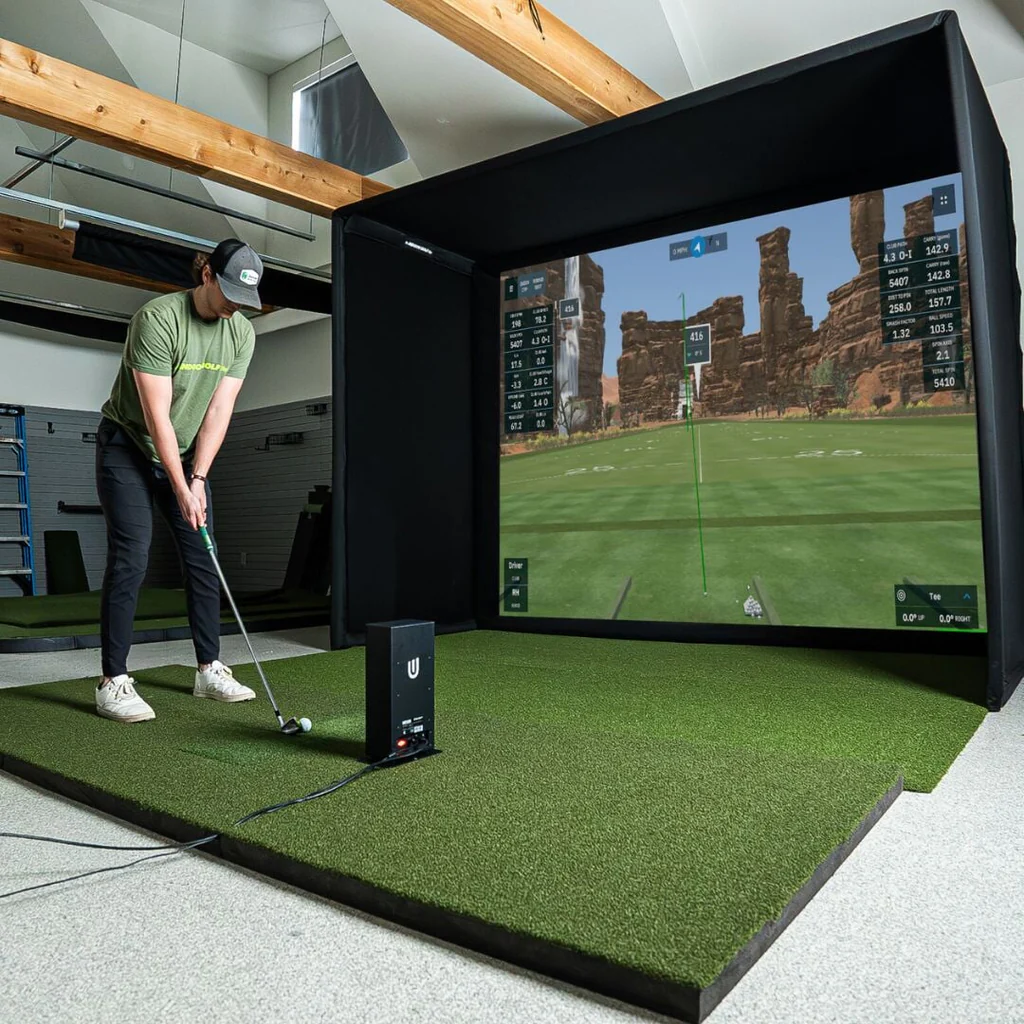
The cleanest, most seamless simulator experience under $10K. Overhead mounting eliminates every floor-clutter problem, and the Dimple Optix tracking is genuinely accurate without requiring special balls. The only catch is ceiling height.
Ideal for
- Mixed left/right households, no repositioning needed
- Players who want a clean, floor-free bay
- Ceilings at 9.5 feet or higher
Not ideal for
- Low ceilings under 9.5 feet
- Renters who can’t ceiling-mount hardware
3. Garmin Approach R50 SIG10, the all-in-one with built-in computer
The Garmin R50 SIG10 package is the most self-contained simulator on this list. The R50 has a built-in 10-inch touchscreen computer that runs Garmin’s simulation software directly on the unit, eliminating the need for a separate PC, phone, or tablet. Three high-speed cameras capture ball and club data, and the unit displays slow-motion impact replays right on the screen.
For a player who values simplicity above all else, this is the closest thing to a “plug and play” simulator that exists. Pair it with the SIG10 enclosure and a projector, and you have a build that genuinely works the first time you turn it on. The R50 also connects to E6 Connect, GSPro, and Awesome Golf through external devices for those who want a bigger software ecosystem.
The trade-off: at ~$5,000 for the R50 alone, the launch monitor takes a large chunk of the budget. But the included computer, software, and display offset the cost of a separate PC, making the total package competitive with the Foresight build.
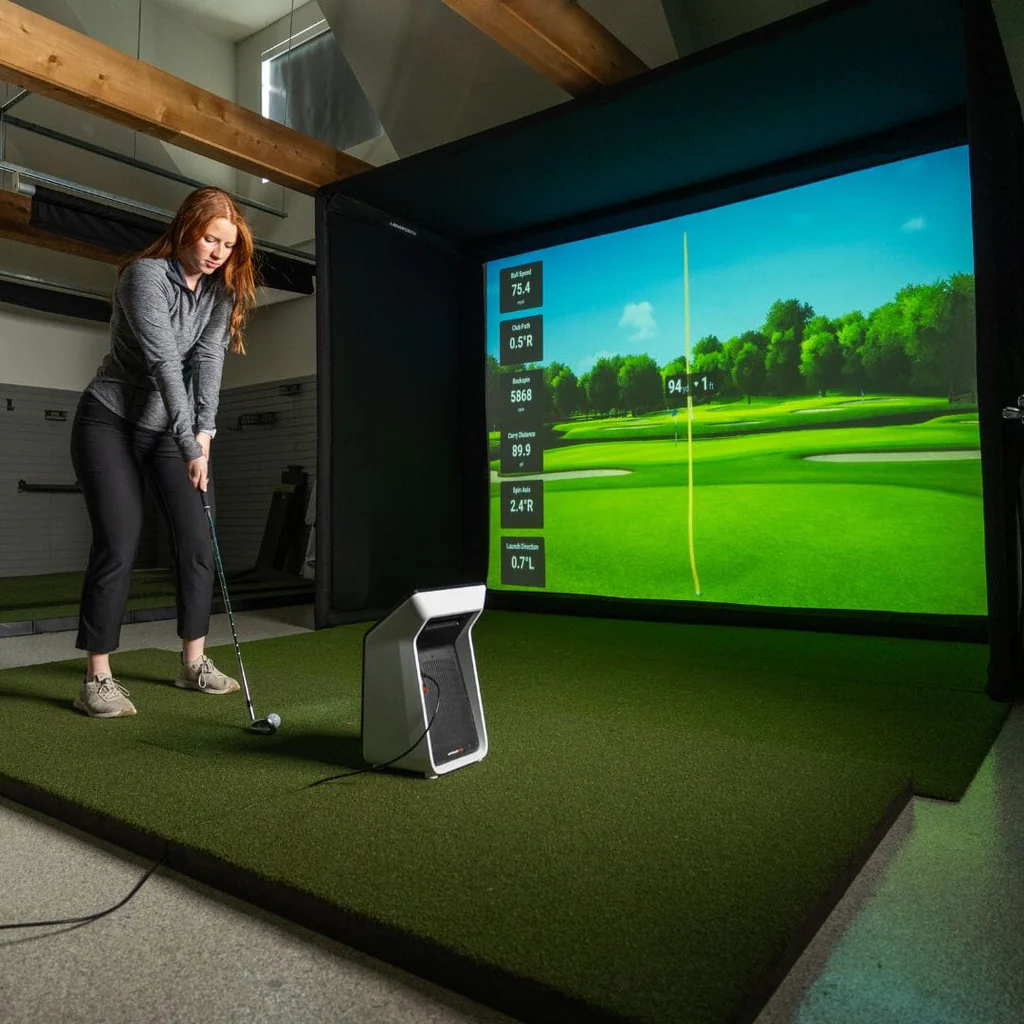
The R50 is the simplest path to a serious simulator. Built-in computer, touchscreen, slow-motion replays, and native Garmin software all in one unit. If you hate dealing with PCs and connectors, this is the build.
Built for
- Players who want zero tech headaches
- Anyone upgrading from an R10 in the Garmin ecosystem
- Builds where a separate PC isn’t practical
Not ideal for
- Players who want the absolute best accuracy (GC3S edges it)
- GSPro-first builders who want native integration without workarounds
4. Bushnell Launch Pro SIG10, tour-level Foresight engine at a lower price
The Bushnell Launch Pro uses the same three-camera photometric engine as the Foresight GC3 but at a $2,499 price point instead of $7,000. That leaves more budget for a premium SIG10 enclosure, a quality mat, and a 4K projector. The total build lands around $7,499, well under the ceiling.
In accuracy testing, the Launch Pro matches the GC3S on ball data and comes close on club data with the optional Club Data add-on. The main trade-off versus the GC3S is software: the Launch Pro requires an annual subscription ($499/year for Performance tier) to unlock full data and third-party software access, which the GC3S bundles in with its Gold plan.
5. SkyTrak ST MAX SIG12, the widest studio with budget to spare
The SkyTrak ST MAX SIG12 package pairs the latest SkyTrak launch monitor with the widest standard SIG enclosure. At around $6,995, it leaves room under the $10K ceiling for a projector upgrade, a better mat, or a full year of SkyTrak Course Play. The ST MAX combines a dual Doppler radar with an improved photometric camera and adds speed training features the SkyTrak+ didn’t have.
For a family sim room where budget matters more than bleeding-edge accuracy, this is the sweet spot. The SIG12 enclosure gives you a 12-foot-wide hitting bay that feels spacious rather than cramped, and the ST MAX works well with both SkyTrak’s own Course Play software and third-party options through the Essential, Core, or Elite subscription tiers.
6. ProTee VX SIG12, the community sleeper pick for overhead accuracy
The ProTee VX is the launch monitor the r/golfsimulator community keeps recommending when nobody’s watching. It’s ceiling-mounted, uses AI and machine learning with high-speed cameras, handles left and right-handed players without recalibration, includes built-in swing cameras, and delivers shot data in under a second. No stickers, no special balls, no repositioning.
At around $6,500 for a full SIG12 build, the ProTee VX package is the cheapest serious overhead simulator on this list. The trade-off is brand recognition: ProTee doesn’t have the market presence of Foresight or Uneekor, but owner feedback on customer service and accuracy is consistently strong across forums.
At this budget, the single biggest mistake is forgetting subscription costs. A GC3S with a three-year Gold plan included at $7,999 is genuinely cheaper over five years than a Bushnell Launch Pro at $2,499 plus $499/year Performance tier. Do the five-year math before you buy, not the sticker math.
How we test golf simulators in this price tier
Every launch monitor runs the same 50-shot protocol against a Trackman 4 reference unit: 20 driver shots, 20 with a 7-iron, 10 wedges. I record carry deviation, spin consistency, and missed-shot rate. For complete packages, I add install time, real room dimensions needed, and how the system handles a left-right player switch.
At the $5K-$10K tier, I also test club data accuracy (face angle, club path, attack angle) and software latency, the time between impact and on-screen ball flight. A sub-1-second response time is the benchmark for an immersive experience.
Testing protocol: 50 shots per unit (driver, 7-iron, wedge) measured against Trackman 4. Carry within 2 yards = pass. Spin within 200 rpm = pass. Club data within 1 degree = pass.
What $10,000 actually buys you in 2026
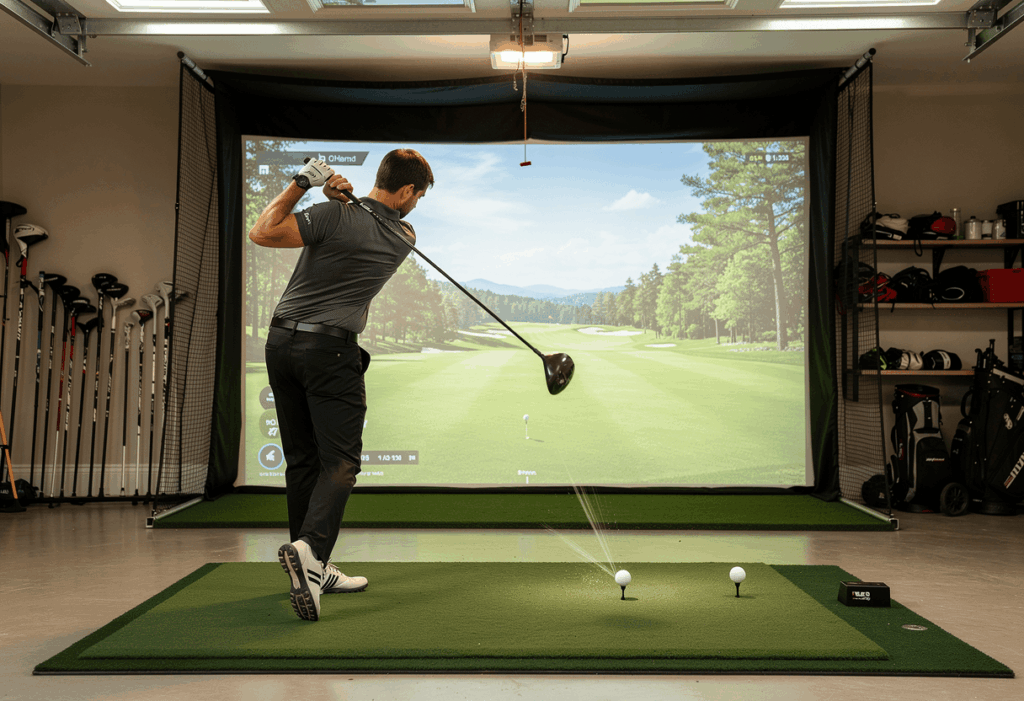
This is the tier where you stop making compromises. A $10,000 budget gets you a fitting-grade launch monitor, a premium full-size enclosure, a 4K short-throw projector, a quality hitting mat with replaceable strips, and enough left over for software subscriptions. Every package above includes all five of those components.
The hidden cost that catches most first-time builders at this tier is the gaming PC. Running GSPro or E6 Connect at 4K resolution on a projector requires at least an RTX 3080 GPU, which means $1,000-$1,500 for a dedicated PC. Two packages on this list (GC3S and R50) solve that by including a computer, which is a genuine financial advantage.
The community consensus on r/golfsimulator for this tier is clear: camera-based tracking (Foresight, Uneekor, Bushnell) is universally preferred over radar for indoor use. The accuracy advantage is measurable, especially on wedges and short game shots where radar units consistently underperform. If your budget reaches this tier, there’s no reason to accept a radar-only launch monitor.
Golf simulator under $10,000 FAQ
What’s the most accurate golf simulator under $10,000?
The Foresight GC3S is the most accurate launch monitor at this price. Its three-camera photometric system consistently reads carry within 2 yards and spin within 200 rpm of a Trackman 4 baseline. The Bushnell Launch Pro uses the same engine at a lower unit price but adds ongoing subscription costs.
Overhead or floor-mounted, which is better?
Overhead (Uneekor EYE MINI Lite, ProTee VX) is better for mixed left/right households and anyone who wants a clean floor. Floor-mounted (GC3S, Launch Pro, SkyTrak ST MAX) offers more portability and simpler installation. If ceiling height is at least 9.5 feet and multiple players share the bay, go overhead.
Do I need a separate gaming PC?
For 4K simulation, yes, unless you buy a package that includes one. The GC3S SIG10 package includes a PC, and the Garmin R50 has a built-in computer. For the other packages, budget $1,000-$1,500 for a PC with at least an RTX 3080 GPU if you want smooth 4K rendering on a projector.
Is the SkyTrak ST MAX worth it vs the SkyTrak+?
The ST MAX adds speed training features, a modular internal design, and an extra USB-C port over the SkyTrak+. If you’re buying new in 2026, the ST MAX is the current product. If you can still find a SkyTrak+ at closeout pricing (~$1,795), that’s also a strong buy with the savings going toward a better enclosure or mat.
What’s the best software for this tier?
GSPro at $250/year remains the community default for course play, with 4,000+ courses and the Sim Golf Tour. E6 Connect is the choice for licensed courses like Pebble Beach. The GC3S and Bushnell Launch Pro also include FSX Play, Foresight’s own simulator, which is polished but has a smaller course library.
Can I upgrade later?
Yes, and at this tier the upgrade path is about components, not the launch monitor. The GC3S, EYE MINI Lite, and R50 are launch monitors you keep for 5-10 years. What you upgrade is the projector (4K laser like the BenQ TK710STi), the mat (Fiberbuilt or SIGPRO Softy), and the software tier.
The bottom line on a $10K simulator build
The $5K-$10K tier is where the home golf simulator market matured in 2025-2026. Two years ago, fitting-grade accuracy with a full studio at this price required compromises everywhere. Today, the Foresight GC3S SIG10 package delivers tour-level data, a PC, and a premium enclosure for $7,999. The Uneekor EYE MINI Lite gives you overhead tracking without special balls or stickers. The Garmin R50 eliminates the PC entirely with its built-in computer.
If I were building a permanent sim room today with this budget, I’d choose between the GC3S for raw accuracy and the EYE MINI Lite for convenience. Both will last a decade. You can find the Foresight GC3S SIG10 package directly on The Indoor Golf Shop.