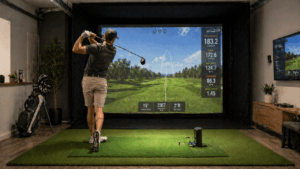
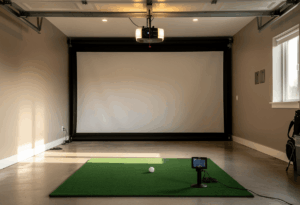
A portable golf simulator is a launch monitor that fits in your golf bag, sets up in under two minutes, and works both indoors hitting into a net and outdoors at the range. No permanent enclosure, no ceiling mounting, no dedicated room. You set it up, hit balls, pack it away, and do it again tomorrow somewhere else.
I’ve tested the units below against a Trackman 4 reference using the same 50-shot protocol I use for premium gear. The picks come from real measurements in both indoor bays and outdoor range sessions. Every unit here is genuinely portable, not a floor-mounted device that technically unplugs.
The honest truth: portable simulators trade accuracy and immersion for flexibility. You won’t get the same experience as a $10K permanent build with a SIG12 enclosure and 4K projector. But you will get real ball data, simulator course play on your phone or tablet, and the ability to practice anywhere, anytime.
Our top picks at a glance
- Best overall: Rapsodo MLM2PRO, dual cameras, radar, swing video, and official GSPro in one $699 device
- Best all-in-one: Garmin Approach R50, built-in touchscreen computer that needs nothing else to run
- Best value: Garmin Approach R10, the $599 launch monitor that started the portable sim revolution
Side-by-side comparison
| # | Launch monitor | Score | Tech | Indoor + outdoor | Price |
|---|---|---|---|---|---|
| 1 | Rapsodo MLM2PRO | 9.2 | Camera + radar | Yes | $699 |
| 2 | Garmin Approach R50 | 9.0 | Camera (built-in PC) | Yes | $4,999 |
| 3 | Garmin Approach R10 | 8.7 | Radar | Yes | $599 |
| 4 | FlightScope Mevo Gen 2 | 8.5 | Radar + Fusion Tracking | Yes | $2,499 |
| 5 | Square Golf | 8.3 | Camera | Indoor only | $699 |
| 6 | Swing Caddie SC4 Pro | 8.0 | Radar | Yes | $599 |
All units are launch monitors only. Add a portable net (~$150-$400) and a hitting mat (~$200-$500) for a complete portable setup.
The 6 best portable golf simulators in 2026
1. Rapsodo MLM2PRO, dual cameras and radar with built-in swing video
The Rapsodo MLM2PRO at $699 is the most complete portable simulator on the market. It combines dual optical cameras with Doppler radar, captures 13 measured metrics including club path and angle of attack, and records swing video from two angles at 240 fps with slow-motion replay at impact. At 0.7 lbs, it’s the only simulator launch monitor you can genuinely carry in your golf bag without noticing it.
In testing against the Trackman 4, the MLM2PRO reads ball speed within plus/minus 1% when paired with Callaway RPT balls, and carry distance tracks within 3-4 yards on full swings. The unit connects to GSPro through an official integration, no third-party connector required. For indoor use, pair it with a basic net and mat. For outdoor sessions, set it up 7-8 feet behind the ball on the range.
The trade-offs: the Premium Membership at $199/year (or $499 lifetime) is required for full features. RPT balls cost $35-$50/dozen and wear faster than standard balls. Indoors, you need at least 14 feet of room depth for reliable reads.
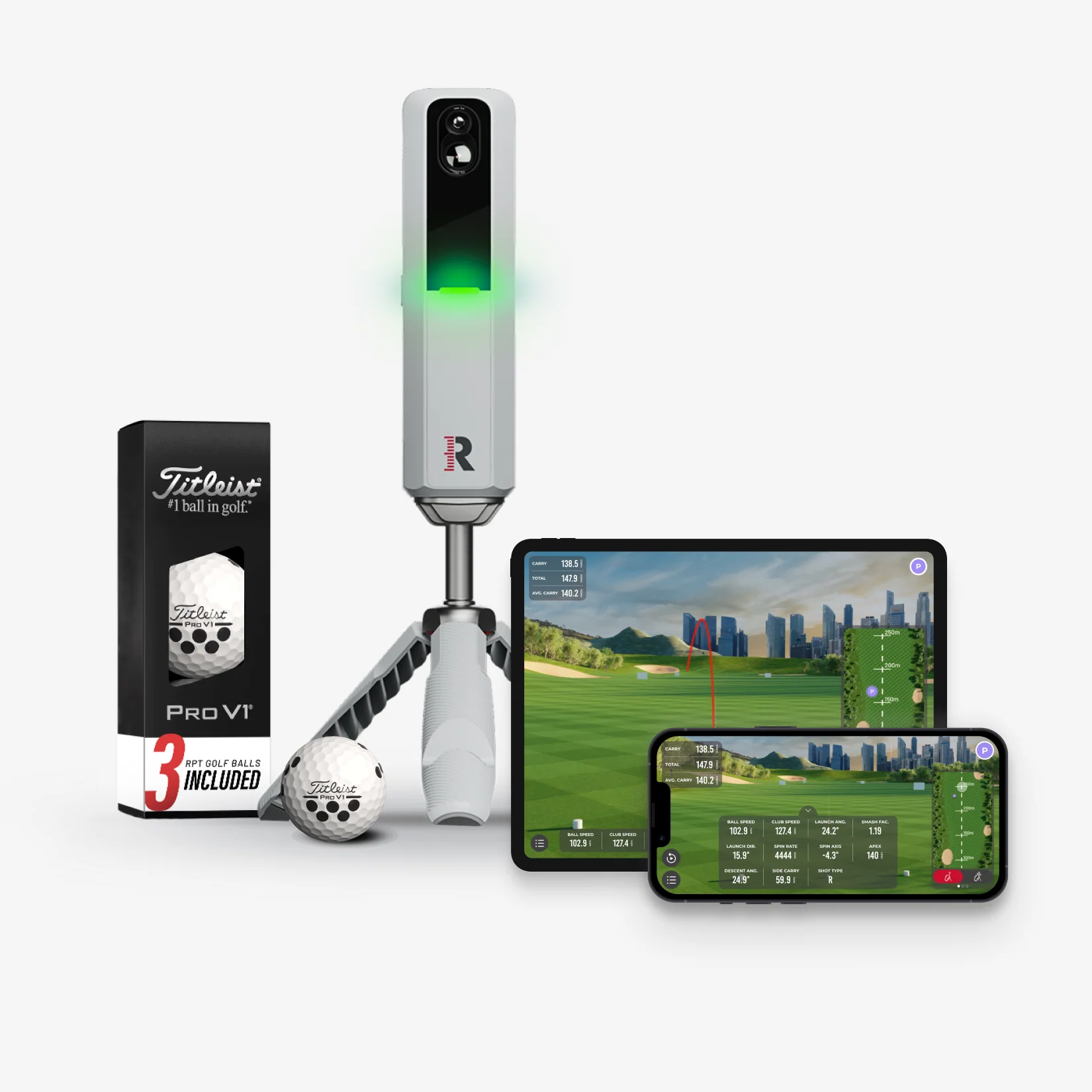
The MLM2PRO is the portable launch monitor I’d buy if I could only own one device. Dual cameras, radar, swing video, measured club path, official GSPro, all in a unit that weighs less than a sleeve of golf balls. The $199/year subscription is the only friction.
Built for
- Players who want one device for indoor sim and outdoor range
- Anyone who values built-in swing video and measured club data
- GSPro users who want official native compatibility
Not ideal for
- Tight basements under 12 feet of depth
- Buyers allergic to annual subscriptions
2. Garmin Approach R50, the all-in-one with built-in touchscreen
The Garmin R50 at $4,999 is the premium portable pick because it’s a complete simulator in one unit. The 10-inch color touchscreen has a built-in computer that runs Garmin’s practice and course play software directly, eliminating the need for a phone, tablet, or PC. Three high-speed cameras capture ball and club data, and the unit displays slow-motion impact replays right on screen.
Set the R50 on the ground behind a net, turn it on, and you’re playing a simulated round within 60 seconds. It also connects to E6 Connect, GSPro, and Awesome Golf on external devices for a bigger software ecosystem. At just over 4 kg, it’s heavier than the MLM2PRO but still genuinely portable.
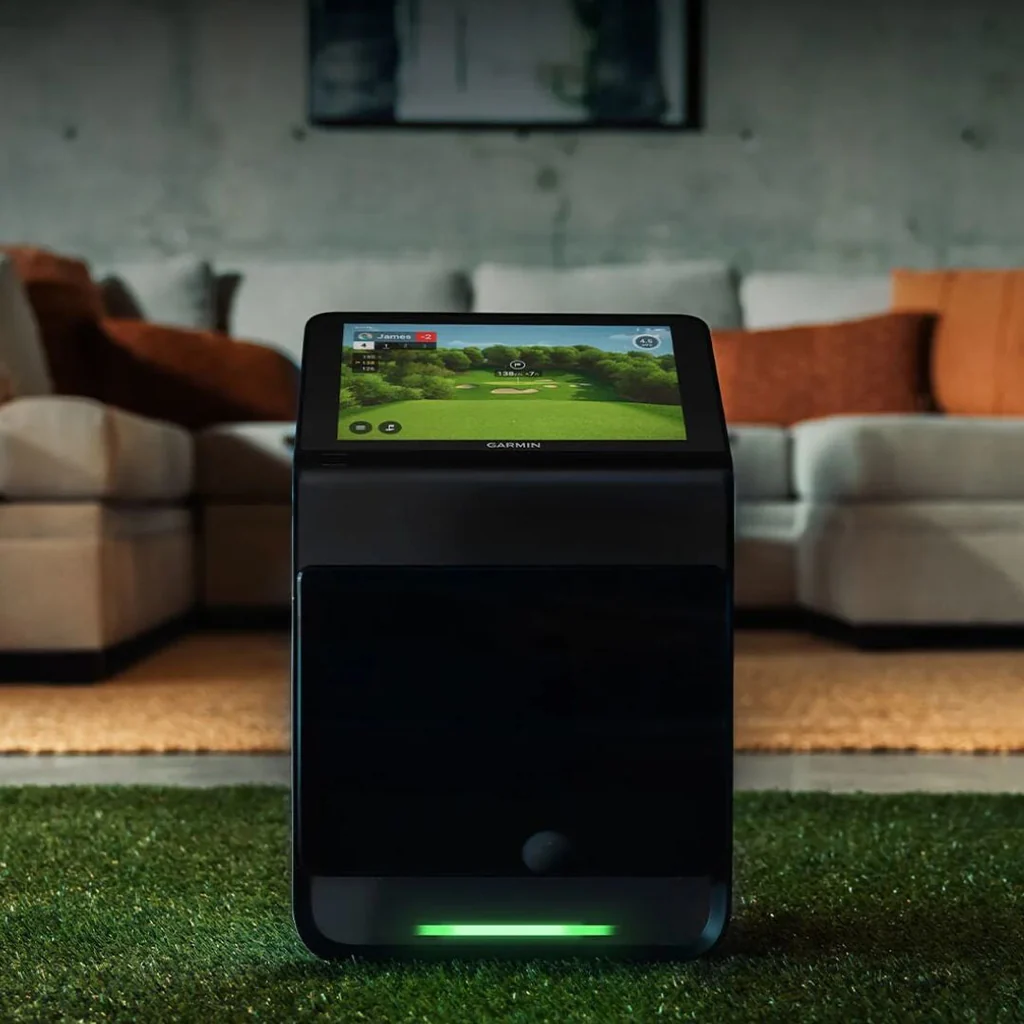
The simplest portable simulator that exists. Built-in computer, touchscreen, slow-motion replays, and native Garmin software in one unit. No phone, no tablet, no PC. If you hate tech setup, this is the answer.
Ideal for
- Players who want zero tech headaches
- Anyone upgrading from an R10 in the Garmin ecosystem
- Indoor and outdoor use without a separate display
Not ideal for
- Budget-conscious buyers (the R10 does most of it for $599)
- Golfers who already own a capable phone or tablet
3. Garmin Approach R10, the $599 portable that started it all
The Garmin R10 at $599 is the launch monitor that built the modern portable sim market in 2021. Five years later, it’s still the most popular budget portable because no other sub-$600 unit gives you this combination: native GSPro support, E6 Connect with 5 free courses, TGC 2019 compatibility, Home Tee Hero with 43,000+ courses, and a form factor the size of a deck of cards.
In testing, the R10 tracks driver carry within 3-5 yards of the Trackman 4 in properly sized spaces. Pair it with a basic net and mat for around $900-$1,100 total, the cheapest legitimate portable simulator setup you can build.
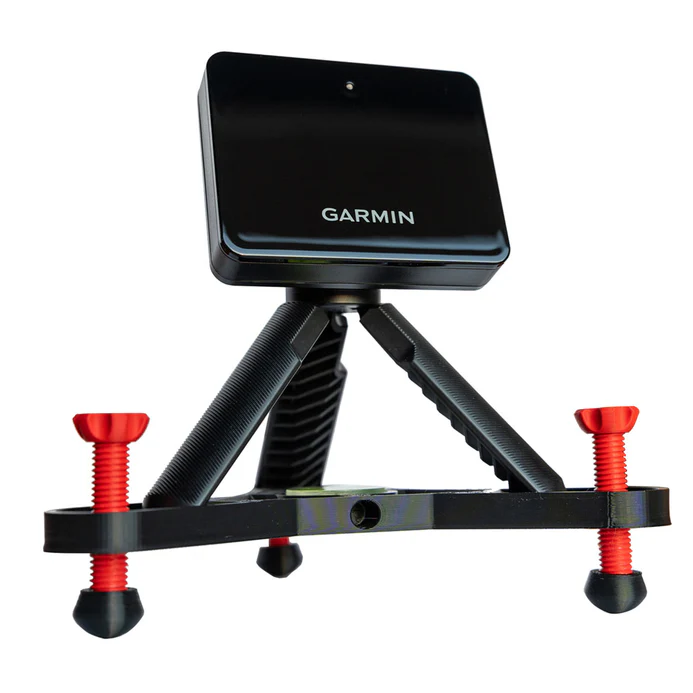
The R10 is still the launch monitor everyone else compares themselves to. Newer competitors beat it on individual features, but no other sub-$600 unit gives you this combination of native GSPro, software flexibility, and five years of proven reliability.
Built for
- First-time portable sim builders on a budget
- Garmin ecosystem users with watches and CT10 sensors
- Range sessions and net-based indoor practice
Not ideal for
- Tight indoor bays under 14 feet
- Players who need direct spin measurement
4. FlightScope Mevo Gen 2, the premium portable radar for serious data
The FlightScope Mevo Gen 2 at $2,499 is the premium portable pick for golfers who want the most accurate radar tracking in a bag-friendly form factor. It uses Fusion Tracking technology combining Doppler radar with image processing, measures 18+ data points, and comes with 12 E6 courses included at no extra cost. Double the battery life versus the old Mevo+, USB-C charging, and a larger radar array.
With the optional Pro and Face Impact packages (~$1,000 combined), it delivers data that competes with floor-mounted units three times its price. The trade-off: it needs 18+ feet of total room depth indoors.
5. Square Golf, the compact camera unit for tight indoor setups
The Square Golf at $699 is the portable pick for the golfer whose primary use is a compact indoor bay. It’s the only photometric launch monitor under $1,000, works in rooms as shallow as 10 feet of depth, and tracks putting, chipping, and full swings. It connects to GSPro, E6, and Awesome Golf with no annual subscription from Square itself.
The trade-off: Square is indoor-only. If you need outdoor range use, the MLM2PRO or R10 is the better choice.
6. Swing Caddie SC4 Pro, the screen-on-device portable for the range
The Swing Caddie SC4 Pro at $599 is the portable pick for golfers who want zero phone dependency. It has a built-in display that shows carry, ball speed, swing speed, and smash factor directly on the unit, plus voice output that calls your distance after every shot. A magnetic remote control lets you change clubs and modes without walking back to the device.
The SC4 Pro includes 5 free E6 Connect courses and connects to the VoiceCaddie S app for 3D range visualization.
The biggest mistake with portable setups is hitting off a thin rubber mat on concrete. It wrecks your wrists within weeks, especially on fat shots. Even for a portable bay, spend at least $200 on a mat with some give. Your joints will thank you in six months.
How we test portable golf simulators
Every unit runs the same 50-shot protocol against a Trackman 4 reference: 20 driver, 20 7-iron, 10 wedge. For portable units specifically, I also test setup time (from bag to first shot), battery life under continuous use, and outdoor accuracy at the range in full sunlight.
Testing protocol: 50 shots per unit (driver, 7-iron, wedge) measured against Trackman 4. Carry within 3 yards = pass. Setup under 2 minutes = pass. Battery life 3+ hours = pass.
What makes a golf simulator truly portable
A truly portable golf simulator meets four criteria: it fits in a golf bag side pocket, it sets up in under two minutes without tools, it works both indoors and outdoors without compromise, and it packs away completely when you’re done. Every unit on this list except the Square meets all four. The Square is indoor-only but still packs away in seconds.
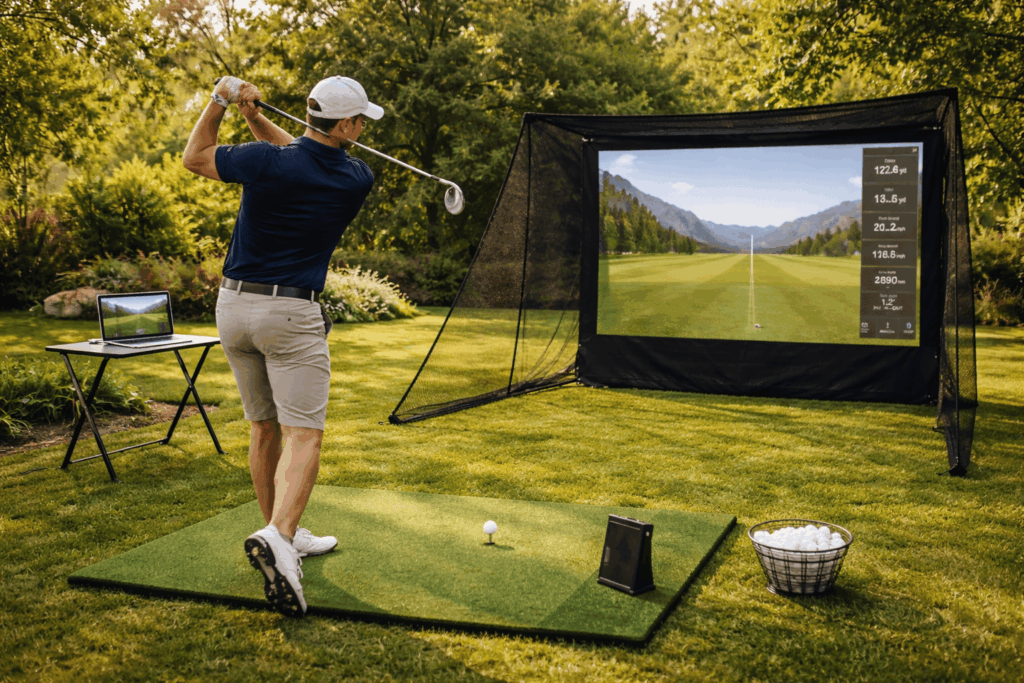
The other portability factor most guides ignore: what you’re hitting into. A portable launch monitor paired with a $300 collapsible net like The Net Return Pro V2 and a foldable mat gives you a complete bay that stores against a wall or in a closet. No permanent enclosure, no projector, no ceiling mount.
The community consensus on r/golfsimulator is consistent: the launch monitor is the engine, and it must be genuinely portable. If a unit is “portable” but weighs 20 lbs or needs 30 minutes of calibration, it’s not portable. Every unit on this list sets up in under 120 seconds from bag to first shot.
Portable golf simulator FAQ
What’s the best portable golf simulator for under $1,000?
The Rapsodo MLM2PRO at $699 is the best overall thanks to dual cameras, measured club data, swing video, and official GSPro support. The Garmin R10 at $599 is the best value if you want native GSPro and the widest software ecosystem at the lowest price. The Square Golf at $699 is the best indoor-only option for tight rooms.
Can you play full simulator courses on a portable setup?
Yes. Every unit on this list except the SC4 Pro connects to GSPro (4,000+ courses) or includes simulator courses natively. You view the course on your phone, tablet, or PC, not on a projected screen. It’s not as immersive as a permanent build, but the course play is real.
Do I need a net for a portable simulator?
Indoors, yes. Outdoors at the range, no, you just set the launch monitor behind you and hit balls normally. For a complete indoor portable bay, pair any of these units with a collapsible net ($150-$400) and a portable mat ($200-$500).
Which portable launch monitor is most accurate?
The Garmin R50 is the most accurate portable unit thanks to its three-camera system, followed by the Mevo Gen 2 with Fusion Tracking. Among sub-$1,000 units, the MLM2PRO edges the R10 on spin and club data.
Indoor or outdoor, which works better with portable sims?
Radar units (R10, Mevo Gen 2, SC4 Pro) perform best outdoors where the radar can see full ball flight. Camera-based units (Square) work best indoors in controlled lighting. The MLM2PRO handles both environments thanks to its dual camera-radar system.
The bottom line on portable golf simulators
The portable simulator market in 2026 is the best it’s ever been. The Rapsodo MLM2PRO at $699 gives you more data, more features, and more flexibility than devices that cost ten times as much just five years ago. For golfers who want zero tech setup, the Garmin R50 is a self-contained simulator in one unit. And for budget builders, the Garmin R10 at $599 is still the smartest entry point to portable sim golf.
If I were buying one portable launch monitor tomorrow, I’d pick the MLM2PRO for the swing video and club data, pair it with a Net Return net and a SIGPRO Lite mat, and practice anywhere. You can find the Rapsodo MLM2PRO directly on Rapsodo.