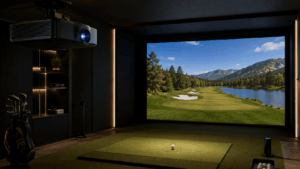
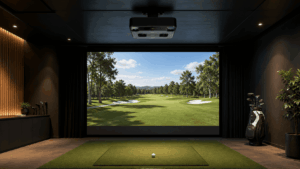
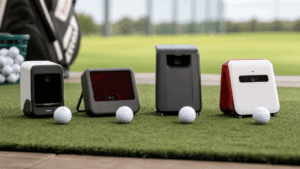
Indoor accuracy is a different game. A launch monitor that performs beautifully at the range can fall apart in a 12-foot basement because radar technology needs ball flight distance to calculate spin and trajectory. Indoors, the ball hits a screen or net within 6-8 feet. That’s why the best indoor launch monitors are overwhelmingly camera-based (photometric), they capture data at impact rather than tracking the ball in flight.
I’ve tested every unit on this list specifically in indoor bays ranging from 10 to 16 feet of depth, side-by-side with a Trackman 4 reference. The 50-shot protocol (driver, 7-iron, wedge) was run entirely indoors with controlled lighting. I scored on indoor carry accuracy, spin consistency in tight rooms, minimum room depth required, and short game tracking reliability.
The picks below cover every price tier from $699 to $14,000. Whether you’re building your first net setup in a spare bedroom or designing a permanent sim bay in your basement, each of these units is optimized for indoor use.
Our top picks at a glance
- Best overall: Foresight GC3, the indoor accuracy benchmark with lifetime software and zero GSPro bridge fees
- Best overhead: Uneekor EYE XO2, ceiling-mounted, sticker-free, seamless L/R switching with the largest hitting zone
- Best under $1,000: Square Golf, the only photometric unit under $1K that works in a 10-foot room
Side-by-side comparison
| # | Launch monitor | Score | Tech | Min room depth | Price |
|---|---|---|---|---|---|
| 1 | Foresight GC3 | 9.6 | Photometric (floor) | 10 ft | ~$7,000 |
| 2 | Uneekor EYE XO2 | 9.4 | Camera (overhead) | 12 ft | ~$11,000 |
| 3 | Bushnell Launch Pro | 9.1 | Photometric (floor) | 10 ft | $2,499 |
| 4 | Garmin Approach R50 | 8.8 | Camera (floor) | 10 ft | $4,999 |
| 5 | Square Golf | 8.5 | Camera (floor) | 10 ft | $699 |
| 6 | ProTee VX | 8.3 | Camera (overhead) | 12 ft | ~$5,500 |
Every unit on this list uses camera-based tracking. No pure radar units made the indoor list because photometric technology is consistently more accurate in enclosed spaces where the ball travels less than 8 feet before hitting a screen or net.
The 6 best indoor golf launch monitors in 2026
1. Foresight GC3, the indoor accuracy benchmark
The Foresight GC3 at ~$7,000 is the launch monitor I trust most for indoor use. Its three high-speed photometric cameras capture ball and club data at impact, which means it needs zero ball flight distance to read accurately. In a 10-foot room with a net 6 feet from impact, the GC3 reads carry within 1.5 yards of the Trackman 4 baseline. Spin tracks within 100 rpm. This is the same technology PGA Tour fitters use in their indoor bays.
For indoor builds specifically, the GC3’s advantage over radar competitors is measurable on every club. Wedge accuracy is where the gap becomes a canyon: radar units calculate spin from ball flight arc, and in a 10-foot room there’s barely any arc to measure. The GC3 reads spin directly from the ball surface at impact, which means your 60-degree lob wedge data is just as reliable as your driver data. For any golfer doing serious wedge gapping or short game practice indoors, this matters enormously.
The lifetime FSX software license and zero GSPro bridge fee make the five-year cost of ownership genuinely lower than the Bushnell Launch Pro despite the higher unit price. The GC3 connects natively to GSPro, E6, and TGC 2019. For a permanent indoor build, this is the investment that pays back over a decade.
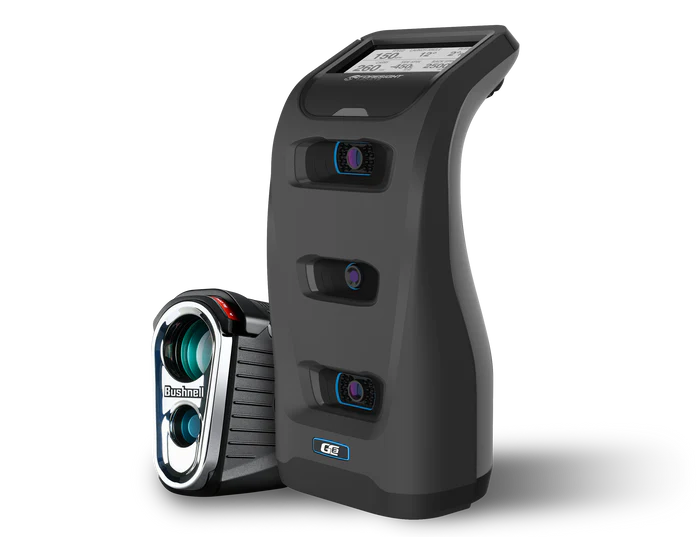
The GC3 is the launch monitor that makes indoor data trustworthy on every club from driver to lob wedge. Lifetime software, zero GSPro bridge fee, and accuracy that radar units cannot match in enclosed spaces. For a permanent indoor build, nothing else comes close.
Built for
- Permanent indoor sim rooms from 10 feet of depth
- Players who need reliable wedge and short game data
- Builders who value zero recurring software fees
Consider alternatives if
- Mixed L/R households (go overhead: EYE XO2 or ProTee VX)
- Budget is under $5,000 for the launch monitor
2. Uneekor EYE XO2, the best overhead for indoor builds
The Uneekor EYE XO2 at ~$11,000 is the best ceiling-mounted indoor launch monitor on the market. Three high-speed cameras track ball and club data from above with Dimple Optix technology that reads the ball surface directly. No stickers, no marked balls, no repositioning between players. Left-right switching is instant. In testing, carry accuracy tracks within 2 yards of the Trackman 4 on every club.
For indoor builds specifically, overhead mounting solves two problems that floor-mounted units create. First, the floor stays completely clean: no cables, no tripods, no unit to accidentally kick mid-swing. Second, short game tracking: the overhead cameras see putting and chipping reliably because they watch the ball from above, rather than trying to track a low-launch shot with radar from behind. The EYE XO2’s trouble mat compatibility (included rough and bunker mats) adds a training dimension no other indoor unit offers.
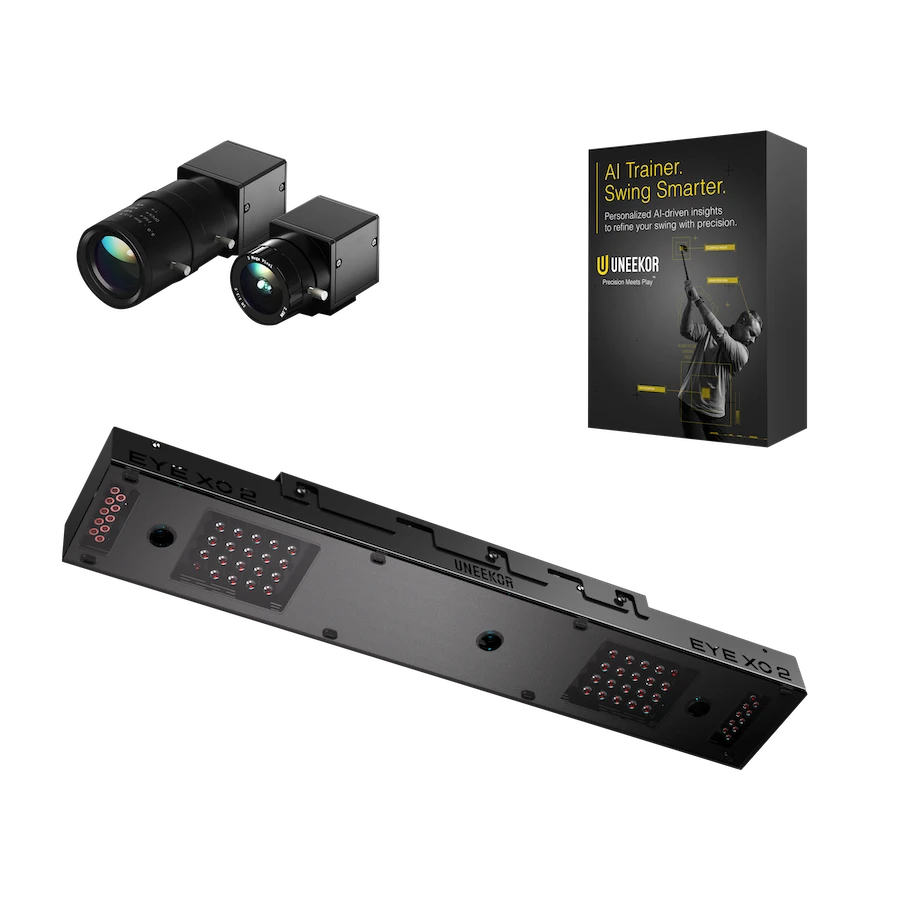
The EYE XO2 is the indoor overhead system that does everything: GCQuad-level accuracy, trouble mats, seamless L/R switching, and the largest hitting zone on the market. If your ceiling clears 9.5 feet and you want zero floor clutter, this is the build.
Ideal for
- Multi-player households with seamless L/R switching
- Basements with 9.5+ foot ceilings
- Players who want trouble mat lie simulation
Not ideal for
- Ceilings under 9.5 feet
- Renters who can’t ceiling-mount a $11K device
3. Bushnell Launch Pro, Foresight photometric at a lower unit price
The Bushnell Launch Pro at $2,499 uses the same three-camera photometric engine as the Foresight GC3 at roughly one-third the unit price. Because it sits beside the ball and captures data at impact, it works in indoor rooms as shallow as 10 feet with the same reliability as the GC3. For indoor builders on a mid-range budget, this is the most accurate launch monitor you can buy under $3,000.
The trade-off versus the GC3 is software: the Launch Pro requires an annual subscription ($299-$499/year for the Silver or Performance tier) to unlock full data and third-party software access. Over five years, the total cost approaches the GC3’s upfront price. But for a builder who wants Foresight-level indoor accuracy right now at $2,499, the Launch Pro delivers it.
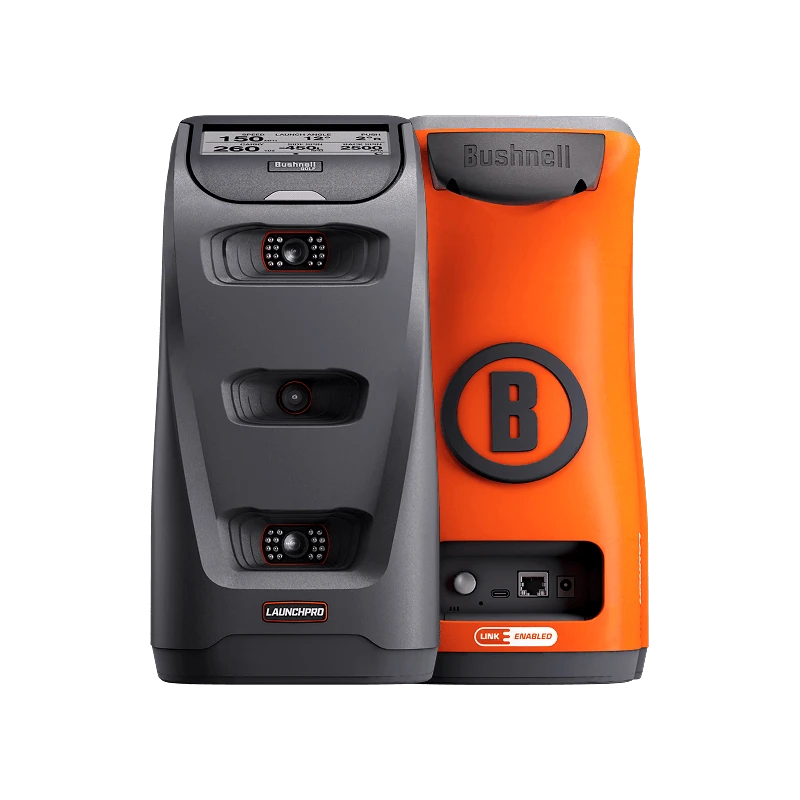
The Launch Pro is the best way to get Foresight-level indoor accuracy without the $7,000 upfront. Same three-camera engine, same 10-foot room compatibility. The annual subscription eventually catches up, but the entry price makes it the most accessible premium indoor option.
Built for
- Indoor builders who want Foresight accuracy under $3K
- Rooms from 10 feet of depth
- Players who prefer lower upfront cost over lower annual cost
Not ideal for
- Buyers who dislike annual subscriptions (go GC3 or Square)
- Mixed L/R households (go overhead)
4. Garmin Approach R50, the self-contained indoor all-in-one
The Garmin R50 at $4,999 is the simplest indoor launch monitor on the market. Its built-in 10-inch touchscreen computer runs simulation software directly, three high-speed cameras capture ball and club data at impact, and slow-motion replays display right on screen. No phone, no tablet, no PC needed. Set it beside the ball in any 10-foot room, press power, and you’re hitting simulated rounds in 60 seconds.
For indoor use, the R50’s camera-based tracking means it doesn’t need ball flight distance to read accurately. The built-in barometer adjusts for altitude, and impact video replay lets you see exactly how you’re striking each shot. It also connects to E6 Connect, GSPro, and Awesome Golf on external devices when you want a projected experience.
5. Square Golf, the only photometric under $1,000 for tight indoor rooms
The Square Golf at $699 is the indoor launch monitor that shouldn’t exist at this price. It uses photometric camera technology that captures ball data at impact, works in rooms as shallow as 10 feet of depth, and tracks putting, chipping, and full swings. It connects to GSPro, E6, and Awesome Golf with no annual subscription. For a tight basement or spare bedroom, this is the only sub-$1K unit that delivers camera-level indoor accuracy.
The trade-off: indoor-only, club marking stickers for full club data, L/R repositioning required, and an occasional missed shot (~1 in 10). But data quality on captured shots is excellent, and the putting tracking with adjustable green speeds is a genuinely unique feature that makes it the best short game practice tool under $1,000.
6. ProTee VX, the value overhead with built-in swing cameras
The ProTee VX at ~$5,500 is the most affordable ceiling-mounted indoor launch monitor on the market. It uses AI-driven high-speed cameras, includes built-in swing cameras for synchronized video replay, handles L/R switching without recalibration, and requires no stickers or marked balls. At roughly half the price of the EYE XO2, it delivers accuracy that competes with units twice its cost.
For indoor builds, the ProTee VX’s overhead mounting clears the floor completely and the built-in swing cameras provide a training tool no other overhead unit includes at this price. Owner feedback on customer service is consistently the strongest in the overhead category. The trade-off: no trouble mat compatibility, smaller hitting zone than the EYE XO2, and less brand recognition for resale value.
The number one indoor accuracy killer isn’t the launch monitor. It’s lighting. Camera-based units need consistent, diffused lighting to read the ball surface reliably. Direct sunlight from a window, flickering fluorescent tubes, or a single harsh overhead bulb will cause missed shots and inconsistent spin reads. Before blaming the device, check your lighting. Two or three diffused LED panels at 5000K positioned to eliminate shadows over the hitting zone will solve most accuracy complaints with any camera-based unit.
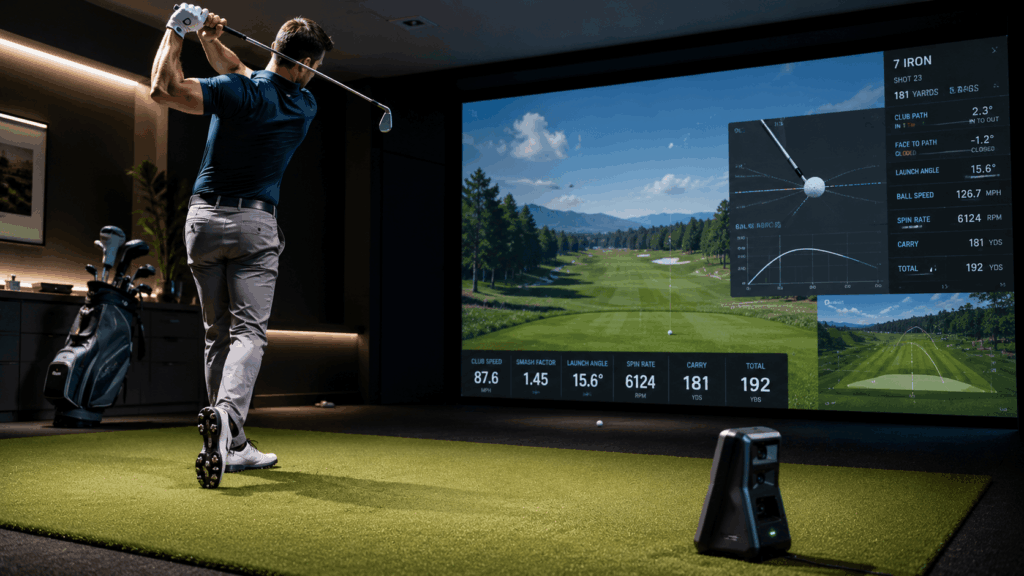
How we test launch monitors for indoor use
Every unit runs the same 50-shot protocol against a Trackman 4 reference: 20 driver, 20 7-iron, 10 wedge. All testing is done entirely indoors in bays ranging from 10 to 16 feet of depth with controlled LED lighting. I specifically score wedge and short-iron accuracy because that’s where radar units fall apart indoors and camera-based units prove their value.
Testing protocol: 50 shots per unit (driver, 7-iron, wedge) vs Trackman 4 in controlled indoor bays. Carry within 2 yards = pass (premium), within 4 yards = pass (budget). Spin within 200 rpm = pass. Wedge data scored separately.
Why camera-based units dominate indoors
Radar-based launch monitors like the Garmin R10 and FlightScope Mevo Gen 2 track the ball after it leaves the clubface using Doppler radio waves. They need to see the ball travel a meaningful distance to calculate spin, trajectory, and carry. In a typical indoor bay, the ball hits a screen or net 6-8 feet from impact. That’s not enough flight for radar to calculate spin reliably, which is why radar-derived spin numbers are notoriously inconsistent indoors.
Camera-based (photometric) launch monitors capture the ball and club at the moment of impact using high-speed cameras. They need zero ball flight distance to read accurately because all the data is extracted from the impact image. This fundamental advantage is why every unit on this indoor list uses cameras rather than radar. The GC3, Launch Pro, Square, R50, EYE XO2, and ProTee VX all read data at impact, making their indoor accuracy independent of room depth.
The community consensus on r/golfsimulator is unanimous on this point: for a dedicated indoor build, camera-based tracking is the only option that delivers reliable spin data. Radar units work fine indoors for carry distance and ball speed, but spin, club path, and launch angle data degrade significantly in enclosed spaces.
Indoor golf launch monitor FAQ
What’s the most accurate indoor launch monitor?
The Foresight GC3 is the most accurate indoor launch monitor on the market. Its three-camera photometric system reads carry within 1.5 yards and spin within 100 rpm of a Trackman 4 baseline in indoor bays as shallow as 10 feet. The Bushnell Launch Pro uses the same engine at a lower unit price.
Can radar launch monitors work indoors?
Radar units like the Garmin R10 and FlightScope Mevo Gen 2 can work indoors for carry distance and ball speed, but spin data degrades significantly in enclosed spaces where the ball travels less than 8 feet before hitting a net or screen. For dedicated indoor builds, camera-based units are universally preferred.
What’s the minimum room size for an indoor launch monitor?
Camera-based floor units (GC3, Launch Pro, R50, Square) work in rooms as small as 10 feet deep, 10 feet wide, and 9 feet tall. Overhead units (EYE XO2, ProTee VX) need 12 feet of depth and 9.5+ foot ceilings. Measure your room before buying.
Do I need special lighting for indoor use?
Yes. Camera-based units need consistent, diffused LED lighting at 5000K over the hitting zone. Direct sunlight, fluorescent flicker, and harsh single-point lighting cause missed shots and inconsistent data. Budget $100-$200 for two or three diffused LED panels.
Floor-mounted or overhead for indoor use?
Floor-mounted (GC3, Launch Pro, R50, Square) for simplicity, portability, and lower ceilings. Overhead (EYE XO2, ProTee VX) for clean floors, seamless L/R switching, and superior short game tracking. If your ceiling is 9.5+ feet and multiple people use the bay, go overhead.
The bottom line on indoor golf launch monitors
Indoor accuracy is a solved problem in 2026. The Foresight GC3 delivers tour-level data in any 10-foot room for $7,000 with lifetime software. The Uneekor EYE XO2 does the same from the ceiling with trouble mats and seamless L/R switching. And the Square Golf at $699 proves you don’t need to spend $2,000+ to get camera-based indoor accuracy with putting tracking. The technology gap between indoor and outdoor launch monitors has closed, and camera-based units are the reason.
If I were building a dedicated indoor sim room today, I’d choose the GC3 for single-player accuracy or the EYE XO2 for a multi-player household. For a first indoor setup on a tight budget, the Square Golf at $699 is the smartest entry point. You can find the Foresight GC3 directly on Foresightsports.