For 90% of home golf simulator builds, a short throw projector (0.5-0.89 throw ratio) ceiling-mounted behind the hitting zone is the right answer. Ultra short throw (under 0.5) solves a real problem – rooms too shallow for a ceiling-mounted short throw – but it introduces complications most buyers don’t anticipate: extreme sensitivity to screen imperfections, mandatory floor-mount protection, and a fixed throw ratio with no zoom flexibility.
I’ve installed both types in client builds, and the pattern is consistent. Short throw is the default for a reason. UST is a specialist tool for tight spaces that works brilliantly when it’s needed and creates unnecessary hassle when it’s not. The choice comes down to one number: how deep is your room from screen to back wall. If you have 15+ feet, short throw wins. If you’re under 13 feet, UST may be your only option.
The quick answer: Short throw (0.5-0.89 ratio) is the standard for golf sims. Ceiling-mounted, 6-9 feet from the screen, works in rooms 15+ feet deep. Ultra short throw (under 0.5 ratio) sits 4-5.5 feet from the screen, typically floor-mounted. Required for rooms under 13 feet deep. More expensive, more sensitive to screen quality, and needs a protective enclosure. Most buyers should default to short throw.
How short throw projectors work in a golf simulator
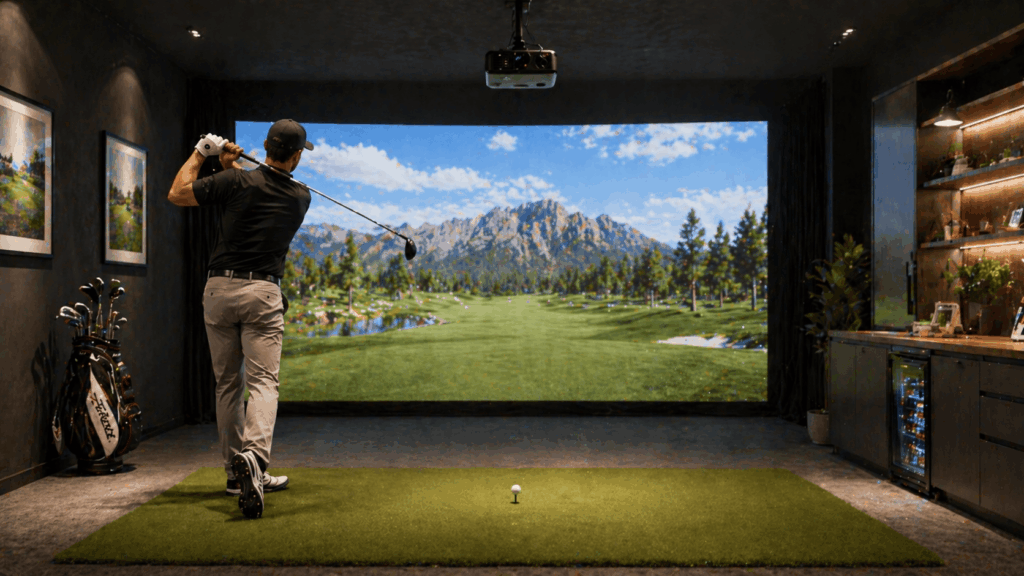
A short throw projector with a throw ratio between 0.5 and 0.89 fills a 10-foot-wide screen from 5-9 feet away. In a golf simulator, it typically mounts to the ceiling above and behind the hitting position, projecting forward and slightly downward onto the impact screen. The light cone passes above the golfer’s head, so the golfer’s body doesn’t cast a shadow on the screen during the swing.
This is the most common projector category in home simulator builds because the geometry works naturally in most residential spaces. A 16-18 foot deep room gives you 8-10 feet from screen to tee, 2-4 feet behind the tee for backswing, and 6-8 feet of throw distance for the projector – all within a short throw projector’s operating range.
Most short throw models include a zoom lens with a variable throw ratio, which is an enormous practical advantage. The BenQ TK710STi at 0.69-0.83 fills a 10-foot screen from anywhere between 6.9 and 8.3 feet. That 1.4-foot window of flexibility means you don’t need to drill the ceiling mount in precisely the perfect spot – you have room to fine-tune position after mounting. The BenQ AK700ST has the same 0.69-0.83 range with motorized zoom, so you adjust from the remote rather than climbing a ladder.
Short throw models also offer the widest selection of resolutions, brightness levels, and price points. Budget 1080p options start around $700 (BenQ TH671ST). Mid-tier 4K models run $1,500-$2,200 (BenQ TK710STi, BenQ AK700ST). Premium 4K laser models hit $3,500-$4,000 (BenQ LK936ST at 5,100 lumens). There’s a short throw projector at every budget tier.
How ultra short throw projectors work in a golf simulator
An ultra short throw projector with a throw ratio under 0.5 fills a 10-foot-wide screen from just 4-5.5 feet away. At a 0.496 throw ratio, a 10-foot screen needs only 4.96 feet of throw distance. That’s roughly half the distance a short throw model requires, which is why UST exists as a category – it solves rooms that simply don’t have the depth for anything else.
UST projectors in golf simulators are typically floor-mounted inside a protective enclosure at or near the base of the impact screen, projecting upward at a steep angle. Some builders also mount them on a low shelf or inside the simulator frame. The projector sits very close to the screen surface, which eliminates shadow issues entirely – the golfer is so far behind the light source that their body never intersects the projection cone.
The BenQ LK830ST ($3,799) at 0.496 throw ratio is the only current 4K UST option genuinely designed for golf simulator use. It fills a 12-foot screen from under 6 feet, features IP6X sealed optics (the highest dust protection rating in the BenQ golf lineup), and has a 114% low projection offset for clean floor-mount installations. The Optoma GT2100HDR ($1,099-$1,199) at 0.496 throw ratio is the budget alternative in 1080p with 4,200 lumens and a 30,000-hour laser lifespan.
The critical limitation: most UST models have fixed throw ratios with no zoom lens. The BenQ LK830ST is fixed at 0.496. That means the projector must sit at precisely the right distance from the screen – there’s no flexibility to adjust. If your mounting position is 6 inches too close or too far, the image either doesn’t fill the screen or overflows the edges, and you have to physically move the projector to fix it.
Screen sensitivity: the UST problem nobody mentions enough
This is the single biggest practical difference between the two types, and it’s the one that catches builders off guard. Ultra short throw projectors magnify every imperfection in the impact screen surface because the projection angle is so extreme.
A short throw projector mounted 7-8 feet from the screen projects at a relatively gentle angle. Minor wrinkles, slight sag, and small tension variations in the impact screen surface are barely noticeable in the projected image. You can get away with a screen that’s 95% flat.
A UST projector sitting 4-5 feet from the screen projects at a steep upward angle where even millimeters of screen surface variation produce visible distortion. A slight wave in the center of the screen becomes a warped fairway. A small droop at the top edge becomes a curved horizon line. The screen needs to be essentially perfectly flat and evenly tensioned, which means either a high-quality factory-tensioned screen or obsessive DIY attention to screen mounting.
Impact screens take hits from golf balls at 100-170 mph and stretch over time. Every screen develops surface imperfections through normal use. On a short throw setup, you don’t notice. On a UST setup, every dent and stretch mark shows up in the projected image. This is a long-term maintenance headache that short throw users simply don’t deal with.
I installed a UST projector in a client’s 13-foot basement last year – it was the only option that fit the depth. The image looked stunning on day one. After 500 ball strikes, the impact screen developed a slight wave in the center that was invisible to the eye but produced a noticeable ripple in the projected image. Re-tensioning the screen fixed it. A short throw setup in the same room would have never shown the imperfection. UST demands better screen maintenance – that’s the trade-off.
Mounting and protection: the practical differences
Short throw ceiling mounting is the simplest installation in the projector world. Universal ceiling mount ($30-$80), lag bolts into a structural joist, HDMI and power routed through ceiling conduit. The projector hangs above and behind the golfer, completely out of the ball flight path and swing zone. No protection cage needed. No risk of a golf ball hitting the unit unless you routinely sky your driver straight up.
UST floor mounting puts the projector in or near the ball flight zone, which means physical protection is mandatory, not optional. A floor-mounted UST projector sitting 4-5 feet from the impact screen is directly in the path of ball rebounds off the screen. A protective enclosure cage ($100-$300) is non-negotiable, and it needs to be robust enough to stop a golf ball traveling at 50+ mph on the rebound. Some builders integrate the projector inside the simulator enclosure frame itself, which adds complexity but provides the cleanest protection.
Cable management differs too. A ceiling-mounted short throw needs a 15-25 foot HDMI run from the PC on the floor to the projector on the ceiling – active or fiber optic HDMI at $30-$60 to maintain 4K signal quality. A floor-mounted UST needs only a 5-10 foot run, which means a standard passive HDMI cable works fine. One small practical win for UST.
When to choose short throw (most builders)
Choose short throw if your room is 15 feet or deeper from screen to back wall. This covers the vast majority of garages (20+ feet), basements (20-30 feet), and dedicated rooms. Short throw gives you zoom flexibility, the widest model selection, ceiling mounting simplicity, and tolerance for screen imperfections. It’s the default for a reason.
Specific scenarios where short throw is clearly better: rooms with 9-10 foot ceilings (ideal for ceiling mounting at screen-top height), rooms where the setup might double as a home theater (ceiling-mounted projector serves both uses), and builds where you want set-and-forget installation without ongoing screen maintenance concerns.
The best short throw options for 2026: BenQ TK710STi (~$1,500) for the best 4K value with manual zoom. BenQ AK700ST (~$2,200) for motorized zoom, Auto Screen Fit, and Golf Mode color calibration. BenQ LK936ST ($3,500-$4,000) for 5,100 lumens in bright rooms. Optoma GT2100HDR ($1,099-$1,199) for the tightest short-throw ratio (0.496) at a budget price in 1080p.
When to choose ultra short throw (tight rooms only)
Choose UST only if your room is under 13 feet deep from screen to back wall, which makes ceiling-mounted short throw geometrically impossible without the projector sitting in or near the swing zone. This includes some single-car garages, shallow basement alcoves, and repurposed closets or small rooms.
UST also makes sense for very high ceiling rooms (12+ feet) where a ceiling mount would place the projector too far above the screen for proper image alignment, and for portable or retractable builds where a floor-mounted UST can be stored and redeployed more easily than a ceiling-mounted unit.
The best UST options for 2026: BenQ LK830ST ($3,799) for the only 4K UST with IP6X sealing and golf-ready specifications. Optoma GT2400HDR ($1,299) for 4,200 lumens at 0.496 throw ratio in 1080p. Both require floor-mount protection and a high-quality, perfectly flat impact screen.
Side-by-side comparison
| Factor | Short Throw (0.5-0.89) | Ultra Short Throw (<0.5) |
|---|---|---|
| Distance to 10ft screen | 5-9 feet | 4-5.5 feet |
| Mounting | Ceiling (standard) | Floor or low shelf |
| Zoom lens | Yes (most models) | No (fixed ratio) |
| Screen sensitivity | Tolerant of minor imperfections | Magnifies every wrinkle/wave |
| Ball protection needed | No (ceiling-mounted) | Yes (mandatory enclosure) |
| Shadow risk | Low (proper placement) | Very low |
| Minimum room depth | 15 feet | 12-13 feet |
| Model selection | Wide ($700-$4,000) | Limited ($1,100-$3,800) |
| Best for | Most home builds | Tight rooms under 13ft depth |
Frequently asked questions
What throw ratio do I need for a golf simulator?
For most home builds, 0.5 to 0.89 (short throw) is the standard range. This lets you ceiling-mount the projector 6-9 feet from a 10-foot screen, behind the golfer, with no shadow issues. Only go below 0.5 (ultra short throw) if your room is under 13 feet deep and a ceiling-mounted short throw won’t fit.
Can I use an ultra short throw projector for a golf simulator?
Yes, but with conditions. UST requires a perfectly flat, high-quality impact screen, a protective floor-mount enclosure, and precise placement since there’s no zoom flexibility. It works well in rooms too shallow for short throw. It creates unnecessary complexity in rooms where short throw fits.
Will an ultra short throw projector get hit by golf balls?
If floor-mounted near the impact screen, yes – ball rebounds are a real risk. A protective enclosure cage ($100-$300) is mandatory for any floor-mounted projector in a golf simulator. Some builders integrate the projector inside the simulator enclosure frame to avoid this issue entirely.
Is a short throw or ultra short throw projector better for image quality?
At equivalent specs (same resolution, same lumens), image quality is comparable. The difference is that UST magnifies screen imperfections that short throw hides. On a perfectly flat screen, both look excellent. On a screen with normal wear from ball impacts, short throw produces a noticeably cleaner image over time.
What’s the best short throw projector for a golf simulator in 2026?
The BenQ AK700ST (~$2,200) is the current consensus pick for most home builds: 4K laser, 4,000 lumens, Golf Mode, Auto Screen Fit, motorized zoom, IP5X dust sealing. The BenQ TK710STi (~$1,500) delivers the same throw geometry at a lower price with manual controls. The Optoma GT2100HDR ($1,099-$1,199) is the budget value pick in 1080p.
In summary: depth determines the answer
The short throw vs ultra short throw decision is simpler than most guides make it. Measure your room depth from the screen wall to the back wall. If it’s 15 feet or more, short throw ceiling-mounted is the answer – more model choices, zoom flexibility, easier installation, and tolerance for screen wear. If it’s under 13 feet, UST floor-mounted may be your only viable path – more expensive, more sensitive, but it fits where nothing else can.
The 13-15 foot gray zone is where the decision gets genuinely interesting. In this range, the tightest short throw models (Optoma GT2100HDR at 0.496, BenQ TK710STi at 0.69 minimum) can sometimes squeeze into a ceiling mount that barely clears the golfer’s swing zone. Run the math, do the shadow test with a temporary mount, and decide based on whether short throw geometry actually works before committing to the added complexity of UST.
One angle the throw-ratio conversation misses: screen quality should match projector type. If you’re going UST, invest in a premium factory-tensioned screen with consistent flatness. If you’re going short throw, a mid-tier screen with reasonable tension works fine. The screen budget should scale with the projector’s sensitivity to surface imperfections – a $300 screen paired with a $3,800 UST projector is a mismatch that will frustrate you for years.
The most common projector regret I see: builders who bought UST because it seemed “more advanced” for a 20-foot room that would have worked perfectly with a $1,500 short throw ceiling mount. They spent $3,800 on the projector, $200 on a protective cage, and deal with screen re-tensioning every few months. Meanwhile their neighbor with a TK710STi ceiling-mounted in 15 minutes hasn’t thought about their projector once in two years. Buy the simpler solution when the simpler solution fits.