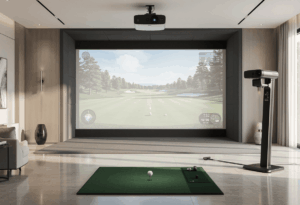
Every golf launch monitor does the same fundamental thing: it captures what happens at the moment of impact and converts that raw data into ball flight, distance, and spin numbers. How it captures that data is where the two technologies split. Camera-based (photometric) systems photograph the ball and club at impact using high-speed cameras running at thousands of frames per second. Radar-based (Doppler) systems emit radio waves that bounce off the ball in flight and measure the frequency shift to calculate speed, trajectory, and spin.
Understanding the difference isn’t academic. It determines which launch monitor works in your specific space, which one delivers reliable indoor data, and where each technology falls short. I’ve tested every major unit against my Trackman 4 baseline, and the technology choice matters far more than most buyers realize – especially indoors, where one approach genuinely outperforms the other.
The two technologies at a glance: Camera (photometric) systems photograph the ball at impact. They excel indoors, need less depth, and measure spin directly from the ball’s surface. Radar (Doppler) systems track the ball in flight using radio waves. They excel outdoors, need 18-20 feet of depth, and measure the full ball trajectory. Both achieve accuracy within 1 mph of ball speed, 1 degree of launch angle, and 200-250 RPM of spin on premium units.
How camera-based launch monitors work
A photometric launch monitor uses one to four high-speed cameras to photograph the ball and club in the few inches before, during, and after impact. The impact itself lasts roughly 0.0005 seconds – half a millisecond – and the cameras need to capture enough images within that window to calculate everything about the shot. The Foresight GCQuad runs four cameras at up to 10,000 frames per second. The Uneekor EYE XO2 uses multiple cameras combined with infrared tracking from an overhead position.
From those images, the system’s algorithms calculate ball speed, launch angle, spin rate, spin axis, and side angle based on how the ball moves and rotates across the captured frames. Club data – face angle, club path, attack angle, impact location on the clubface – comes from tracking the clubhead through the same image sequence. Some units like the Foresight GC3 require reflective stickers on the clubface for full club data. Others like the Uneekor systems read the club without stickers.
The critical detail: camera systems measure data at the point of impact, then calculate the rest of the ball flight using physics algorithms. They don’t need to see the ball travel 200 yards. They need to see it travel a few inches. This is why photometric systems dominate indoor simulators – they work identically whether the ball hits a screen 10 feet away or flies 250 yards on an outdoor range.
The trade-off is environmental sensitivity. Camera systems need consistent lighting in the hitting zone, a contrasting background behind the ball (avoid white walls), and precise placement relative to the ball. If the camera can’t see the ball clearly at impact, the shot doesn’t register. Direct sunlight, shadows, or flickering lighting all degrade data quality.
How radar-based launch monitors work
A radar launch monitor uses Doppler radar technology – the same fundamental science behind weather radar, speed guns, and military missile tracking. The unit continuously emits radio waves at a fixed frequency. When those waves hit the moving golf ball, they bounce back at a slightly different frequency. The difference between the emitted and returned frequency – the Doppler shift – tells the system exactly how fast the ball is moving, in which direction, and how it’s spinning.
Trackman 4, the gold standard of radar launch monitors, uses dual radar: one tracking the club, one tracking the ball. The club-tracking radar captures club speed, path, face angle, and attack angle by measuring the Doppler shift off the metallic clubhead. The ball-tracking radar follows the ball’s trajectory from launch through the full flight arc, measuring real ball flight rather than calculating it from impact data. This is why Trackman was adopted on the PGA Tour before any camera system – it tracks the actual trajectory, not a modeled one.
The critical advantage outdoors: radar systems track the ball over its entire flight, which means carry distance, total distance, apex height, and landing angle are all directly measured rather than calculated. On a driving range or outdoor practice facility where the ball can fly freely, this produces the most complete and accurate picture of what a shot actually does.
The critical weakness indoors: the ball hits a screen 10 feet after impact, giving the radar a fraction of a second of real flight data to work with. The system has to extrapolate the remaining 200+ yards of trajectory from that tiny sample. Modern radar algorithms do this impressively well, but it’s prediction, not measurement. Camera systems measuring directly at impact don’t have this limitation indoors, which is why the community consensus for indoor use favors photometric technology.
Radar units also need more room depth than camera systems. The Garmin R10 sits 6-8 feet behind the golfer and needs 18+ feet of total room depth. The FlightScope Mevo+ has similar requirements. In basements, concrete walls reflect radar signals and metal ductwork scatters them, introducing interference that camera systems simply don’t experience.
The simplest way I explain the difference to clients: a camera system is like a photographer taking a picture at the moment of impact and calculating what the ball will do from that snapshot. A radar system is like a traffic cop pointing a speed gun at the ball and tracking it as it flies. The photographer works the same whether the ball travels 10 feet or 200 yards. The traffic cop needs distance to get an accurate reading. That’s why cameras win indoors and radar wins outdoors.
Hybrid systems: the best of both
Several newer launch monitors combine camera and radar technology in a single unit to leverage the strengths of each approach. The Trackman iO fuses radar, infrared, and high-speed imaging into a ceiling-mounted system designed specifically for indoor use. The SkyTrak+ uses photometric cameras for impact data alongside radar-enhanced tracking. The Rapsodo MLM2PRO pairs radar with smartphone camera integration.
The hybrid approach tries to solve a specific problem: getting indoor camera-level precision at impact with radar-level ball flight tracking. The Trackman iO achieves this most successfully – it’s the only Trackman product that works in rooms shorter than 18 feet because it doesn’t rely solely on long-range radar tracking. It uses the camera and infrared data to compensate for the limited radar flight distance indoors.
Hybrid systems are increasingly common in the mid-tier price range. As the component cost of adding a secondary sensor drops, more manufacturers are combining technologies rather than choosing one. This trend will likely continue, and the pure-radar or pure-camera distinction may matter less in future product generations.
What data each technology actually measures vs. calculates
This distinction matters more than most buyers realize. Measured data is captured directly by the sensor. Calculated data is derived from the measured data using algorithms. Measured data is inherently more reliable. Calculated data is only as good as the algorithm.
Camera systems directly measure: ball speed, launch angle, backspin, sidespin, spin axis, clubhead speed (with stickers or advanced imaging), face angle, club path. They calculate: carry distance, total distance, apex height, landing angle – all derived from the measured impact data using ball flight algorithms.
Radar systems directly measure: ball speed, launch angle, carry distance (outdoors), total distance (outdoors), apex height, ball trajectory, clubhead speed. They calculate: spin rate and spin axis indoors (derived from the limited flight data available before the ball hits the screen), face angle and club path (on units with club-tracking radar like Trackman).
The practical takeaway: camera systems measure spin directly and calculate distance. Radar systems measure distance directly (outdoors) and calculate spin (indoors). For an indoor simulator where you care about spin data for club gapping and shot shaping, camera systems deliver more reliable spin numbers because they measure spin rather than derive it.
Which technology is better for indoor simulators
Camera-based, and the community consensus is essentially unanimous on this point. The r/golfsimulator and GolfWRX communities overwhelmingly recommend photometric systems for indoor builds, and the reasoning is straightforward.
Camera systems don’t need ball flight distance. They capture everything at impact, so a 10-foot screen distance produces the same data quality as a 200-yard outdoor flight. Radar systems lose accuracy indoors because they’re extrapolating the full flight from a fraction of a second of data.
Camera systems need less room depth. A Bushnell Launch Pro works in 15 feet of total depth. A Garmin R10 needs 18-20 feet. In most basements and garages, that 3-5 foot difference determines whether the build is possible at all.
Camera systems aren’t affected by room materials. Concrete walls, metal ductwork, steel beams – all of these scatter or reflect radar signals. Camera systems photograph the ball with light, and concrete and metal don’t interfere with photography.
The one indoor scenario where radar adds value: the Trackman iO’s hybrid approach, which uses radar alongside camera and infrared to achieve ceiling-mounted tracking that doesn’t require any sensor near the ball. This is a genuine engineering achievement, but at $13,995 it’s a premium solution. At every other price point, pure camera-based systems deliver better indoor accuracy per dollar.
Which technology is better outdoors
Radar, and it’s not close for full ball flight tracking on a driving range. A Trackman 4 or FlightScope Mevo+ tracking the actual trajectory of a ball from launch to landing provides data that no camera system can match outdoors – because the camera system never sees the ball after the first few inches of flight.
Camera systems work outdoors, but they calculate outdoor carry and total distance from impact data. The calculations are good – within 2-3 yards on premium units – but they’re calculations, not measurements. If you need verified carry numbers for on-course club selection, a radar system tracking the real flight is the definitive answer.
Most home simulator buyers don’t need outdoor performance. If you’re building an indoor sim and occasionally want to take the unit to the range, a photometric system with outdoor capability (like the Foresight GC3 or SkyTrak+) gives you 95% of the value. The 5% you’re missing is real-time trajectory tracking, which matters for professional fitters and tour coaches but rarely affects a home golfer’s practice quality.
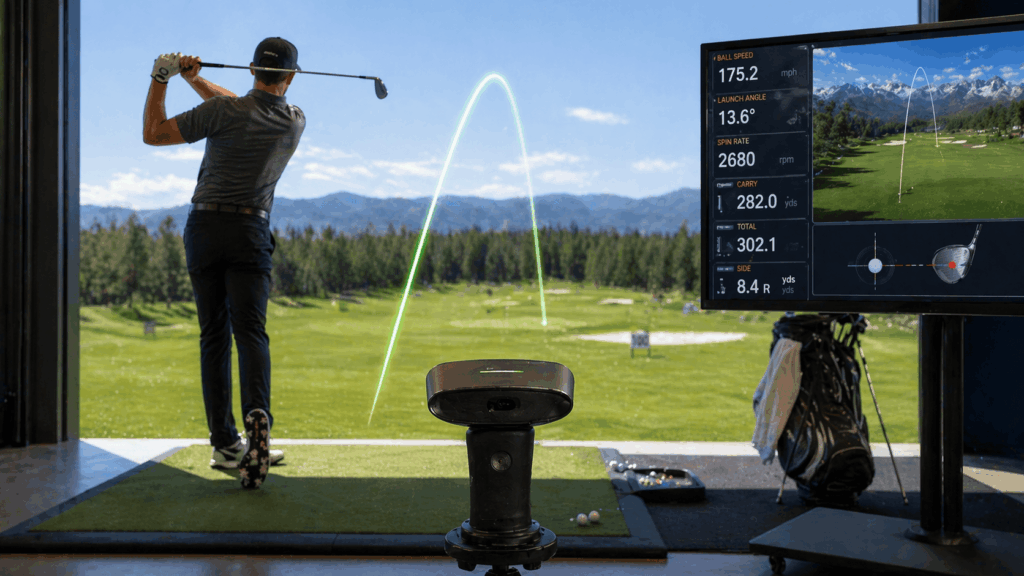
Which launch monitors use which technology
Knowing the technology helps you understand why certain units work better in certain environments. Here’s the current landscape.
Camera (photometric): Foresight GC3, Foresight GCQuad, Foresight QuadMax, Bushnell Launch Pro, Uneekor EYE XO, Uneekor EYE XO2, Uneekor EYE MINI, ProTee VX. These are the community favorites for indoor simulator builds because of their direct spin measurement and compact space requirements.
Radar (Doppler): Trackman 4, Garmin Approach R10, FlightScope Mevo Gen 2. These units shine outdoors and on driving ranges. The R10 is the most popular budget option; the Trackman 4 is the professional standard.
Hybrid (camera + radar): Trackman iO (radar + infrared + imaging), SkyTrak+ (photometric + radar enhancement), Rapsodo MLM2PRO (radar + smartphone camera). The Trackman iO is the most sophisticated hybrid system, designed specifically for indoor use with no minimum depth requirements.
Frequently asked questions
How accurate are golf launch monitors?
Premium units (Trackman 4, GCQuad, EYE XO2) deliver accuracy within 1 mph of ball speed, 1 degree of launch angle, and 200-250 RPM of spin rate. Mid-tier units (Bushnell Launch Pro, SkyTrak+) are within 1-2 mph and 200-400 RPM. Budget units (Garmin R10) are less consistent on indoor spin data because they calculate rather than measure spin.
Do I need special golf balls for a launch monitor?
Most camera systems read standard golf ball markings and don’t require special balls. However, Trackman offers RCT (Radar Capture Technology) balls designed with metallic markings that improve indoor radar spin measurement. Callaway’s RPT balls offer similar functionality. Standard premium balls work fine for camera-based units.
Can launch monitors track putting?
Yes, but with limitations. Camera systems like the GCQuad and ProTee VX have dedicated putting analysis modes that track face angle, path, speed, and impact point. Radar units struggle with putting because the ball moves too slowly for reliable Doppler tracking. Neither technology replicates real green reading, slope, or grain.
Why do camera launch monitors need stickers on the clubface?
Some photometric units (Foresight GC3, Bushnell Launch Pro) use reflective stickers to track the clubface through impact. The cameras photograph the sticker positions across multiple frames to calculate face angle, club path, and attack angle. Without stickers, these units still track ball data accurately but lose club data. Uneekor systems use infrared tracking to read the club without stickers.
Which is better for a home simulator, camera or radar?
Camera-based systems are better for indoor simulator use by a significant margin. They measure spin directly at impact (radar calculates it indoors), they work in shorter rooms (15 feet vs 18-20 feet), and they aren’t affected by room materials like concrete and metal. For indoor-only builds, camera is the clear choice at every price point except the Trackman iO’s $13,995 hybrid tier.
In summary: the technology choice is really about where you play
The camera vs. radar question has a clean answer once you know your primary use case. Building an indoor simulator? Camera-based. Using it primarily outdoors on the range? Radar. Need both? Look at hybrid units or accept that a camera system’s outdoor calculations are good enough for most golfers – because they are.
One angle most technology explainers miss: the distinction between measured and calculated data matters more than the brand name on the box. A mid-tier camera system that directly measures spin (like the Bushnell Launch Pro at $2,499) produces more reliable indoor spin data than a premium radar system that calculates spin indoors (like the Trackman 4 at $21,495+). You’re not buying accuracy by spending more. You’re buying the right measurement method for your environment.
The technology is converging. Hybrid systems that combine camera and radar are becoming more common, and the pure-technology distinction will matter less with each product generation. For now, though, the practical advice hasn’t changed: if you’re building indoors, buy camera-based. If you’re training outdoors, buy radar. If you’re doing both, a quality photometric system with outdoor capability covers 95% of what you need.
Every year I get at least one client who buys a Garmin R10 for their 14-foot basement because it was $499 and the Bushnell Launch Pro was $2,499. Then they discover the R10’s indoor spin data is unreliable because it’s calculating spin from a fraction of a second of radar data rather than measuring it from an image. They end up buying the Launch Pro anyway. The $499 they “saved” became a $499 lesson in why technology type matters more than price when you’re building indoors.