The Trackman iO starts at $13,995 for the indoor-only ceiling-mounted unit, and the Trackman 4 starts at roughly $21,495-$24,950 for the indoor/outdoor dual-radar flagship. Those are the launch monitor prices alone. A complete Trackman home simulator build, with enclosure, projector, screen, mat, PC, and installation, lands between $25,000 and $55,000+ depending on how premium you go.
I’ve fitted Trackman setups for tour-adjacent clients and pure-hobbyist private rooms, and the same pattern shows up every time: the headline launch monitor price is roughly half the real five-year cost. Subscription fees, room build, and installation are where most buyers get surprised. This guide breaks all of it down with current 2026 pricing – no fluff, no salesman framing.
The quick answer: Trackman iO unit alone $13,995. Trackman 4 unit alone $21,495-$24,950. Complete iO home build $25,000-$35,000. Complete Trackman 4 build $35,000-$55,000+. Annual TPS subscription $1,100 after year one. Commercial installs run $50,000-$100,000+.
Trackman iO vs. Trackman 4: which one and what it costs
Trackman sells two launch monitors today, and they’re aimed at completely different buyers. Picking the right one is the first cost decision you make.
The Trackman iO is $13,995 direct from Trackman or through retailers like The Indoor Golf Shop and GolfBays. It’s a ceiling-mounted unit that combines radar, infrared, and high-speed imaging – purpose-built for indoor simulator use only. There are no minimum distance requirements in front of or behind the ball, which makes it work in tight rooms where a Trackman 4 would struggle. For a home buyer who only cares about indoor play, the iO is the cheaper and arguably better option.
The Trackman 4 starts at roughly $21,495 per Trackman’s own pricing, and most retailers quote $24,950 for the indoor/outdoor version. It’s the dual-radar flagship used by 95%+ of PGA Tour players. The 4 works on the range, on the course, and indoors – but indoors it needs at least 16 feet of room depth to track ball flight properly. If you only ever play indoors, you’re paying $7,000-$11,000 more for capabilities you’ll never use.
Both units include one year of Trackman Performance Studio (TPS) at purchase. After that first year, the subscription runs roughly $1,100/year, and there’s also a 3-year package around $4,000 that drops the effective annual cost. Without TPS, you can still hit balls and see basic data, but you lose simulated rounds, the Combine testing protocol, shot history, and the cloud analytics that justify owning a Trackman in the first place.
What the launch monitor price actually includes
The $13,995 iO and $21,495 Trackman 4 prices cover the hardware unit, power supply, base software, and a 12-month TPS subscription. You also get a 12-month warranty covering ball and club damage, which matters when you’re swinging at a $14,000 device hanging from your ceiling.
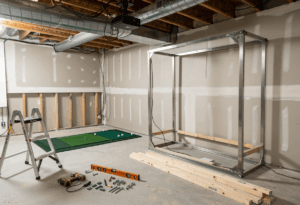
What’s not included: enclosure, impact screen, projector, hitting mat, gaming PC, mounting hardware, electrical work, and installation. None of it. Buyers regularly assume the launch monitor price covers more than it does, and the gap between « I bought a Trackman » and « I have a working simulator room » is typically $10,000-$25,000 of additional spending.
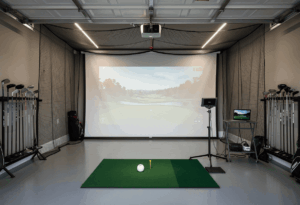
Trackman doesn’t sell complete simulator packages directly. To get a turnkey build, you go through authorized retailers like Shop Indoor Golf or GolfBays, where bundled iO packages run $20,000-$30,000 and Trackman 4 packages run $30,000-$45,000. Those bundles include the SIG10 or SIG12 enclosure, screen, projector, mat, and PC pre-matched to the launch monitor.
The real total: a complete Trackman simulator build
Here’s what the math actually looks like for a mid-tier Trackman iO home build, using current 2026 pricing for each line item. These are the components I’d specify for a private client today.
Start with the Trackman iO at $13,995. Add a SIG10 enclosure with impact screen at $3,599-$3,999. A BenQ TK710STi 4K short-throw projector runs $1,500. A Fiberbuilt Studio mat at $949 protects your joints over the long haul. A capable gaming PC for 4K Trackman software lands around $1,900. Mounting hardware, cables, and ceiling brackets add another $300-$500.
That’s roughly $22,200-$23,000 in components alone, before installation. Professional installation for a ceiling-mounted Trackman iO typically adds $1,500-$3,500 because the alignment and calibration are non-trivial – the iO has to be positioned precisely or the data degrades. Add room prep (electrical, ceiling reinforcement, acoustic panels) and you’re looking at $25,000-$28,000 for a working iO sim room.
A Trackman 4 build follows the same template but starts $7,000-$11,000 higher on the launch monitor and typically uses larger enclosures because the radar needs the room depth. Realistic complete cost: $32,000-$45,000 for a residential build, $50,000-$70,000+ for a commercial-grade install with custom finishes and design integration.
The cost trap most buyers walk into: The launch monitor is roughly 50-60% of a complete Trackman build. Budget the other 40-50% upfront, or you’ll have a $14,000 unit sitting in a box waiting on parts you didn’t price in.
Trackman Performance Studio: the ongoing cost nobody emphasizes
Trackman runs on a subscription model after year one, and this is the single most consistently underestimated line item in the budget. The annual TPS renewal is approximately $1,100, and over five years that’s $5,500 in subscription fees on top of the hardware.
What you get for $1,100/year: cloud-stored shot history, the Combine testing protocol, Trackman Virtual Golf course library (400+ courses in 4K), Performance Studio analytics, video integration, online tournaments, and ongoing software updates. For a coach, fitter, or commercial venue, this is genuinely valuable and the lock-in makes sense. For a casual home user who just wants to play simulated rounds, it’s a meaningful recurring expense that compounds over time.
The Trackman software does not natively run GSPro, E6 Connect, or TGC 2019. This is a recurring complaint in the r/golfsimulator community and a real drawback – if you’ve heard friends rave about GSPro’s 4,000+ community courses or the Sim Golf Tour tournaments, none of that runs on your $25,000 Trackman setup. You’re locked into Trackman’s own software ecosystem, period.
Some buyers run Trackman alongside a separate launch monitor for GSPro access, which is an absurd-sounding workaround that I’ve actually seen in two private installs. The fact that this happens at all tells you something about how meaningful the software lock-in is.
Why Trackman costs what it costs
The premium over competitors isn’t arbitrary. Trackman 4 uses patented dual-radar technology with 24 GHz sensors, combined with high-speed cameras capturing 4,600 frames per second. The data processing happens in 0.7 seconds, and the carry distance accuracy is verified within 1 yard against GPS tracking on tour. Nothing else on the market matches this consistently.
Trackman iO takes a different technical approach – radar, infrared, and high-speed imaging fused into a single ceiling unit, with no minimum distance requirements. The engineering required to make a launch monitor work indoors with that level of accuracy from any swing position is genuinely difficult, and Trackman is one of the only manufacturers solving it well.
Then there’s the brand and ecosystem premium. Tour pros use Trackman almost exclusively, which drives R&D investment, pricing power, and resale value. The Trackman name on a commercial venue’s marketing material draws customers in a way that « Foresight » or « Uneekor » don’t, even when the underlying data quality is comparable. You’re paying for the badge as much as the technology.
Cheaper alternatives that get you 90% of the way there
The honest truth I tell every fitting client: unless you’re a coach, fitter, or commercial operator, you don’t need a Trackman. Several alternatives deliver near-Trackman accuracy at half the price or less, and they all support third-party simulator software.
The Foresight GCQuad starts around $14,000-$18,000 and matches Trackman 4 on club and ball data accuracy in indoor environments. The Foresight GC3 at $7,500 uses the same technology with one fewer camera and slightly less data depth – it’s the genuine sweet spot for serious home buyers who want professional-grade accuracy without the Trackman markup. The Bushnell Launch Pro at $2,499 is built on the same Foresight GC3 hardware platform, just stripped down and rebadged.
The Uneekor EYE XO2 at roughly $9,000-$10,000 is the community consensus pick for home overhead tracking. It supports GSPro, E6 Connect, and TGC 2019 natively, has no annual subscription, and r/golfsimulator regulars consistently rate it as competitive with or beating the GCQuad in head-to-head testing. For a home user who wants overhead-mounted accuracy without Trackman pricing, it’s the smartest play in 2026.
The real cost comparison isn’t just the launch monitor. Over five years, a $25,000 Trackman build with $5,500 in subscriptions costs $30,500. A $12,000 Uneekor EYE XO2 build with no subscriptions costs $12,000. That’s a $18,500 gap, and the data quality difference is meaningful but not transformative for a recreational golfer.
In eight years of fitting, the only clients who genuinely needed a Trackman were teaching pros and one obsessive 2-handicap who wanted PGA Tour-grade data. Everyone else bought the badge and could have spent half as much on a Foresight or Uneekor with zero functional loss.
Who Trackman actually makes sense for
Teaching professionals and club fitters get clear value. Trackman Combine scores are an industry-recognized benchmark that students respect, the TPS analytics let you track progress objectively, and the software ecosystem integrates with PGA-level tools. If your livelihood involves explaining swing data to other people, Trackman pays for itself through credibility alone.
Commercial venues and indoor golf lounges benefit from the brand pull. Customers walking past a Trackman bay versus an unbranded simulator make different choices, and that translates to bookings. The hardware durability and warranty also matter when you’re running a unit 12 hours a day, 7 days a week.
Tour-adjacent players and serious low-handicap competitors get the pure data advantage. If you’re a +2 handicap working on a specific shot pattern, the resolution of Trackman 4’s club delivery data tells you things a $5,000 launch monitor can’t see. For everyone else, that resolution is academic.
Wealthy buyers who want the best are a real category, and there’s nothing wrong with that. If $30,000 is a small budget item for you and you want the unit Tiger and Rory use, Trackman is genuinely the gold standard. Just go in knowing you’re paying a premium for the brand on top of the technology.
The 5-year total cost of Trackman ownership
Most buyers calculate the day-one purchase price and stop there. The real number is the five-year total cost of ownership, and it’s roughly 30-40% higher than the initial sticker.
For a Trackman iO home build: $25,000 initial build + $4,400 in TPS subscriptions over years 2-5 + $1,000-$2,000 in screen and mat replacements = roughly $30,500-$31,500 over five years. That’s $6,300/year amortized.
For a Trackman 4 home build: $40,000 initial build + $4,400 in TPS subscriptions + $1,500-$2,500 in component replacements = roughly $46,000-$47,000 over five years. That’s $9,400/year amortized.
For comparison, a Foresight GC3 build with no subscription runs about $16,000 initial + $1,500 in replacements = roughly $17,500 over five years, or $3,500/year. That’s the gap to weigh honestly before you pull the trigger on a Trackman.
Frequently asked questions
How much is a Trackman 4?
The Trackman 4 launch monitor starts at $21,495 per Trackman’s official pricing, and most authorized retailers quote $24,950 for the indoor/outdoor version. This includes the unit, power supply, base software, and one year of Trackman Performance Studio. A complete Trackman 4 simulator room with enclosure, projector, and installation runs $35,000-$55,000+.
How much is the Trackman iO?
The Trackman iO starts at $13,995 for the unit alone. It’s the cheapest way into the Trackman ecosystem and the only Trackman model designed specifically for indoor use. A complete Trackman iO home simulator build typically runs $25,000-$35,000 with enclosure, projector, mat, PC, and installation.
Does Trackman have a monthly fee?
Trackman uses an annual subscription model, not monthly. The first year of Trackman Performance Studio (TPS) is included with the unit purchase. After that, annual renewal runs approximately $1,100/year, or you can buy a 3-year package for around $4,000 to lower the effective cost.
Is Trackman compatible with GSPro?
No. Trackman does not natively support GSPro, E6 Connect, or TGC 2019. You’re locked into Trackman’s own software ecosystem – Trackman Virtual Golf, the Combine testing protocol, and Performance Studio. This is a meaningful limitation for buyers who want access to GSPro’s 4,000+ community courses or the Sim Golf Tour competitive tournaments.
Why is Trackman so expensive?
Three reasons. First, the dual-radar technology in Trackman 4 and the radar/infrared/imaging fusion in Trackman iO are genuinely best-in-class engineering that no competitor matches. Second, R&D investment from PGA Tour use justifies premium pricing. Third, the Trackman brand carries serious weight in commercial and teaching contexts, and Trackman protects that pricing power tightly.
What’s a cheaper alternative to Trackman?
The Foresight GC3 at $7,500 is the closest direct alternative on accuracy, supports GSPro and E6 Connect natively, and has no annual subscription. The Uneekor EYE XO2 around $9,000-$10,000 is the community favorite for overhead tracking. The Bushnell Launch Pro at $2,499 uses the same Foresight hardware platform as the GC3 and delivers comparable data at a fraction of the price.
In summary: when the price actually makes sense
The Trackman price tag isn’t the question to start with. The right question is whether you’ll use the Trackman-specific features that justify the premium – Combine scores, TPS analytics, the closed software ecosystem, the brand credibility for teaching or commercial work. If those features matter to your specific use case, the math works. If they don’t, you’re paying $15,000-$25,000 extra for a badge.
One angle worth knowing that doesn’t show up in most cost guides: Trackman holds its resale value better than any other launch monitor on the market. A 4-year-old Trackman 4 still sells for 65-75% of new pricing, and Trackman iO units released in 2023 are holding similarly well. If you ever decide to sell, the depreciation hit is smaller than the alternatives – which partially offsets the premium pricing for buyers who think long-term.
The buyers I see regret a Trackman purchase fall into one specific group: recreational golfers who bought it because it’s « the best », then discovered they wanted to play GSPro courses with friends and couldn’t. Know your use case before you spend $25,000+. The technology is real, but it only delivers value when you’re actually using what makes it different.
If you’re seriously considering Trackman, book an hour at a Trackman-equipped indoor golf facility before you buy. Hit a session, run a Combine, see what TPS actually shows you. Spending $50-$80 on a real test session is the cheapest way to find out whether the Trackman experience is worth the spend over a Foresight or Uneekor build.