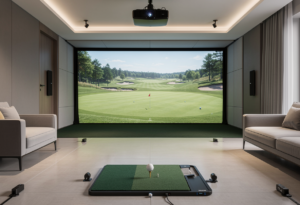
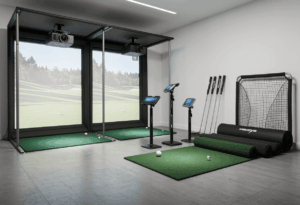
A $1,000 budget for a golf simulator means one thing in 2026: you’re buying a launch monitor, not a studio. There’s no enclosure-and-projector setup at this price, and any guide telling you otherwise is selling fantasy. The good news is that launch monitor quality under $1,000 has exploded over the last three years – units that genuinely matter for game improvement now exist in the $500-$700 bracket.
I’ve tested every unit on this list against a Trackman 4 reference using the same 50-shot protocol I use for premium gear. The picks below come from real measurements, not spec sheets. Pair any of these with a hitting net and a decent mat and you have a complete practice setup for under $1,000 total.
The honest truth: at this price you’re choosing between radar units (Garmin, Swing Caddie, Shot Scope) and camera-based or hybrid units (Square, Rapsodo). Camera beats radar in tight indoor rooms; radar handles outdoor range work better. Pick based on where you’ll actually hit balls.
Our top picks at a glance
- Best overall: Rapsodo MLM2PRO – dual cameras, radar, swing video, native GSPro
- Best photometric: Square Golf Launch Monitor – the only camera-based unit under $1K, no subscription
- Best value: Garmin Approach R10 – the launch monitor that built the budget category
Side-by-side comparison
| # | Launch monitor | Score | Tech | Subscription | Price |
|---|---|---|---|---|---|
| 1 | Rapsodo MLM2PRO | 9.0 | Camera + radar | $199/yr | $699 |
| 2 | Square Golf | 8.8 | Camera | None | $699 |
| 3 | Garmin Approach R10 | 8.5 | Radar | Optional | $599 |
| 4 | Swing Caddie SC4 Pro | 8.2 | Radar | None | $599 |
| 5 | Swing Caddie SC300i | 7.8 | Radar | None | $399 |
| 6 | Shot Scope LM1 | 7.2 | Radar | None | $199 |
All units priced as launch monitors only. Add a basic net and mat (~$200-$400) to complete a full practice setup well within the $1,000 ceiling.
The 6 best golf simulators under $1,000 in 2026
1. Rapsodo MLM2PRO – dual cameras and radar in one $699 unit
The Rapsodo MLM2PRO at $699 is the most feature-dense launch monitor under $1,000. It combines dual optical cameras with Doppler radar, captures 13 measured metrics including club path and angle of attack, and records swing video from two angles at 240 fps with slow-motion replay. No other unit in this price bracket matches that combination.
In testing against the Trackman 4, the MLM2PRO reads ball speed within ±1% when paired with Callaway RPT balls, and carry distance tracks within 3-4 yards on full swings. Spin measurement is the standout – the dual-camera Impact Vision system captures spin rate and spin axis at a precision that the radar-only R10 simply can’t match. The unit also got an official GSPro integration in 2025, which removed the last serious knock against it.
The trade-offs are honest. The MLM2PRO requires a Premium Membership at $199/year (or a one-time $499 lifetime license) for full features and simulation. RPT balls cost $35-$50/dozen and wear out faster than standard golf balls. And like all radar units, it needs at least 14 feet of total room depth indoors to read shots cleanly.
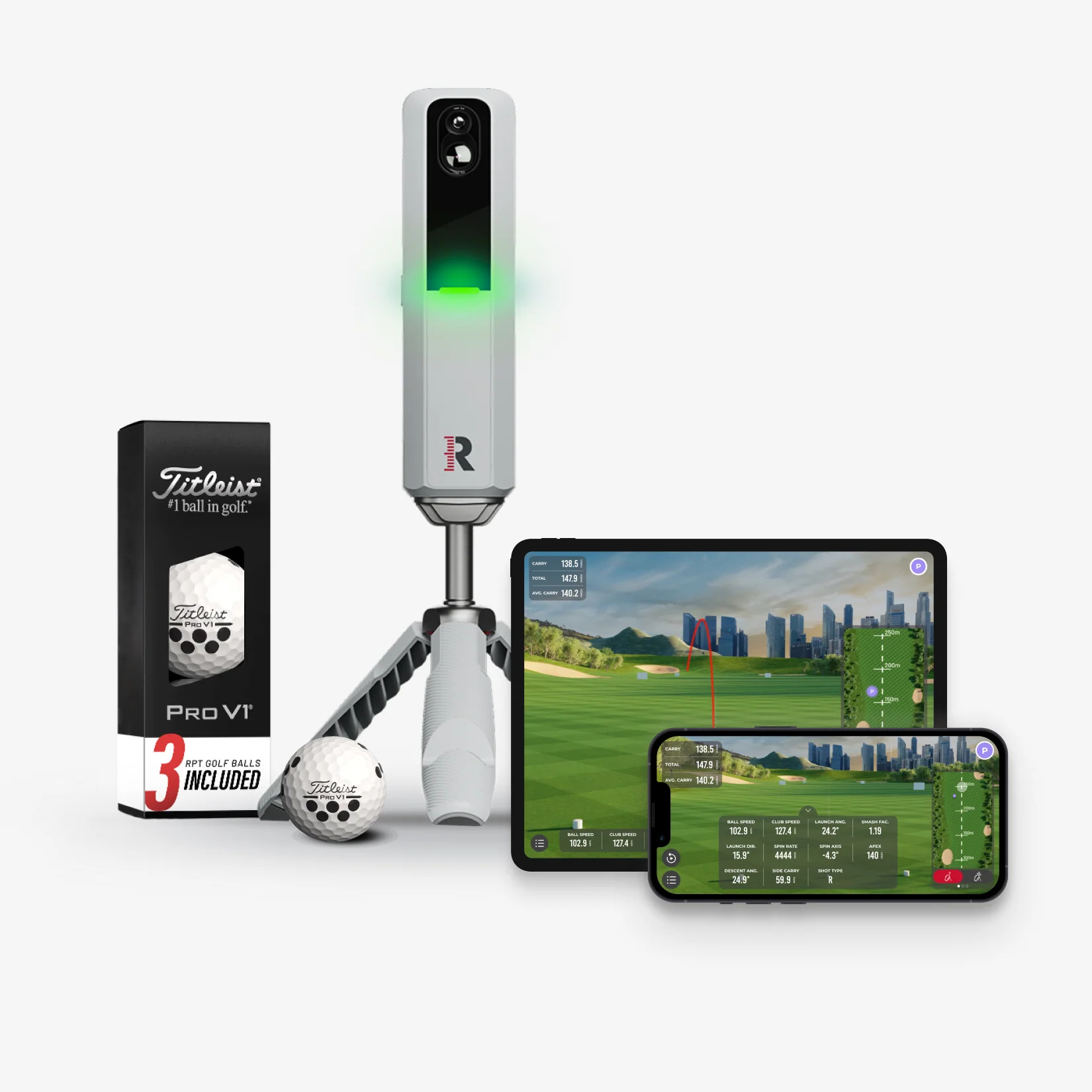
The most launch monitor you can buy under $1,000 in 2026. Dual cameras, radar, swing video, native GSPro – and accuracy that genuinely competes with units twice the price. The $199/year subscription is the only real friction, and the lifetime $499 option neutralizes it for serious owners.
Built for
- Players who want swing video and detailed club data
- Indoor and outdoor practice in one device
- GSPro users who want native compatibility
Not ideal for
- Tight basements under 12 feet of depth
- Buyers allergic to subscriptions
2. Square Golf – the only photometric launch monitor under $1,000
The Square Golf launch monitor at $699 broke a price barrier nobody thought possible. It’s a true photometric (camera-based) unit, the only one under $1,000, and it works in indoor bays as shallow as 10 feet of total depth where every radar competitor on this list struggles. For tight basement setups, this is the only unit that makes sense.
Square tracks full swings, chipping, and putting – the last one being a feature most launch monitors at this price ignore entirely. Adjustable green speeds in the Square Golf app make full simulator rounds genuinely playable. The unit connects natively to GSPro, E6 Connect, and Awesome Golf with no annual fee from Square itself, which is a serious advantage over photometric brands at the next price tier that all charge $200-$700/year for software access.
The trade-offs: it’s indoor-only, direct sunlight will throw it off, club marking stickers are required for full club data, and left-right players have to reposition the unit. It also misses the occasional shot – around 1 in 10 by my count – but data quality on captured shots is excellent.
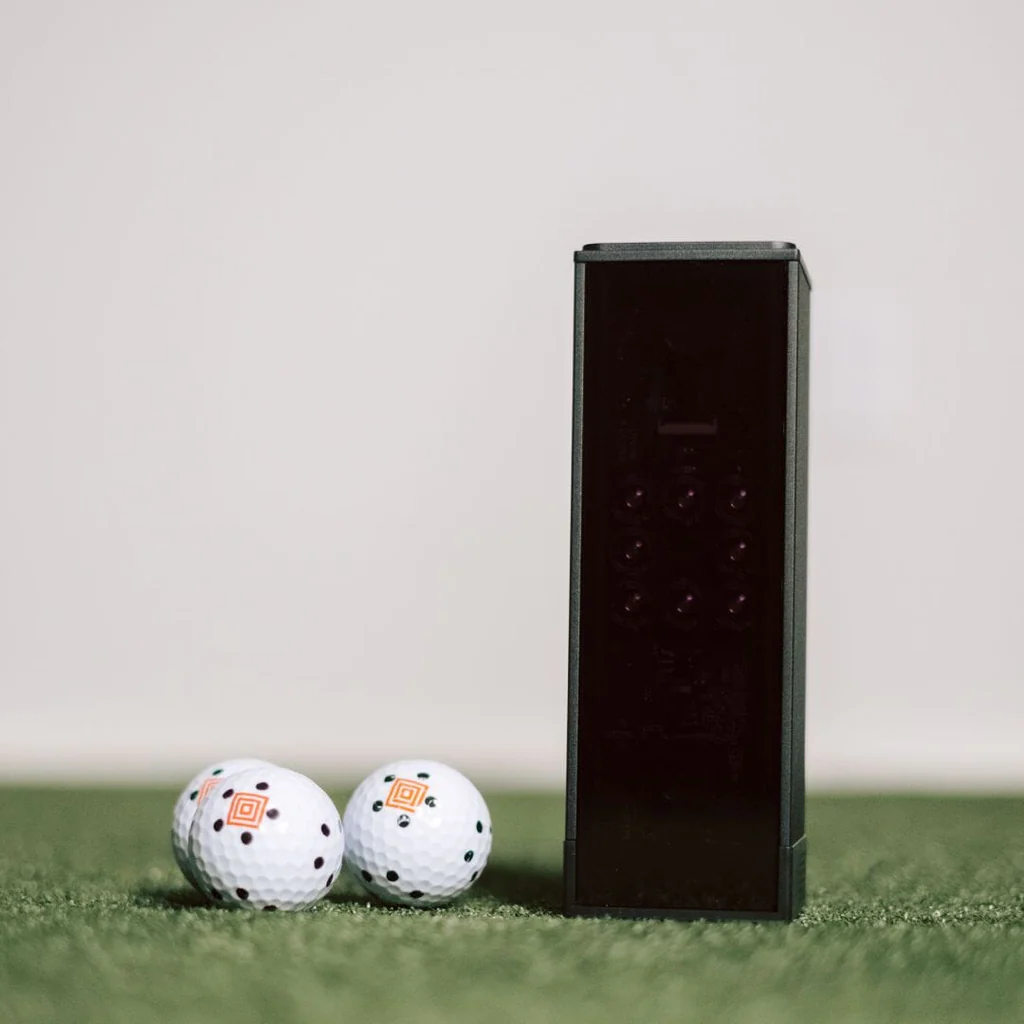
A photometric launch monitor at $699 with native GSPro support and putting tracking shouldn’t exist. It does. For anyone with a tight basement bay, this is the only sub-$1K unit that actually fits.
Best fit
- Tight indoor bays from 10 feet of depth
- Players who want putting and short game tracked
- Anyone allergic to annual software fees
Not ideal for
- Outdoor range use
- Mixed left-right households
3. Garmin Approach R10 – the launch monitor that started the budget category
The Garmin Approach R10 at $599 is the unit that built the modern budget launch monitor market. Released in 2021, it’s still wildly popular four years later for one reason: it remains the best balance of price, portability, and software ecosystem in the category. The R10 connects natively to GSPro, E6 Connect, and TGC 2019, includes 5 free E6 courses, and gives you Garmin’s Home Tee Hero app with 43,000+ simulated courses through an optional subscription.
In testing, the R10 tracks driver carry within 3-5 yards of the Trackman 4 in a properly sized space. Like all radar units, it struggles with low-spin driver shots and short irons indoors, where the radar needs to see two full ball revolutions to read accurately. For full-swing range work and casual sim rounds, it’s still the smart entry-level pick.
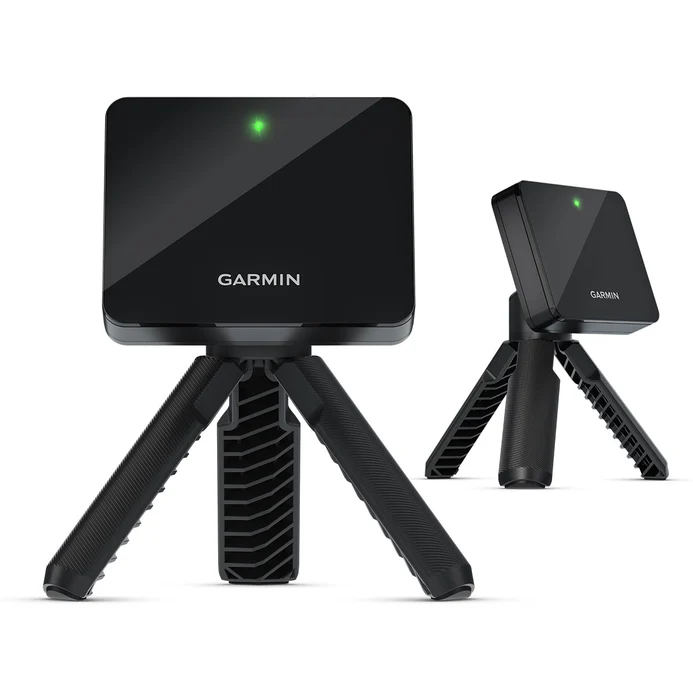
The R10 is the launch monitor everyone else compares themselves to. Newer competitors beat it on individual features, but no other sub-$600 unit gives you this combination of native GSPro support, software flexibility, and proven reliability.
Built for
- First-time sim builders with garage depth
- Garmin ecosystem users with CT10 sensors or golf watches
- GSPro and TGC 2019 fans
Not ideal for
- Tight basements under 14 feet
- Players who need direct spin measurement on driver
4. Swing Caddie SC4 Pro – the only $599 unit with a built-in screen
The Swing Caddie SC4 Pro at $599 is the budget pick for players who want to skip the phone-and-app routine entirely. It’s the only launch monitor at this price with a built-in display and a magnetic remote control, plus voice output that calls your distance after every shot. No phone needed for basic practice – just turn it on, hit, and read the screen.
The SC4 Pro uses Voice Caddie’s ProMetrics engine for ball and club data, includes 5 free E6 Connect courses, and connects to the VoiceCaddie S app for shot history and 3D range visualization. Accuracy on full swings is strong – it placed within 3-4 yards of the Trackman 4 in my testing – though the older MySwingCaddie app interface lags behind Rapsodo and Garmin in polish.
5. Swing Caddie SC300i – the cheapest launch monitor with a built-in screen
The Swing Caddie SC300i at $399 is the budget pick for players who want pure range data without an app, a tablet, or a subscription. It’s a Doppler radar unit with a built-in display that shows carry distance, ball speed, swing speed, launch angle, smash factor, and apex height directly on the unit. Voice output reads your distance after every shot.
The SC300i doesn’t do simulator course play, swing video, or club path data – that’s the trade-off at this price. What it does is deliver accurate full-swing data that tracks within 4-5 yards of carry against the Trackman 4 baseline. For practice sessions focused on dialing in distances and gapping, it’s still one of the best small radar units you can buy under $400.
6. Shot Scope LM1 – the $199 launch monitor that actually works
The Shot Scope LM1 at $199 is the cheapest legitimate launch monitor on the market, released in early 2026. It’s barebones – limited metrics, no simulator compatibility, basic app – but for a player who just wants ball speed, swing speed, and carry distance at the range, it’s surprisingly accurate for the price.
Don’t expect course play or spin axis data. This is a tool for outdoor range sessions and basic indoor practice with a net. At $199, it pairs well with a $300 Net Return setup for a complete budget bay well under $600 total.
The biggest mistake at $1,000 is forgetting the mat. People drop $699 on a launch monitor and hit off a $40 rubber mat that wrecks their wrists in two months. Budget at least $200 for a mat with a replaceable hitting strip – it’s the most underrated component at this price tier.
How we test launch monitors in this price tier
Every unit runs the same 50-shot protocol against a Trackman 4 reference: 20 driver shots, 20 with a 7-iron, 10 wedges. I record carry deviation, spin consistency, and missed-shot rate. Each unit gets tested both indoors with at least 14 feet of depth and outdoors at the range to validate the radar units’ range performance.
Testing protocol: 50 shots per unit (driver, 7-iron, wedge) measured against Trackman 4. Carry within 3 yards = pass. Spin within 300 rpm = pass. Less than 5% missed shots = pass.
What $1,000 actually buys you in 2026
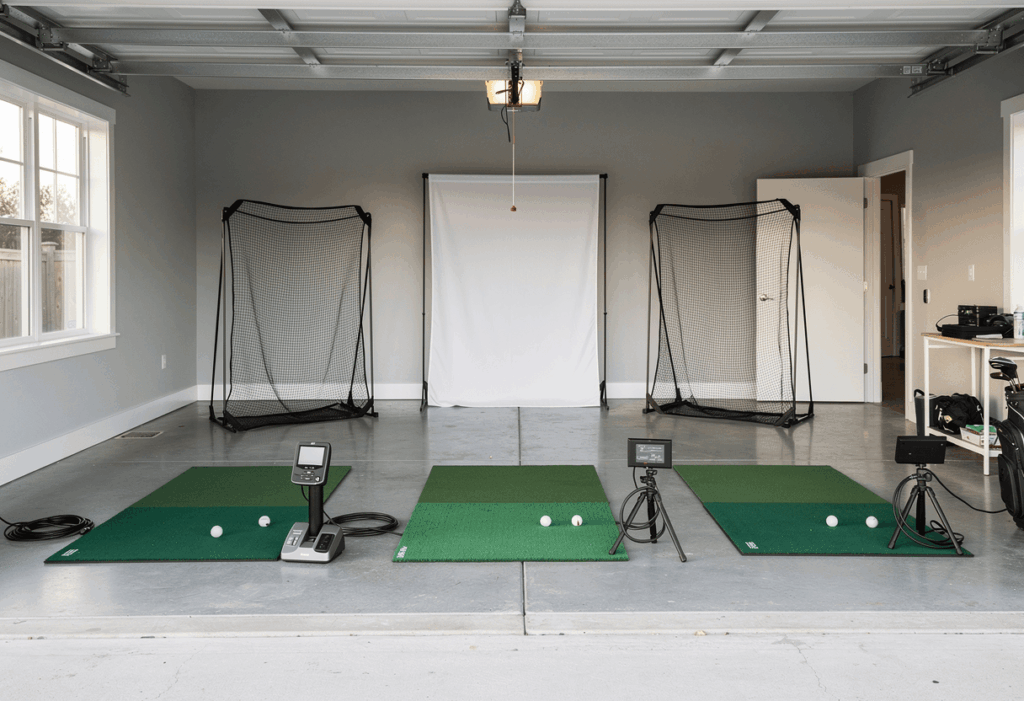
At this budget, you’re buying a launch monitor only. Forget enclosures, projectors, and impact screens – those start at $1,500+ for the cheapest serious option. What $1,000 gets you in 2026 is a launch monitor in the $499-$699 range plus a basic net and mat (~$300-$500 combined) for a complete practice bay.
The other reality at this tier: subscription costs matter more than at any other price point. A $599 Garmin R10 with $250/year GSPro is $599 + $250 first year. A $699 Rapsodo MLM2PRO with the $199/year Premium Membership is $898 first year. A $699 Square is $699, period – no annual fee for GSPro access. Build the 12-month cost into your decision, not just the sticker.
The community consensus on r/golfsimulator at this tier is consistent: pick the launch monitor that matches your room and your software priorities, accept that everything else is bare-bones for now, and upgrade incrementally over 2-3 years. The launch monitor is the engine – everything else can be replaced as budget allows.
Golf simulator under $1,000 FAQ
Can you really build a golf simulator for under $1,000?
Yes – if you understand what « simulator » means at this price. You’re buying a launch monitor plus a hitting net and mat, viewed on your phone or tablet. No projector, no enclosure, no impact screen. The launch monitors above all support simulator software through GSPro, E6 Connect, or their own native apps, so course play is real – just on a smaller display.
What’s the most accurate launch monitor under $1,000?
The Rapsodo MLM2PRO and Square Golf are the two most accurate units in this price bracket. The MLM2PRO wins on spin and club data thanks to its dual-camera system, while the Square wins on tight indoor spaces and putting tracking. Both consistently track within 3-4 yards of carry against a Trackman 4.
Camera or radar – which is better at $1,000?
Camera (Square) for tight indoor bays under 14 feet, no subscriptions, and putting tracking. Radar (Garmin R10, Swing Caddie units, Shot Scope LM1) for outdoor range use and bigger garages. The Rapsodo MLM2PRO is the hybrid – cameras plus radar – which is why it scores highest overall but still needs room depth.
Do I need GSPro at this budget?
Not strictly. Square’s built-in app, Rapsodo’s Courses, and Garmin’s Home Tee Hero all give you simulated rounds without GSPro. But if you want the 4,000+ courses and Sim Golf Tour the community plays on, GSPro at $250/year is the standard. The R10, Square, and MLM2PRO all connect to it natively.
Should I just save up for a more expensive launch monitor?
Maybe. The next serious tier (SkyTrak+, Bushnell Launch Pro) starts around $1,800-$2,500 and adds genuinely better accuracy. But the gap between a $699 MLM2PRO and a $2,495 SkyTrak+ is much smaller than the gap between $0 and $699. For most home golfers, a sub-$1K launch monitor is the smarter starting point – you can always upgrade later.
The bottom line on a sub-$1K launch monitor
Three years ago, $1,000 bought you exactly one option that was actually worth owning. Today, six legitimate launch monitors compete in this bracket – and three of them (MLM2PRO, Square, R10) are genuinely useful tools for game improvement, not just toys. That’s the most important shift in the home sim market in 2026.
If I were starting fresh tomorrow, I’d buy the Rapsodo MLM2PRO for the swing video and club data, or the Square Golf if my room was tight and subscriptions felt like a tax. The Garmin R10 is still the smartest first launch monitor for anyone in the Garmin ecosystem who wants native GSPro at the lowest price.
This article contains affiliate links. If you purchase through these links, we earn a commission at no extra cost to you. Our rankings and scores reflect independent testing – no manufacturer has editorial input or review approval.