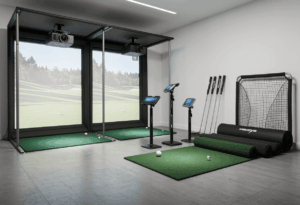
A $2,000 budget for a golf simulator is the real entry point to the home sim market. Below it you’re buying a launch monitor and a net. At this number, you can actually build a setup that includes an enclosure, a screen, and a mat – just barely. The trade-offs get sharper as the budget shrinks, and the launch monitor choice becomes everything.
I’ve tested the units on this list against a Trackman 4 reference using the same 50-shot protocol I use for premium gear. The picks below come from real measurements, not spec sheets. Every package here is buildable today, and I’ve been honest about what each one gives up to hit the price.
The honest truth: at $2,000, you’re choosing between a premium launch monitor with a net or a budget launch monitor in a small enclosure. Pick based on your room and your priorities – not on what looks fanciest in the photo.
Our top picks at a glance
- Best overall: Square Golf Net Return Studio Package – photometric tracking and a real net setup under $2K
- Best value: Garmin R10 SIG8 Package – the cheapest full enclosure with native GSPro support
- Best closeout: SkyTrak+ standalone – premium photometric unit at $1,495 while inventory lasts
Side-by-side comparison
| # | Package | Score | Tech | Min depth | Price |
|---|---|---|---|---|---|
| 1 | Square Golf Net Studio | 9.0 | Camera | 10 ft | $1,695 |
| 2 | Garmin R10 SIG8 | 8.6 | Radar | 14 ft | $1,549 |
| 3 | SkyTrak+ standalone | 8.4 | Camera + radar | 10 ft | $1,495 |
| 4 | Rapsodo MLM2PRO Net Studio | 8.2 | Camera + radar | 14 ft | $1,395 |
| 5 | FlightScope Mevo | 7.9 | Radar | 16 ft | $499 |
| 6 | Rapsodo MLM2PRO standalone | 7.7 | Camera + radar | 14 ft | $699 |
Scores reflect both the launch monitor and the complete package. Prices shift with seasonal promotions.
The 6 best golf simulators under $2,000 in 2026
1. Square Golf Net Return Studio – photometric tracking in a real net setup
The Square Golf Net Return package is the most disruptive sim under $2K. Square is the only photometric launch monitor under $1,000, and pairing it with The Net Return Pro V2 gives you a real practice studio with auto-ball-return. The unit tracks putting, chipping, and full swings, connects natively to GSPro, E6, and Awesome Golf, and charges no annual subscription for third-party software access.
In testing, the Square reads driver carry within 3-4 yards of the Trackman 4 baseline and rarely misses shots. The trade-off: it’s indoor-only, club marking stickers are required for full club data, and left-right players have to reposition the unit. For a basement bay focused on practice rather than projector-based course play, it’s the smartest sub-$2K buy on the market.
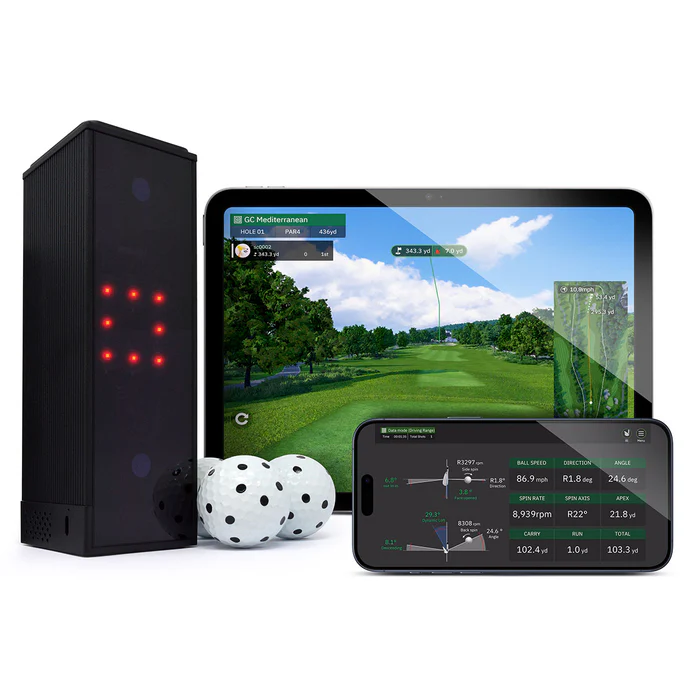
A $700 photometric launch monitor with native GSPro support and putting tracking, in a Net Return package, under $2K. Two years ago this combination didn’t exist. Today it’s the smartest entry to home sim golf for anyone with a tight basement bay.
Built for
- Tight indoor bays from 10 feet of depth
- Players who want putting and short game tracked
- Anyone allergic to annual software fees
Not ideal for
- Outdoor range use
- Mixed left-right households
2. Garmin R10 SIG8 Package – cheapest full enclosure that runs GSPro
The Garmin R10 SIG8 package is the budget answer for anyone who wants a real enclosure – frame, impact screen, mat, side barriers – rather than a net. The R10 retails at $599.99 and pairs with The Indoor Golf Shop’s compact SIG8 enclosure to land comfortably under the $2K ceiling. The R10 connects natively to GSPro at $250/year, no bridge connector required.
Radar units need 14 feet of total depth minimum, and the R10 is no exception. In a properly sized garage it tracks driver carry within 3-5 yards of the Trackman 4. Wedges and short irons are weaker – that’s the radar trade-off indoors. For full-swing practice and course play, it’s a legitimate setup.
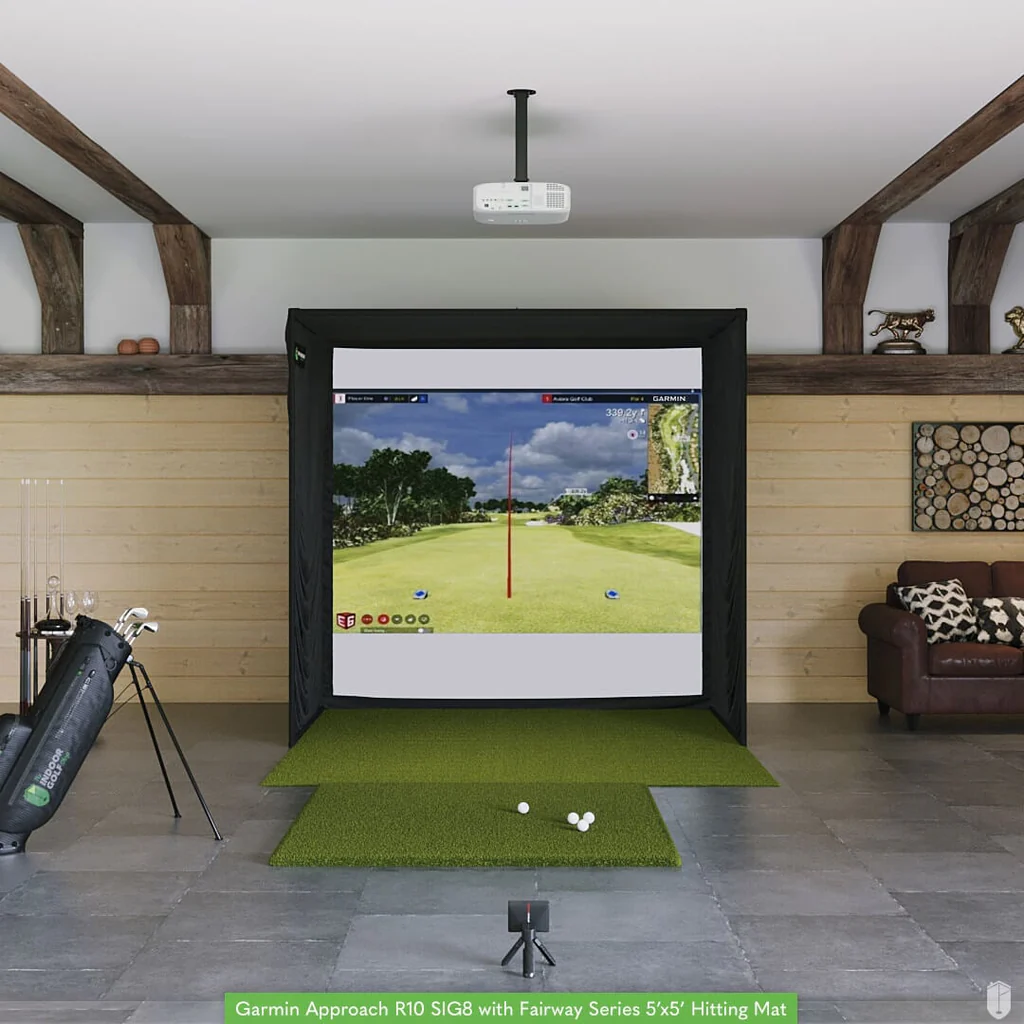
The cheapest path to a real enclosure with native GSPro at this price. Not the most accurate unit, but the most flexible build for a garage with depth.
Best fit
- Garage builds with 14+ feet of depth
- GSPro fans who want native compatibility
- First-time sim builders
Not ideal for
- Tight basements under 12 feet
- Wedge precision work
3. SkyTrak+ standalone – premium photometric unit at closeout pricing
The SkyTrak+ at $1,495 is the closeout deal of 2026. SkyTrak announced the ST MAX in late 2025 and the SkyTrak+ is being phased out, which means current pricing is well below historical retail. The unit combines a photometric camera with dual Doppler radar and tracks carry and ball speed within 1-2 yards of a Foresight GC3 in side-by-side testing.
Buying it standalone leaves no budget for an enclosure, screen, or projector at this tier – you’d add a basic net and mat separately, or save toward a full studio. For players who care about data accuracy first and will upgrade the room later, this is the smartest dollar in the sub-$2K market while inventory lasts.
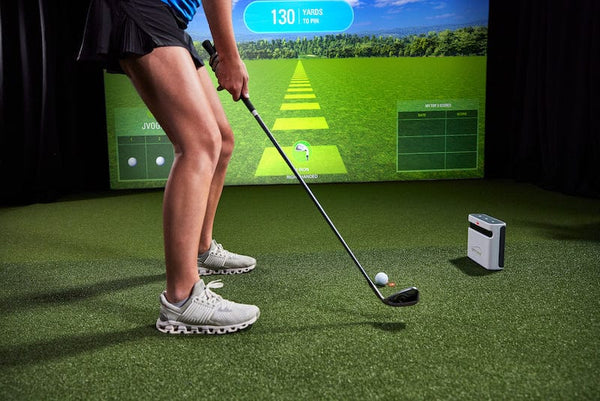
The SkyTrak+ at closeout is more launch monitor than anything else under $2,000. Buy it now, build the room later. Mac compatibility is a bonus most rivals can’t match.
Built for
- Players prioritizing data accuracy over enclosure
- Mac users
- Anyone planning incremental upgrades
Not ideal for
- Buyers who need a full studio at the budget
- Outdoor range use
4. Rapsodo MLM2PRO Net Studio – portable launch monitor with swing video
The Rapsodo MLM2PRO Net Studio pairs a $699 launch monitor with a hitting net and mat. The MLM2PRO uses dual cameras plus radar, captures 13 measured metrics including club path, and connects to GSPro through an official integration. Built-in swing video from two angles is genuinely useful for tempo and path work.
5. FlightScope Mevo – the cheapest reliable launch monitor for the range
The original FlightScope Mevo at $499 is the budget pick for the player who wants reliable carry, ball speed, and spin without breaking the budget. It’s a pure radar unit, indoor or outdoor, with FlightScope’s polished mobile app. No course play, no full simulator features – just 8 measured metrics on every shot, accurate within a few yards on full swings.
Pair it with a basic net and a decent mat and you have a $1,200-$1,500 practice setup focused on data feedback. It needs 16+ feet of total depth indoors to read shots cleanly, which makes it a better fit for garages than basements. For range work and outdoor sessions, it’s still one of the best small radar units on the market.
6. Rapsodo MLM2PRO standalone – portable launch monitor with swing video
The Rapsodo MLM2PRO at $699 is the most feature-rich launch monitor under $1,000. Dual cameras plus Doppler radar, 13 measured metrics including club path and angle of attack, built-in swing video from two angles with slow-motion replay, and an official GSPro integration. It’s the unit you can drop into a golf bag and take to the range, then bring home and run in the basement.
Buying it standalone leaves you free to add a basic mat and net (~$300-$500 total) and stay well under the budget ceiling. The MLM2PRO requires a Premium Membership at $199/year for full functionality, which is the only real ongoing cost. For a player who values flexibility – indoor practice, outdoor range, swing video – over a polished enclosure, it’s the smartest standalone buy at this price.
The biggest mistake at $2K is spending the entire budget on the launch monitor and forgetting the mat. A cheap rubber mat will wreck your wrists in two months. Budget at least $200 for a decent mat with a replaceable hitting strip – it’s the most underrated component at this price.
How we test golf simulators in this price tier
Every launch monitor runs the same 50-shot protocol against a Trackman 4 reference unit: 20 driver, 20 with a 7-iron, 10 wedges. I record carry deviation, spin consistency, and missed-shot rate. For complete packages, I add install time, real room dimensions needed, and how the system handles a left-right player switch.
Testing protocol: 50 shots per unit (driver, 7-iron, wedge) measured against Trackman 4. Carry within 3 yards = pass. Spin within 300 rpm = pass. Less than 5% missed shots = pass.
What $2,000 actually buys you in 2026
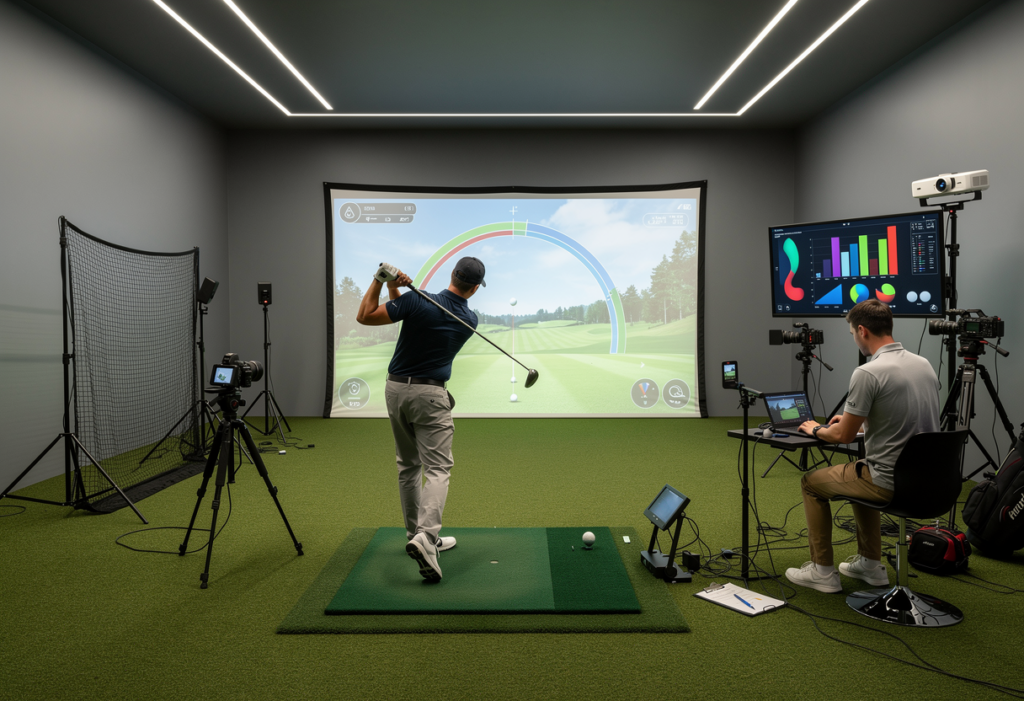
At this budget, the launch monitor eats 50-70% of total spend. That leaves $400-$1,000 for the enclosure or net, mat, and any projector you might add later. Forget projector-based course play at this price – it’s not realistic without sacrificing the launch monitor or the mat.
The other reality: subscription costs matter more here than at higher tiers because they’re a larger share of total cost. The R10 with GSPro at $250/year is the cheapest serious software path. The Square charges nothing extra for GSPro access. The Rapsodo requires a $199/year Premium Membership for full features. Build the 12-month total into your decision.
The community consensus on r/golfsimulator is clear at this tier: prioritize the launch monitor, accept a basic enclosure or net, and upgrade everything else over time. The unit is the engine – everything else can be replaced incrementally as budget allows.
Golf simulator under $2,000 FAQ
Can you really build a golf simulator for under $2,000?
Yes, with honest trade-offs. You’ll pick between a premium launch monitor with a net, or a budget launch monitor with a small enclosure. You won’t get both projector-based course play and fitting-grade data at this price. The packages above are real configurations being used by thousands of home golfers right now.
What’s the minimum room size?
For the Square or SkyTrak+ (camera-based), 10×10 feet with 9-foot ceilings works. For the Garmin R10 or Rapsodo MLM2PRO (radar), plan on 14 feet of depth, 10 feet of width, and 9-10 foot ceilings. Measure before you buy – this is the most common mistake.
Is the Garmin R10 or Square Golf better at this price?
Square wins for tight indoor bays, putting, and zero subscription fees. The R10 wins if you have 14+ feet of depth, want native GSPro, and need outdoor use. Camera beats radar in tight rooms; radar handles outdoor better.
Do I need GSPro at this budget?
Not strictly. Square’s built-in app, Rapsodo’s Courses, and Garmin’s Home Tee Hero all give you simulated rounds without GSPro. But if you want the 4,000+ courses and Sim Golf Tour the community plays on, GSPro at $250/year is the standard – and the R10, Square, and MLM2PRO all connect to it natively.
Should I upgrade later?
Yes – and that’s the smart strategy. The launch monitor is the engine and the hardest piece to swap. Everything else (net, mat, projector, enclosure) can be upgraded one piece at a time as budget allows.
The bottom line on a $2K simulator build
Two years ago, $2,000 bought you a launch monitor and a hitting net – end of story. Today, the same budget gets you photometric tracking, native GSPro support, putting practice, and a real Net Return setup. That’s the Square Golf Net Return Studio, and it’s the package I’d buy if I were starting fresh tomorrow.
If you have garage depth and want a real enclosure, the Garmin R10 SIG8 package is the smarter buy. And if you’re prioritizing pure data accuracy with plans to build the room out over time, the SkyTrak+ at $1,495 is the closeout that won’t last forever.