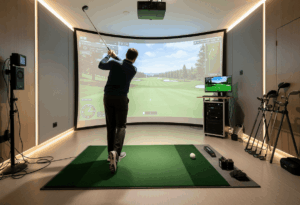
A golf simulator is worth it if you play 25+ rounds a year and live somewhere that takes months off your season. At that usage level, a mid-tier $8,000 setup pays for itself in 2-3 years compared to green fees, range costs, and travel. Below that threshold, renting bay time at a local indoor golf lounge is cheaper, and nobody talks about that enough.
I’ve fitted sim rooms for clients spending $5,000 and clients spending $50,000. The ones who actually use their simulators – and I mean 4+ sessions a week, year after year – are almost always mid-tier buyers who built around a finished basement or garage. The ones gathering dust tend to be premium builds in rooms that never quite got finished. The value equation isn’t about how much you spend. It’s about how much you swing.
The short answer: Yes for golfers playing 25+ rounds/year with a 3+ month off-season. The breakeven against range fees and green fees is typically 2-3 years on a mid-tier build ($5,000-$12,000). No for casual golfers playing under 15 rounds/year – rent simulator bay time instead at $40-$80/hour.
The math: simulator ownership vs. what you’re already spending
Most golfers dramatically underestimate their annual spending on practice and play. Let me walk through three real profiles I see constantly in my fitting work, because the numbers speak louder than opinions.
A competitive player hitting the range 3x a week and playing 40+ rounds a year burns through money fast. Large bucket at $15-$18, three times a week, 40 weeks a year: that’s $1,800-$2,160 in range balls alone. Add 40 rounds at a mid-tier public course ($45 average green fee): $1,800. Gas, food, drink at the course, the occasional lesson – call it $600 more. Total: roughly $4,200-$4,600 per year, and that’s conservative.
A mid-tier golf simulator build around a Bushnell Launch Pro, Carl’s Place enclosure, and GSPro runs about $8,000 upfront plus $250/year in software. Against $4,400/year in course and range spending, the simulator breaks even in roughly two years. Every year after that is savings plus the compound benefit of year-round, data-driven practice.
A recreational golfer playing 10-15 rounds and hitting the range once a week spends closer to $1,500-$2,000 a year on golf. At that rate, an $8,000 simulator takes 4-5 years to break even – and that assumes consistent use, which casual golfers rarely maintain. Renting simulator bay time is the smarter play at this usage level. Most indoor golf lounges charge $40-$80/hour, and a few sessions a month keeps you sharp without the sunk cost.
What a simulator gives you that a driving range never will
The value of a home simulator isn’t just financial. There are practice advantages that don’t exist at any outdoor facility, and they’re the real reason serious golfers make the investment.
First: data on every single swing. A camera-based launch monitor like the Bushnell Launch Pro or Foresight GC3 tracks ball speed, spin rate, launch angle, spin axis, club path, and face angle on every shot. At the driving range, most golfers hit ball after ball making the same mistakes with zero feedback. Community consensus on r/golfsimulator is blunt: golfers who train with launch data improve measurably faster than golfers who rely on feel alone.
Second: full course simulation. GSPro gives you 4,000+ courses for $250/year. E6 Connect adds licensed courses like Pebble Beach for $300-$600/year. You’re not just hitting into a net – you’re playing rounds, managing strategy, dealing with pin placements and wind. This is practice that transfers directly to on-course decision-making, and no range session replicates it.
Third: time compression. A range session eats 20-30 minutes of travel each way, plus the session itself. A home simulator is 10 seconds from your couch. That convenience compounds over months and years. I have clients who tell me they hit more balls in their first six months of sim ownership than they did in the previous two years combined.
Who gets the most value from a golf simulator
Cold-climate golfers with 3-6 months of dead season get the clearest return. If you’re in Minnesota, Michigan, or the Northeast, you’re losing half the year to weather. A simulator doesn’t just replace summer practice – it eliminates the spring rust that costs you the first 4-6 rounds of the season. I’ve had clients in Phoenix tell me their simulator is nice to have. Clients in Chicago and Boston call theirs indispensable.
Low-handicap players chasing improvement get disproportionate value because they can actually use the data. A 5-handicap tracking spin axis variation shot to shot is doing meaningful work. A 25-handicap doesn’t need spin axis data – they need swing lessons. If you’re trying to break 80, the data feedback loop of a good launch monitor and GSPro is one of the most efficient training tools available.
Families and households with multiple golfers multiply the value immediately. Two golfers using the same $8,000 setup effectively cut the per-person cost in half. The entertainment factor matters too – I’ve fitted sim rooms where the kids play more than the dad who bought it. Software like GSPro and E6 Connect includes multiplayer modes, closest-to-the-pin games, and online tournaments through the Sim Golf Tour that keep non-competitive players engaged.
Who should probably skip it
Casual golfers playing under 15 rounds a year almost never recoup the investment. The simulator sits there, the guilt sets in, and eventually it becomes expensive storage. If you play a handful of summer rounds and don’t visit the range between them, a home sim will not change your habits. Rent bay time when the mood strikes and put the $8,000 toward green fees and lessons instead.
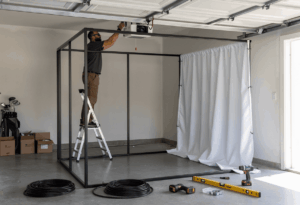
Golfers without a dedicated space face a different problem. A simulator needs minimum 9-foot ceilings, 10 feet of width, and 12-16 feet of depth depending on the launch monitor technology. If those dimensions mean borrowing from a shared family room or a garage that still needs to park cars, the friction of setup and teardown kills usage within months. Retractable screen systems exist but add $1,000-$2,000 to the build and still require clearing the space for every session.
Beginners who haven’t settled into the game yet should wait. If you picked up golf last summer and you’re not sure it’ll stick, spending $5,000+ on a simulator is premature. Play a full season, take a few lessons, decide you’re committed – then invest. The technology will still be there, and prices trend downward over time as older models hit clearance.
The single best predictor of whether a client actually uses their simulator long-term is room readiness, not component quality. A $6,000 build in a finished, dedicated space gets used 5x more than a $15,000 build in an unfinished garage that still needs drywall and HVAC work.
The hidden value most buyers overlook
There’s an angle to simulator ownership that almost no cost analysis covers: resale value. Camera-based launch monitors hold their value remarkably well on the used market. A 3-year-old Bushnell Launch Pro or SkyTrak+ sells for 60-70% of new pricing. A Foresight GC3 holds even better. If you buy at $8,000 and sell the monitor and enclosure three years later for $4,500, your actual depreciation cost is $3,500 over three years – under $100/month.
Compare that to a golf club membership. A mid-tier private club runs $300-$500/month in dues plus $3,000-$10,000 in initiation fees, and you get exactly zero back when you leave. Or compare to a TopGolf or indoor golf lounge habit. Two sessions a week at $50-$60/hour adds up to $5,000-$6,000 a year with no equity and no data history to track your improvement. The simulator, by contrast, is a depreciating asset you actually own.
Home value matters too. Real estate agents in cold-climate markets report that finished simulator rooms are increasingly listed as amenities alongside home theaters and wine cellars. It won’t add $30,000 to your home value, but a clean, professional installation in a finished basement is a genuine differentiator when listing.
What « worth it » actually requires from you
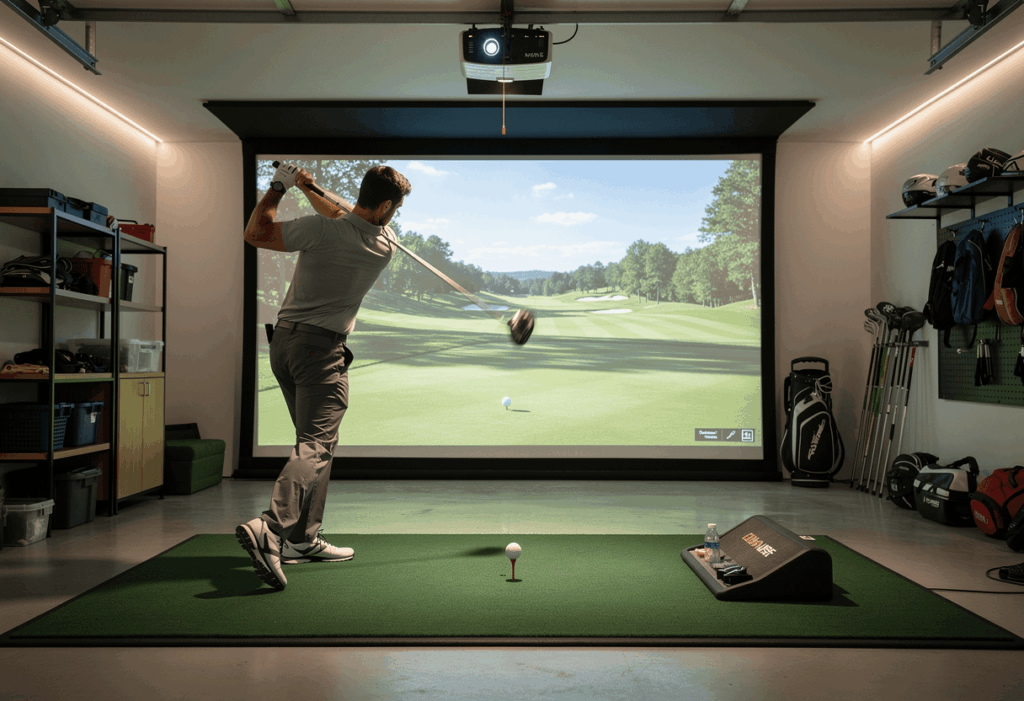
Buying the simulator is the easy part. Getting value from it requires consistent use, and consistent use requires a few things most guides won’t tell you about.
You need a practice structure. Golfers who just « hit balls » on their sim without intent burn out within 6 months. The ones who stick with it treat it like a training tool – they run drills, play rounds on GSPro tracking their stats, and use the data to identify weaknesses. Software like GSPro’s Sim Golf Tour adds competitive motivation that keeps sessions purposeful instead of aimless.
You need to budget for ongoing costs honestly. Software subscriptions run $250-$600/year. Impact screens need replacement every 2-5 years ($300-$800). Mats wear out after 50,000-100,000 swings ($200-$900). Projector lamps on non-laser units run $150-$400 every 2,000-4,000 hours. Over five years, these recurring costs add roughly $1,500-$4,000 on top of your initial build.
And you need to accept what a simulator can’t do. It won’t replace real golf. Putting on a flat mat doesn’t replicate green reading. Hitting off artificial turf doesn’t teach you to handle tight lies and wet conditions. The wind data in simulator software is approximate at best. A simulator is the best training tool for full swing, ball flight, and course strategy – but it’s a complement to outdoor golf, not a substitute.
Frequently asked questions
Is a golf simulator worth it for a high handicapper?
Conditionally. If you’re actively trying to improve and willing to use the data, a mid-tier simulator with a quality launch monitor accelerates progress faster than range sessions alone. If you’re just hitting balls for fun, the investment is harder to justify – stick with the range and spend the savings on lessons, which will drop your handicap faster than any technology.
How many years does a golf simulator last?
The launch monitor itself lasts 5-10 years with normal use. Impact screens need replacing every 2-5 years depending on usage intensity. Hitting mats wear in the strike zone after 50,000-100,000 swings. Projector lamps are the most frequent replacement at 2,000-4,000 hours, though laser projectors eliminate this entirely. Plan for the core system lasting 5+ years with periodic component swaps.
Can a golf simulator actually improve my game?
Yes, if you use it with intent. Launch data on every swing – carry distance, spin rate, club path, face angle – creates a feedback loop that outdoor practice can’t match. The r/golfsimulator community consistently reports that golfers who train with simulator data 3+ times per week see measurable handicap drops within 6-12 months, particularly on full swing consistency and distance control.
Is renting simulator time better than buying?
It depends on frequency. Indoor golf lounges charge $40-$80/hour depending on market and time slot. At two sessions per week, that’s $4,000-$8,000/year – more than the annual amortized cost of owning. At one session per month, renting is dramatically cheaper. The crossover point is roughly 2-3 sessions per week: above that, ownership wins on cost and convenience.
Do golf simulators add value to a home?
A professionally installed simulator in a finished, dedicated space adds appeal to a listing, particularly in cold-climate markets. It won’t appraise like a bathroom renovation, but real estate agents increasingly list them as lifestyle amenities. The key is « professionally installed » – a temporary net-and-mat setup in an unfinished garage adds nothing.
In summary: the question you should actually ask
The real question isn’t whether a golf simulator is worth it. It’s whether you’ll use it enough to justify the money. Every data point I’ve seen over eight years of fitting and consulting points to the same conclusion: the value comes from usage volume, not component price.
A $6,000 build that gets used 4 nights a week is one of the best investments a serious golfer can make – better data than a lesson, cheaper than a club membership, available at midnight in January. A $20,000 build that gets used twice a month is an expensive piece of basement furniture. Be honest about which golfer you are before you start shopping, and you’ll end up on the right side of the equation.
One thing I’d add that I rarely see discussed: the best time to buy is late fall, not spring. Manufacturers clear inventory in October-November, retailers run Black Friday deals, and you have all winter to dial in the setup and actually build the practice habit. Buying in March means paying full price and losing the season where the simulator delivers the most value.
I track client usage data informally, and the pattern is consistent: golfers who play at least one full GSPro round per week during the first three months of ownership are still using their simulator daily two years later. The ones who only hit range balls on it tend to drop off by month four. Full course play is what creates the habit.